The LOGBOOK
Welcome to The LOGBOOK, the section of the magazine for all those various bits of aviation history that don’t really fit in any other place. Here you will find short stories, hangar flying, bull sessions, along with preservation news, gate guards, museums, and just about anything else. In over 20 years of publication, we have a lot of stuff to post here. Additionally, new items will be posted on a regular basis, so check back often. Have a quick story to tell? Drop us a line.
The following article was written by 2d Lt. Herbert L. Merillat, Marine Corps Public Relations Officer in the Solomon Islands.
It appeared in the 1 January 1943 issue of Naval Aviation News magazine:
Guadalcanal, Nov. 18 -- (Delayed)
Marine Crops ground crews on Henderson Field, working in mud and dust, under shellings and bombings, to keep the planes flying, have made possible the brilliant successes of our aviators here. Their tools are few, and some primitive. They have no elaborate machine shops or weatherproof buildings. They have little rest. Many of the tattered planes which they put back into the air would discourage less determined repair gangs. "The Book" on proper organization and methods for maintaining plans has long since been discarded. The men have improvised repairs, patches, stop-gaps that would make the book writers groan. They've worked miracles of repair which have spelled success for the others who defended this American toehold in the Solomons.
"We salvage everything but the bullet holes," said 2d Lt. George Cole, who since mid-October has been in charge of heavy repair work on Henderson Field.
"Take, for example, No. 117," he said. "She needs an engine change. Both elevators, both stabilizers, the right auxiliary gas tank, the right and center section flaps, the right aileron, windshield, rudder, both wheels, and brake assembly will have to be replaced by parts from other ships.”
“Then after some quick figuring she'll be in the air. What we used to do in six months we do here in six days. Here a motor is changed in two and a half to three hours. Back home we considered three days a fast change.
"Experience went all to hell in favor of hard work. We have taken kids who don't know anything about the work and after a little while they can produce. Before we thought they had to have long training.
"What makes it so enjoyable (what a word to describe work under such conditions) is the willingness of everyone to chip in and work in the midst of shells, bombs, and everything else.”
2d Lt. Morris K. Kurtz was in charge of repairing the Douglas dive bombers in the early days of Henderson Field. Marine Gunner Norman G. Henderson, who arrived in September to help supervise the work, is still on the job. 2d Lt. William L. Woodruff was engineering officer in charge of scout bomber repair work during the critical days of mid-October, when the Japs repeatedly shelled and bombed the airfield for three days and nights. For 72 hours the repair crews had no rest.
Lt Col. Albert D. Cooley, in charge of dive bomber operations, has called Lt. Woodruff the real hero of October 15, when dawn revealed Jap transports busily unloading within a few miles of the airfield. Under Woodruff's supervision, the ground crews had put many planes into commission by noon. They blasted the Jap transports.
1st Lt. Robert E. Wall is the new engineering officer in charge of dive bomber repair work. He is assisted by Marine Gunner Zachariah J. Brown.
Lt. Wall and Marine Gunner Brown took us around the bomb-pocked, shell-torn field to show us some of the miracles of repair work that have been done. Almost every plane bore a patch of some kind. Each dive bomber is inspected as it comes in from a flight. Shrapnel and bullet holes are quickly patched. "What we used to call a 'temporary patch usually outlasts the plane here," Brown said.
The rudder of one plane had been riddled by shrapnel from a Jap anti-aircraft gun. More than 50 patches had bern slapped on the rudder. The plane was ready to fly again even minutes after she landed. In truth, they don't seem to be discouraged by any repair job. They have kept the dive bombers in the air. Once in the air, the dive bombers and their pilots have proven many times what they can do.
This article appeared in the 1 Quarter 2024 digital issue of LOGBOOK magazine.
Preservation
George R. Hall Air Park
Hattiesburg, Mississippi
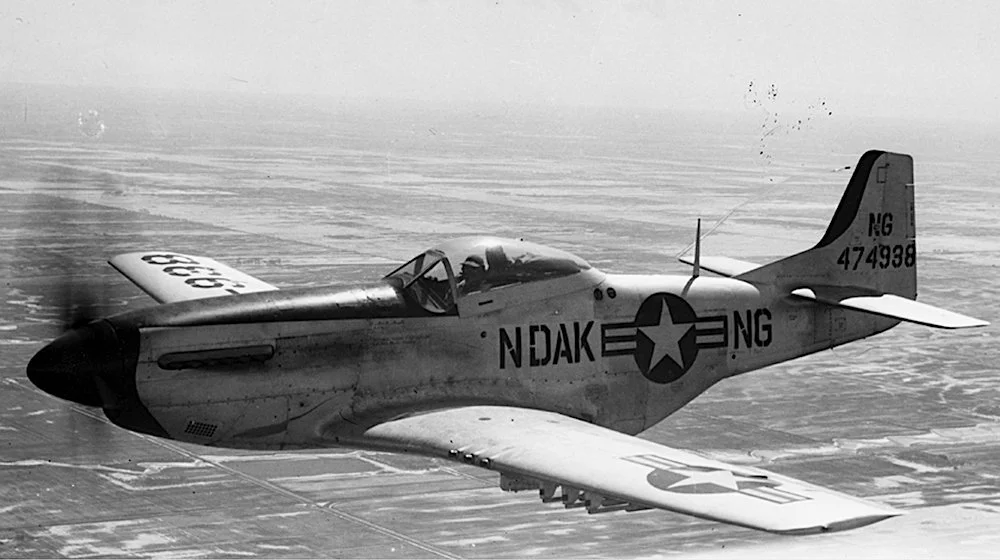
Located at the Bobby L. Chain Municipal Airport in Hattiesburg, Mississippi, the George R. Hall Air Park is named for Colonel George R, Hall, U.S. Air Force, and as the plaque states, is: “Dedicated in memory of all American Prisoners of War and those listed as Missing in Action in service to our Country’s Defense.”
A native of Hattiesburg, Colonel Hall pinned on his Air Force pilot’s wings in August 1954, and after various flying assignments, in May 1963, began flying reconnaissance missions over Vietnam for the 15th Tactical Reconnaissance Squadron . On 27 September 1965, his McDonnell RF-101C Voodoo took ground fire while then Captain Hall was on a mission over North Vietnam, and he was forced to eject. He subsequently spent the next 2,695 days as a Prisoner of War. On 12 February 1973, as part of Operation Homecoming, he was finally released from captivity.Returning to flight status, he finished out his career as the Deputy Commander of Operations for the 67th Tactical Reconnaissance Wing, flying the McDonnell RF-4C Phantom II. In 2005, retired Colonel Hall published a book about his experiences in Southeast Asia titled: Commitment to Honor, a Prisoner of War Remembers Vietnam. Colonel Hall passed away on 16 February 2014.
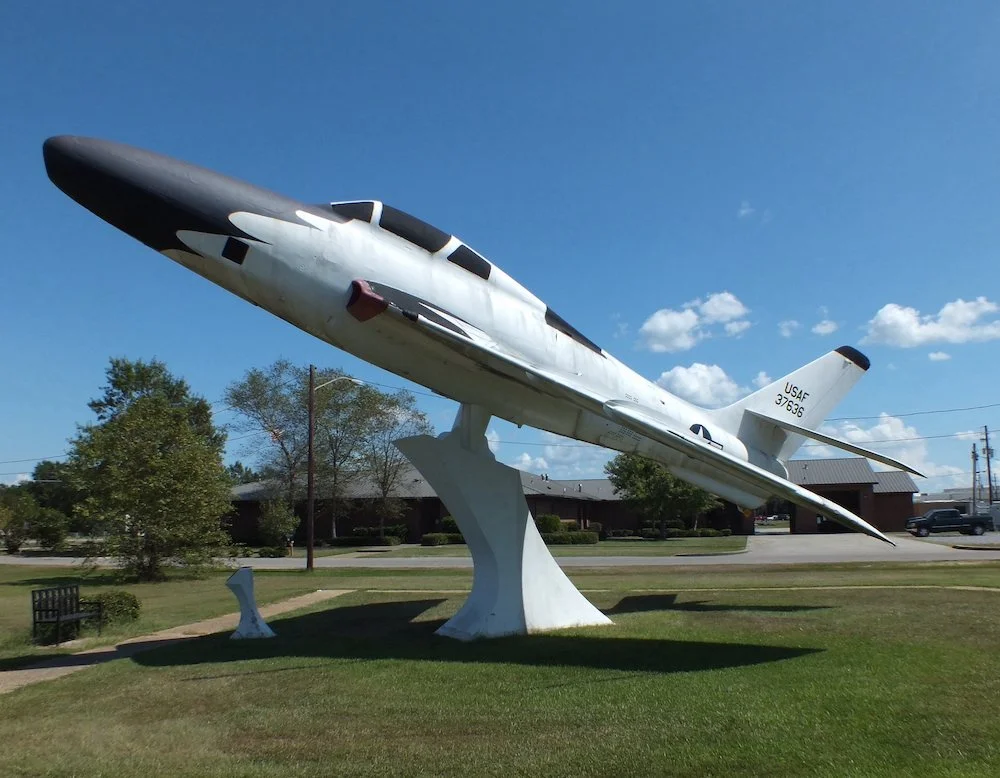
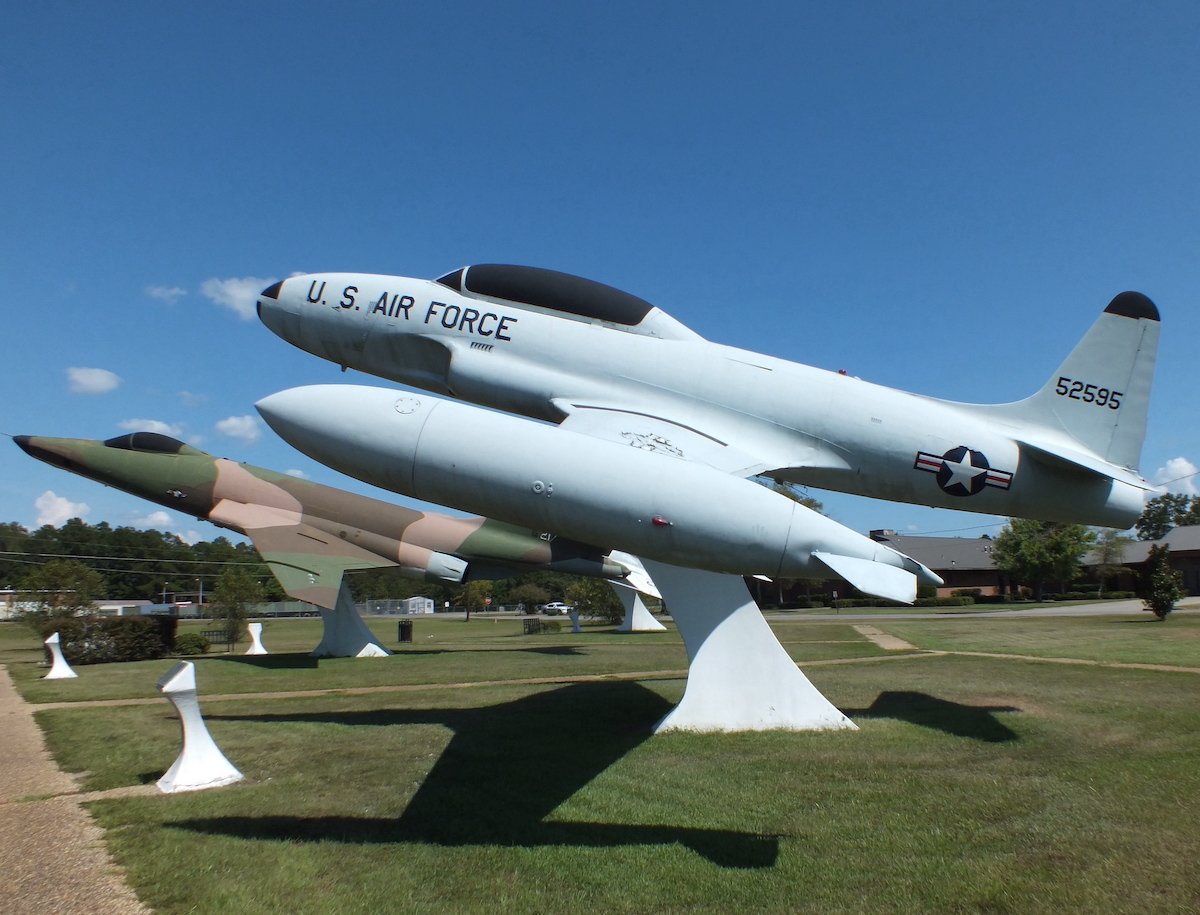
Developed in the mid-1980s. the George R. Hall Air Park displays three plinth-mounted jets (seen below) that would have been appropriate for Colonel Hall’s days in the Air Force, including an McDonnell RF-101C Voodoo - Serial Number (S/N) 56-217, a Lockheed T-33A Shooting Star (or T-Bird) S/N 52-9590, and a Republic RF-84F Thunderflash - S/N53-7636. All of the aircraft a very well cared for, and presented in fine condition.
This article appeared in the 2nd Quarter 2016 print issue of LOGBOOK magazine
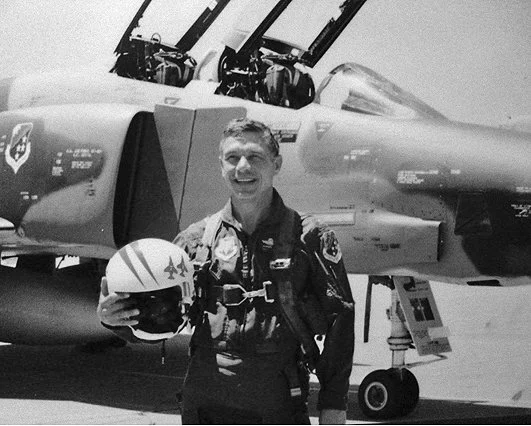
Later in his Air Force career, Colonel George R Hall stands in front of a McDonnell RF-4C Phantom II. Photo: U.S. Air Force
The Flying Resume of Ralph W. Ritchie
by
Dave Powers
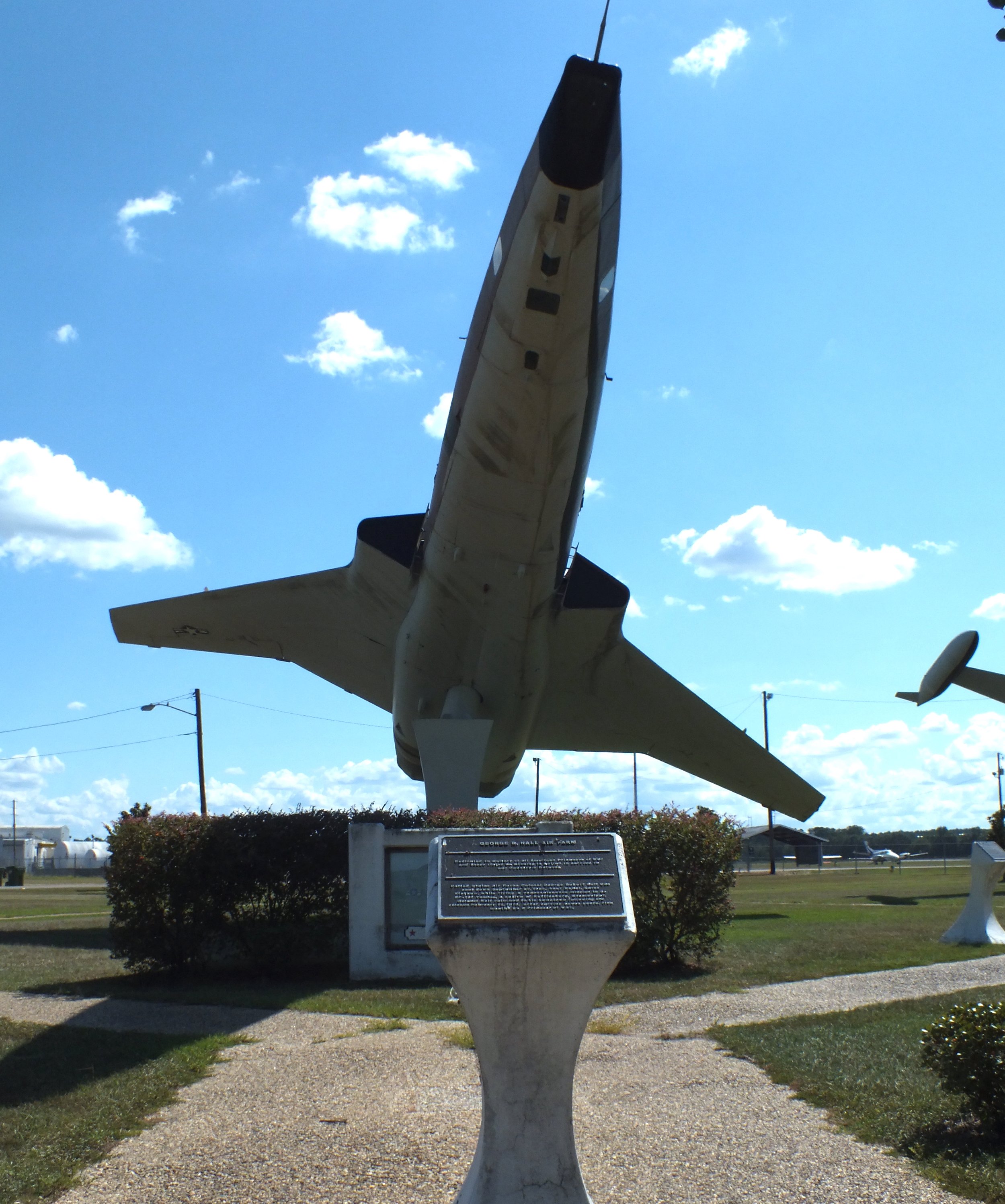
In a previous issue of LOGBOOK magazine I introduced you to a man by the name of Ralph Westley Ritchie (see image below, when he was an officer in the Royal Air Force), who according to a couple of old magazine articles, supposedly lived a flying life that was more suitable to an adventure novel. Much of the information in the articles was a bit vague, and without much corroboration, so I decided to do some more research. Could what was presented in those old articles really be true? Well, the answer is actually “Yes,” well sort of.
Two avenues of research that I tapped were the military records folks, both the U.S. Navy and the Royal Air Force. The other day, the U.S Navy records arrived – all 500 pages of them. It will take a while to fully delve through these records, but I have found an interesting document that chronicles much of his life in the air. I am still awaiting the Royal Air Force records.
After World War Two, Ritchie reenlisted in the Navy. At the time he was not in a flying billet, rather, as a chief boatswain’s mate, he was working a series of ground jobs. A qualified pilot – an enlisted Naval Aviation Pilot – Ritchie made an application to get back into flying, and along with the official paperwork Ritchie included a resume of his flying experience. Presented here, in an unedited form, is that resume.
SUMMARY OF FLYING EXPERIENCE OF:
RITCHIE, RALPH WESTLEY, 183 60 25, CBM(AA) USN
1922 - Made application for course in photography at Naval Photographic School, Anacostia, D.C. During this course of instructions became interested in aviation as this course included aerial photography. Passed this course with mark of 4.0. Remained at Anacostia as station photographer, also at the Bureau of Aeronautics.
1923 - Made application for flight training and was sent to Pensacola, Florida to enter training in Class 18. Finished this course November 1923 mark 3.56. Was transferred to U.S.S. WRIGHT and attached to
VS-l. Made regular routine flights with this Squadron. At this time, squadron was equipped with F5L’s. After the Hawaiian Maneuvers 1925-1926, re-equipped with SC2’s. Remained in VS-1 and VT-1 until being
transferred to NAS Pensacola as Flight Instructor.
1927 - Instructor in practical flying at Pensacola Squadron #6 and #8, Land and Seaplanes. Carried students through total course. Qualified 22 lost 1.
1929 - Was transferred from Squadron #8 to photographic section as pilot. Summer of 1929 was transferred to U.S.S. LEXINGTON, VT-2. November 5, 1929 was discharged from U.S. Navy by reason of
Special Order (Own convenience).
1929-1930 - Flying for NyrBa Line. (New York, Rio and Buenos Aires Line), ferried new Consolidated flying boats P.B.Y. types, from factory (Buffalo, N.Y.) to divisions on Company line. After second trip was
made division superintendent Trinidad-Para. 1930 this company sold out to Pan-American Airways. Was taken over, by Pan-Air and flew between Miami and San Salvador, regular schedules first pilot.
October 1930 left Pan-Air due to excessive pilots and expiration of contract.
1931-1932 - Flew for TWA Transcontinental and Western Air. Flew between Newark, N.J. and Kansas City, Mo. Night mail (Northrop mail planes) and Ford Tri Motors Passengers mail and express.
1933 - Left TWA to make trip around world with Miss Aloha Wondwewell (Evylnn Hill). Spent 6 months in preparation for this flight which did not materialize due to lack of suitable aircraft for trip.
1934 - During this year flew as private pilot and owner of Charter plane and passenger flights. Newark N.J. or any place plane was charter to. Lost this aircraft in East River N.Y. at night due to fog.
(Stinson Reliant.)
1935-1936 - Was employed by Bol-Inca Mining Corporation flying a Sikorsky S-38. This job consisted of carrying freight from La Paz, Bolivia to the mine in the Kaka River. This river is situated in the interior
of Bolivia near the head waters of the Amazon. The airport at La Paz is 13,200 feet above sea level. The course led through a pass in the Andus at 15,500. Carried 1500 pounds of cargo per trip. These trips
were made daily (weather permitting) more than one per day. Flight was one hour and one half average. 1400 hours including ferrying plane to Bolivia.
1937 - Bol-Inca ceased to operate and I flew for Floyd Aero-Boliviana as pilot and instructor on JV-52 (Hinie) regular airline work. Approximately 825 hours.
1938 - Left Bolivia and went to Peru (Lima) to fly for Faucett Airways. Remained with Faucett for one year averaging 75 to 80 hours per month. Regular airline schedules in Peru. Plane owner built. Something like single engine Stinson but larger.
1939 - Returned to Bol-Inca to fly S-38 again. In June this year S-38 was lost due to running over a rapids in the river and tearing out bottom. At this time, took over flying duties for Avamya Mines using Tri Motor Ford. Used same airport (La Paz) but landed in valley by mine on one way strip, 600 meters. Finished contract with Aromya and returned to United States. Flew for Mr. Gordon Barbour as private pilot until May 1940. Mr. Barbour was Vice President of Bol-Inca.
1940 - Bought another S-38 from Pan-Air and flew it to Bolivia by way of Cuba, Mexico, Honduras, Nicaragua, Costa Rica, Panama, Columbia, Equidor, Peru and Chile. Finished other contract for Bol-Inca, returned again to Peru with Faucett. Met quite a few English in Peru and Bolivia and decided to join Royal Air Force.
1941 - Left Lima, Peru for London to Join RAF. Arrived in London in April and was commissioned in RAF after a course on British aircraft, was sent to a squadron and maintenance as test pilot. I remained on these duties until July 1941 when I was sent to Africa as test and ferry pilot. Made some trips from England to Gibraltar with long range bombers. While in Africa was convoy leader. These duties consisted of leading a convoy of aircraft from Takarodi, West Africa to squadrons in Egypt and Western Desert. Convoys ranged from 8 to 20 planes. Route 3,600 miles.
1943 - Left convoy duties and was attached to AirSeaRescue, Western Desert. These duties consisted of locating un-luckies shot down and remaining over them until they were rescued by surface craft. Squadron was credited with 207 rescues. Planes used were Wellington Bombers (land planes). After duties in Western desert went to Iran and Persian gulf to organize AirSea Rescue. Operated between Basra and Karachi, India.
1944 - After short tour of duty as Commanding Officer at Wadi-Haifa, Anglo Egyptian Sudan, returned to England and was released from RAF. Remained in London one month and re-enlisted in U.S. Navy, December 4, 1944. Was sent to Paris as Chief MAA on Admiral Kirks staff. Was then sent to Plymouth, England at Amphibious Base until June 1945. Returned to United States. (Five years away). Was discharged on points at P.S.C. Minneapolis on October 15, 1945. Re-enlisted January 5, 1946.
All these statements are true and may be verified through companies and air forces which employed me. I have flown a total of over 10,000 hours during my aviation career.
Ralph Westley Ritchie.
CBM, U. S. Navy.
Some Analysis: Well, there you have it. Except for his civilian flying, most of the above is corroborated by other official documents that came in the package. From his original enlistment in 1914, up through 1929, when he left the Navy for the first time, his service life is pretty well verified, and runs closely to the above narrative. He was a Naval Aviation Pilot and a flight instructor, as well as being the All-Navy heavyweight boxing champion and on the All-Navy football team.
His civilian flying life, starting in late 1929, while not wholly documented in the Navy documents, does at least have a ring of truth to it. Various non-Navy sources do corroborate his work at New York, Rio and Buenos Aires (NYRBA) Line, and while not so well established, his move to Pan American in 1930 is a reasonable transition. A few vestigial sources do indicate that a Ralph Ritchie flew for TWA, and his narrative tends to confirm this.
One interesting interlude in his flying career took place in 1933. Ritchie notes that he left TWA to assist a “Miss Aloha Wondwewell” on her round-the-world flight. To tell you the truth, I had to do a little research on this. Turns out that Aloha Wondwewell was born in 1906, as Idris Hall. In 1922, still only 16 years old, she joined an automobile racing team head by Valerian Johannes Pieczynski, who went by the name Walter Wanderwell. The race was a round-the-world driving contest between two Ford Model T-equipped teams. By the end of the race, she had adopted the name Aloha Wanderwell, eventually marrying Walter in 1925. For the next several years, Aloha developed her career as a professional explorer, photographer and film maker, lecturer and author. Legends abound about her life, everything from being held prisoner in China to joining and fighting for the French Foreign Legion. In 1932, her explorer husband, who some thought was an international spy, was murdered in California, a crime that was never solved. Later in 1932, after Walter’s murder, she learned how to fly, and made a trip to Brasil in search of lost explorer Percy Fawcett. During this expedition she crashed and was forced to live several months with jungle natives before being rescued. I really did not find too much about her planned round-the-world flight, to be assisted by Ritchie. Certainly, given her life up to 1933, a trip of this type was well within the realm of possibility. Perhaps the airplane she crashed in South America was the one that she was going to use on her round-the-world flight. Well, maybe.
As for Ritchie’s adventures in South America we only have his narrative to go by, but there are a few connections with historical records. The Bol-Inca Mining concern, owned by NYRBA founder Ralph O’Neill, did have a small fleet of Sikorsky S-38 amphibians. The airline Lloyd Aereo (not Floyd Aero) Boliviano did operate a small fleet of Junkers Ju-52 (not JV-52) Tri-Motors. By the why, Ritchie’s used the word “Hinie” in his narrative, which was a then quite popular, but highly derogatory, reference to Germany, particularly German soldiers.
In 1938 Faucett Airways – Compania de Aviacion Faucett, which was founded in 1928, by an American named Elmer J “Slim” Faucett, did operate a number of locally designed and built single engine transports known variously as Faucett-Stinson F.19s. Elmer Stinson had obtained the rights to build Stinson monoplanes in Lima, and with the help of Gale Alexander, a Stinson engineer, modified the original design to optimize it for high altitude work. The aircraft was quite popular in the region, and over 30 examples were built. This could be the “Plane owner built” mentioned in Ritchie’s narrative.
Further Navy documents do relate Ritchie’s induction into the Royal Air Force, however this consists mostly of the inclusive dates, not his actual service record. I will have to wait for the Royal Air Force records to get a better handle on his flying in Europe, Africa and the Middle East.
Unfortunately his post-war application to return to a flying billet in the U.S. Navy was denied, the document noting that there was an over abundance of both Naval Aviators and Naval Aviation Pilots. This was during the drastic post war demobilization, so it stands to reason that flying billets were becoming more and more scarce. Ritchie did remain in the Navy, as an Aviation Boatswain’s Mate and an Aviation Mechanist’s Mate, before retiring in 1950. He passed away in 1967, in Tampa, Florida.
If anyone out there has any clues on Ritchie’s rather eventful life, please feel free to drop me a line.
This article originally appeared on the 2nd Quarter 2016 print issue of LOGBOOK magazine.
The Origin of The Happy Hooligans
Possibly no other Air National Guard (ANG) unit has a nickname as well known as the “Happy Hooligans.” Where did that nickname come from?
The North Dakota Air National Guard’s 178th Fighter Squadron (FS) commander in the mid 1950s was Major Duane S. Larson ( later Brigadier General, Retired). Because of his
fatherly instincts, Major Larson became known as “Pappy” to his entire squadron. His men were dubbed “Hooligans” for their mischievous antics. Locally, they became known
as “Pappy and his Hooligans.” Because of Major Larson’s striking resemblance to the Steve Canyon comic strip character named “Happy Easter,” the squadron was soon
known as “Happy and his Hooligans,” and later shortened to the “Happy Hooligans” (around 1958). Soon everyone around the base was using the nickname “Happy Hooligans”
to describe the squadron.
According to unit lore, the name really took hold because of events at a 1950s summer camp at Volk Field, located near Camp Douglas, Wisconsin. Legend has it the 178th FS
had to march on the ramp to make up for the late night shenanigans of throwing all the “brass” out of bed after the club closed for the night. While marching on the ramp
the next day, with “Pappy” Larson, their 178th FS commander at their side, the 119th Fighter Group Commander, Lieutenant Colonel Marsh Johnson, called the squadron a
bunch of Hooligans, to which someone answered, “we might be Hooligans but we are happy Hooligans.”
In the early 1960’s, the North Dakota Air National Guard was searching for a motto to set them apart from other units. A contest was held to choose an official nickname;
no names received topped “Happy Hooligans,” so it was officially adopted as the unit’s nickname. In 1964, during the ANG Rick’s Trophy competition, “Happy Hooligans” was
painted on the unit’s Northrop F-89J Scorpion aircraft. This was the first time it appeared on the aircraft, but since then, each North Dakota ANG aircraft has carried that motto/logo prominently displayed on the tail.
Article courtesy of the 119th Wing, North Dakota Air National Guard. For more information, log on to: https://www.119wg.ang.af.mil
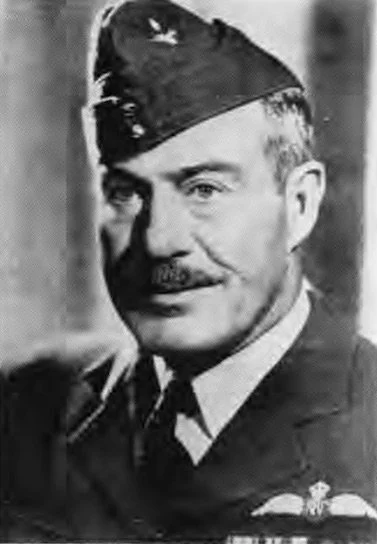
Above: Receiving federal recognition on 16 January 1947, the 178th Fighter Squadron (SE) was first equipped with the North American Aviation P-51D Mustang. The jet era began in June 1954, when the Mustangs were traded in for Lockheed F-94A/B Starfires, and the unit became a Fighter Interceptor Squadron. Photo: North Dakota Air National Guard
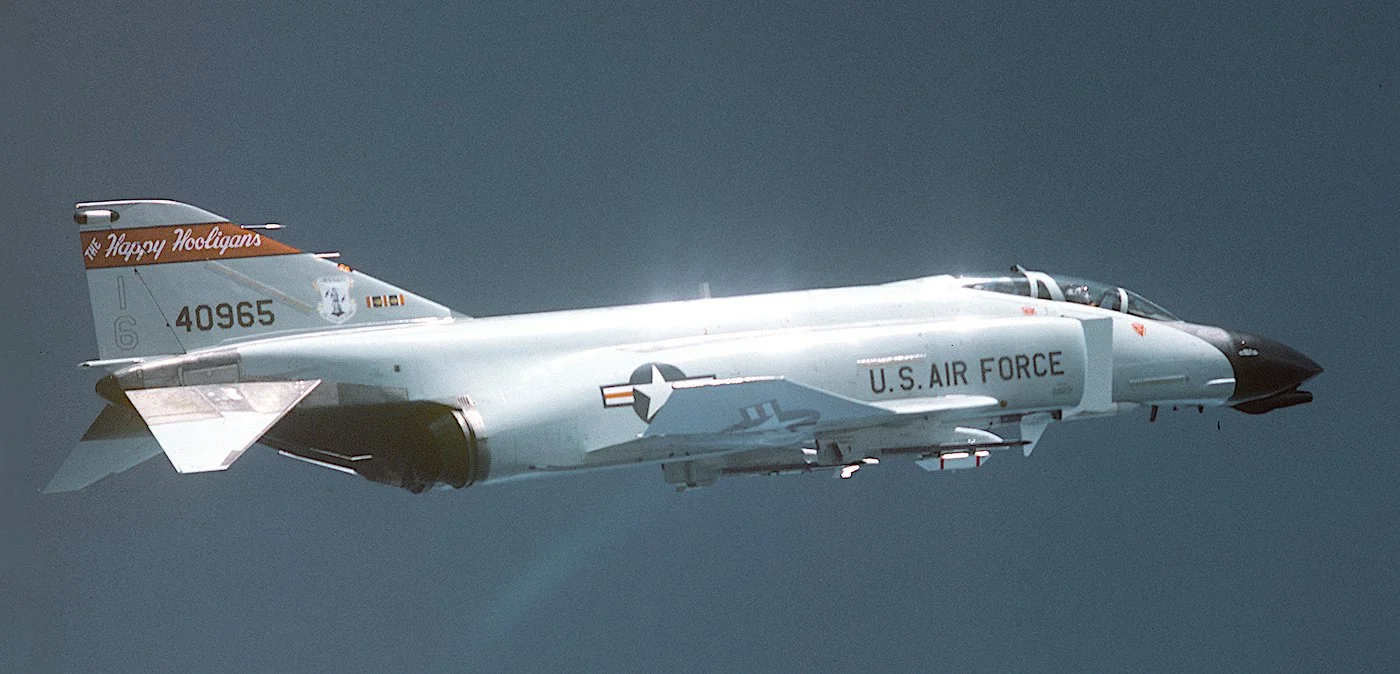
Below: A McDonnell F-4D-26-MC Phantom II - SN 64-965 - assigned to the “Happy Hooligans” of the North Dakota Air National Guard. The 178th flew the Phantom II from 1977 through 1990, back when the squadron was designated the 178th Fighter Interceptor Squadron, part of the 119th Fighter Interceptor Wing. This photo was taken during the USAF Air-To-Air Fighter Weapons Meet - “WILLIAM TELL ‘84.” In 1990, the squadron transitioned to the General Dynamics (now Lockheed Martin) F-16A Fighting Falcon. Today, the 178th Attack Squadron, 119th Wing, operates the General Atomics Aeronautical Systems MQ-9 Reaper. Photo: USAF by Staff Sergeant David Cornwell
This article originally appeared in the 1st Quarter 2021 print issue of LOGBOOK magazine
A Fine Gator Farewell
by
Garnett W. Haubelt
It was the summer of ‘75 at Naval Air Station (NAS) Miramar - FIGHTERTOWN, USA, and home to “The Eyes of the Fleet” - Detachment Three of Light Photographic Squadron SIXTY-THREE (VFP-63). We were on a shore tour, or on one of our infamous 72 hour standby cruises, when the squadron got a call from the Executive Officer (XO) of NAS Chase Field, in Beeville, Texas. Commander Bob Crowl was asking around if there was any way to have a static display of an F-8 Crusader at Beeville for the retirement ceremony of the Base Commanding Officer (CO), Captain Robert E. Ferguson. “Fergie” Ferguson, who flew the Crusader with Fighter Squadron ONE-TWO-FOUR (VF-124), as the Operations Officer, from 1959 to 1963, then with Fighter Squadron FIFTY-ONE (VF-51), as XO then CO, from 1965 to 1967, and then as the commander of Carrier Air Wing FIVE (CVW-5) as “CAG-5” in 1967. A static display would be really befitting as Captain Ferguson had commented to his XO that a “Crusader Farewell would be nice!” The task was turned over to Det. Three for implementation of this fitting farewell. Captain Ferguson was transitioning from a fine military career of over 32 years of Naval Service to his country to that of civilian life. The decision was made whereby not only a static display was a great compliment for such a great career, but a fly-by in burner would be even better. If a fly-by in burner was better, what would a section fly-by going “gates*” at the same time be like! Crusader Drivers don’t just “do” something unless it’s done “right,” so the mission was on.
Myself and wingman Commander John Peck - retired, and one of the last Gator
Drivers of Light Photographic Squadron THREE-ZERO-SIX (VFP 306) - set about to
accomplish the mission. Manning our Crusaders for our trip from Gunfighter Land
to Training Land was the start of a mission that has been firmly burned into my
aging brain. It so happened that the Big Man in the sky was looking favorable on the
day and provided the best of weather …. relative cool - for a Southern Texas August
day, calm and not a cloud in the sky. Things were planned, or more than likely luck
had its way, from the time of being handed off from Center to NAS Chase Field tower,
to the fly-by and to the landing. Upon check-in with TWR, from about 75 miles out
and 39,000 feet, we requested a high speed, low fly-by. XO Crowl had laid the ground
work as the pattern was cleared and permission was granted. Little did the TWR know
what we meant by high speed, low fly-by! Passing the lead, we started down hill
hoping to make an appearance sometime close to Fergie giving up his command and
career. Again the gods of aviation were smiling. Arriving at the northwest boundary of
the field somewhere between the hangar and Runway 13L, we were in super tight
formation, smoking at 550+ knots, cooler doors open, and somewhere between the
ground and the top of the hangar. I knew John had us in the weeds as I remember
looking through his lead and level at the top of the hangar. The hanger doors hand
been cracked open by about 10 to 20 feet - we were later told it was more for audio
effect than cooling - and as we went to MIL power and lit the burners that wonderful sound erupted from our two chariots of fire. There is nothing quite like the sound of a [Pratt & Whitney]
J-57 P 420 turbojet going into burner at warp speed ….. much less two of them at eyeball level. You can imagine the effect we had, especially when it all happened at the moment
Captain Ferguson’s foot stepped on the pavement as he was coming down the gangplank ….. going from military life to that of civilian.
Commander Crowl surly received the “last mission accomplished” award by making this great flyby a possibility …. starting with searching for the Crusaders to clearing the pattern for his CO.
“By the completion of the beautiful, precise, finale I must admit that I was in complete meltdown. The total surprise, exact precision and timing of the flyby as I departed the ceremony was the
final frosting on the cake. I had no idea there would be an F-8 flyby so the surprise was complete. It is, to this day, one of my most vivid, treasured memories,” were some of Fergie’s subsequent
remarks about the honor we had the pleasure of bestowing upon him. So much so, that by the time we had pulled up and came around for the break, doing either a “fan” or “tuck under” break -
can’t remember which … if either, landed, taxied to the Operations tarmac and shut down, Fergie’s replacement, Captain “Red” Issacks, who in his own right was a first class Landing Signal Officer
(LSO) and a MiG Master, met us with 4 beers in hand ….. one for each of ours, even before our feet could hit the tarmac! “By orders of the retiring CO,” we were told! Nothing could keep Captain Issacks from whisking us away to the reception, as it was his command , as well as the “command” of Fergie to be in attendance in order to receive the proper “Thank you from the bottom of my heart!” Can’t remember how many hands I shook that afternoon after being introduced as “These are the Gator Drivers that made my day!” Here it was, his special day but the Old Salt of a MiG Master Captain showered us young pup Lieutenants with more congratulations and “attaboys” than we were due! It’s stuff like this that warms the heart, at least mine and one retired Navy Captain!
It is truly amazing how the 1,929 Crusader Drivers (give or take a few) who flew the 1,219 F-8 Crusaders that were manufactured by the Chance Vought Company (again give or take a few) could experience the same feeling for this trusty ole bird - whether you flew it during the 50s, 60s, 70s or in it’s retirement years of the 80s & 90s.
F-8s Forever
Garnett W. “Hubie” Haubelt.
* Gates: “Going Gates” - into afterburner, accompanied by a loud bang as the 'burner lit. In the F-8 you ran the throttle forward to the stop and then moved it outward to ignite the afterburner. The F-8 Crusader did not have a modulated ’burner like modern aircraft. You were either in ’burner or out of ’burner.
This article originally appeared in the 1st Quarter 2021 print issue of LOGBOOK magazine.
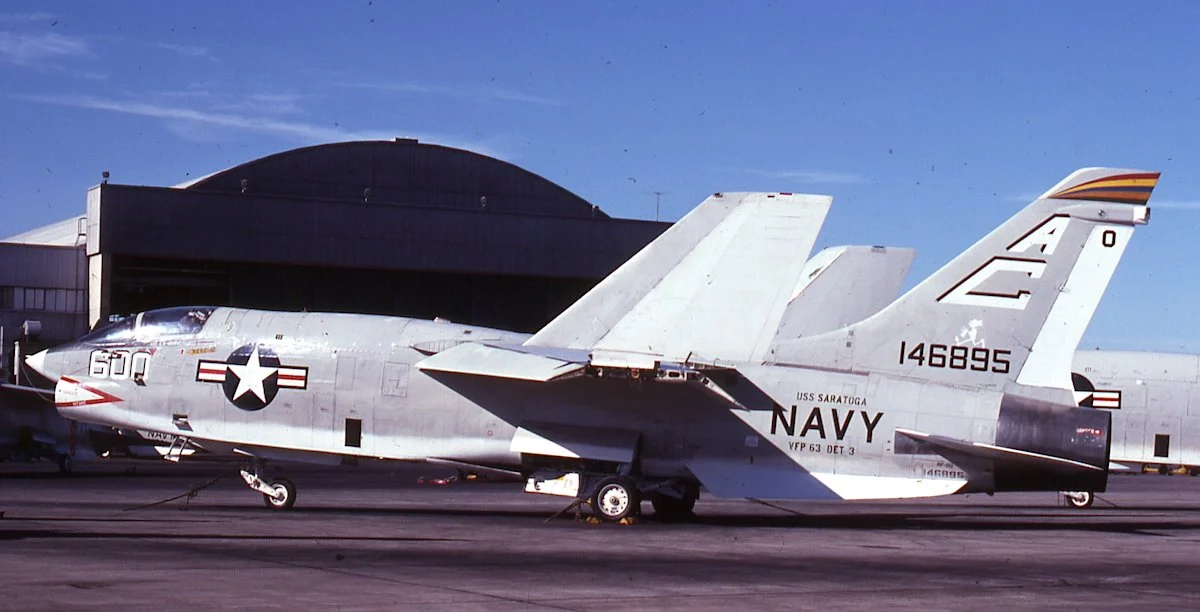
A file photo of a Vought (LTV) RF-8G Crusader - a Photo-Crusader - assigned to Detachment Three of Light Photographic Squadron SIXTY-THREE (VFP-63). At the time - the mid-1970s - Det. Three was attached to Carrier Air Wing THREE (CVW-3), then embarked aboard the USS Saratoga (CV-60). The Modex Number 600 would indicated that this was the Carrier Air Wing commander’s aircraft - CAG Three’s bird.
Photo: U.S. Navy
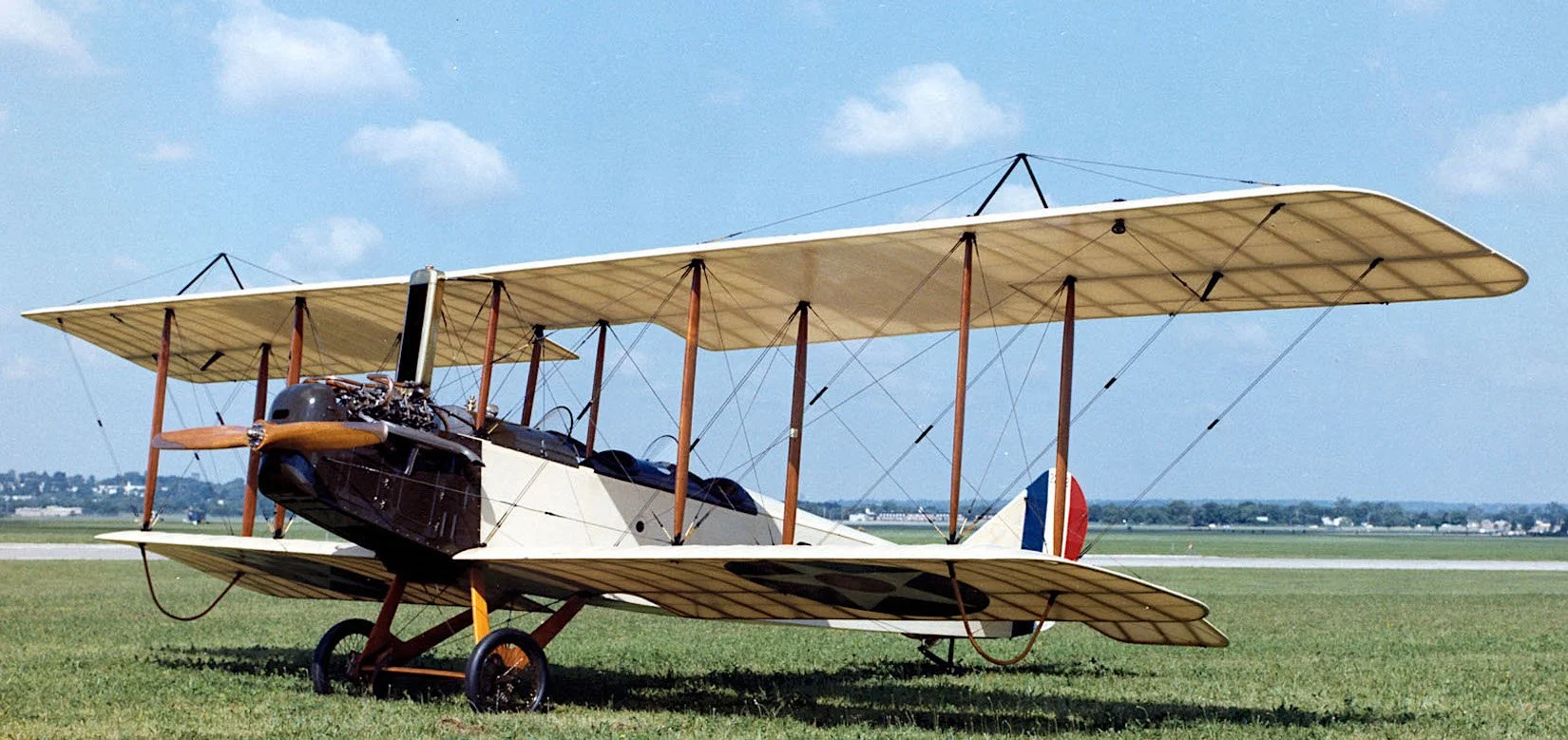
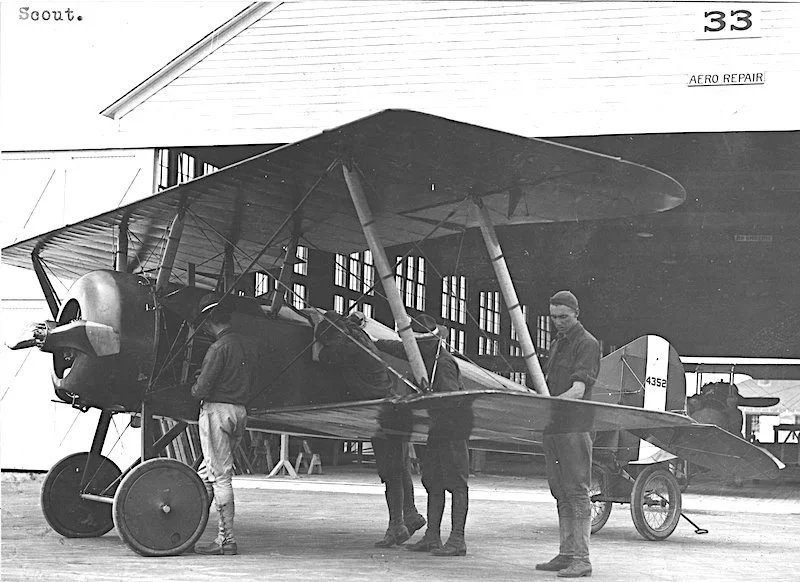
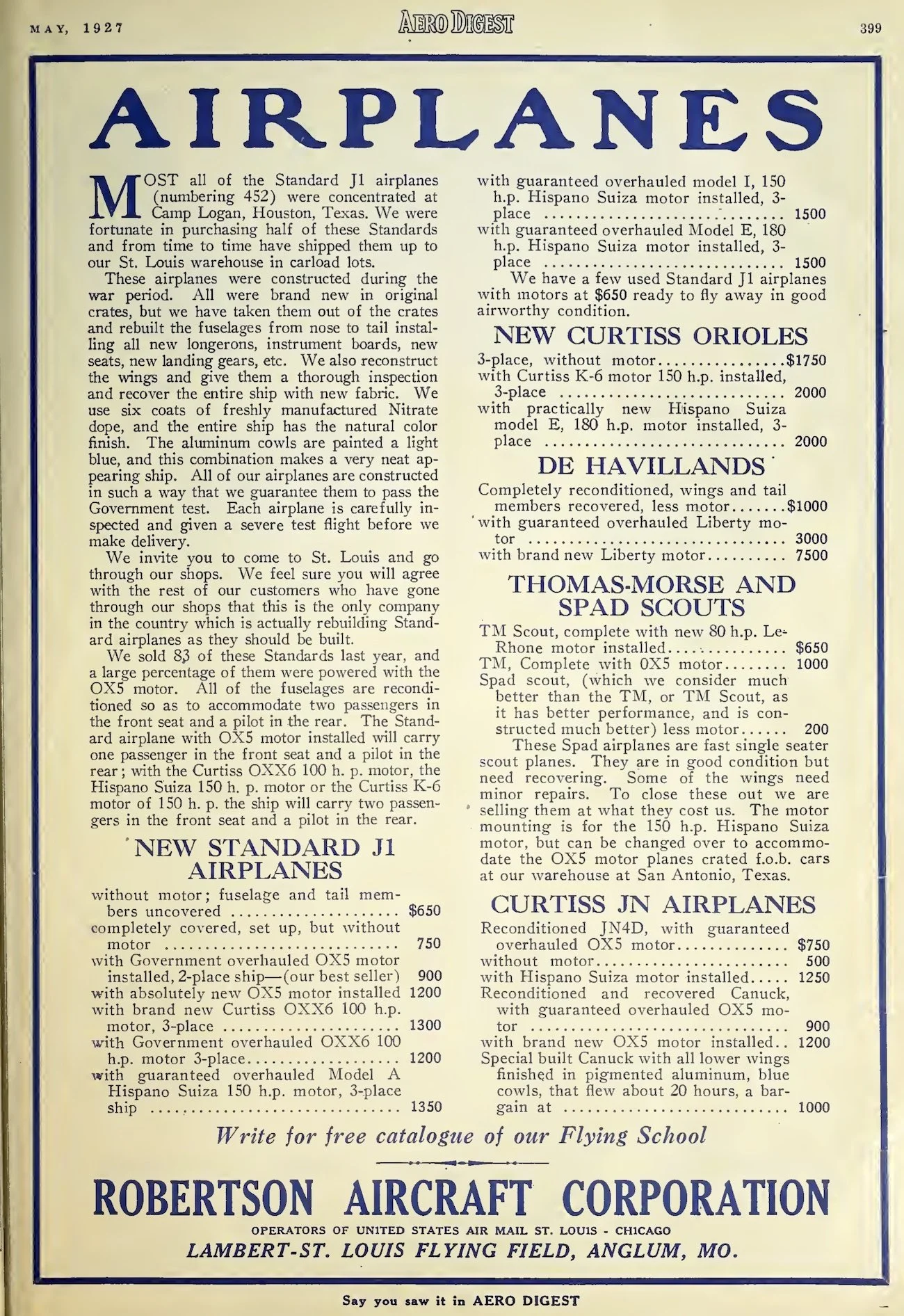
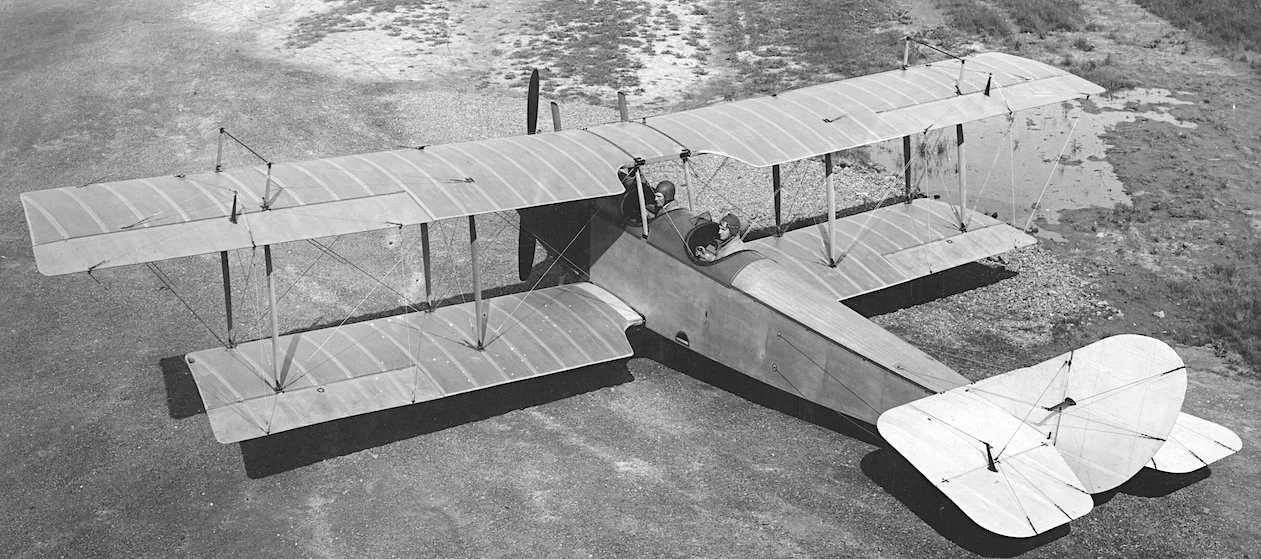
Some file photos of a few of the aircraft listed for sale in the Robertson Aircraft Corporation’s advertisement - May 1927, in Aero Digest.
Above: A Standard Aircraft Corporation J1 biplane. This restored example is in the collection of the National Museum of the USAF, Wright-Patterson Air Force Base, Dayton, Ohio. Photo: USAF
Left: Over the years, the Thomas-Morse Aircraft Corporation built a number of versions of their Scout, this one is an S-4B. The Scouts were all nicknamed “Tommys.” Photo: NARA
Below: A fine study of a Curtiss JN4D biplane, built by the Curtiss Aeroplane Company. Photo: NARA
This article was orignally published in the 1sr Quarter 2024 digital issue of LOGBOOK magazine.
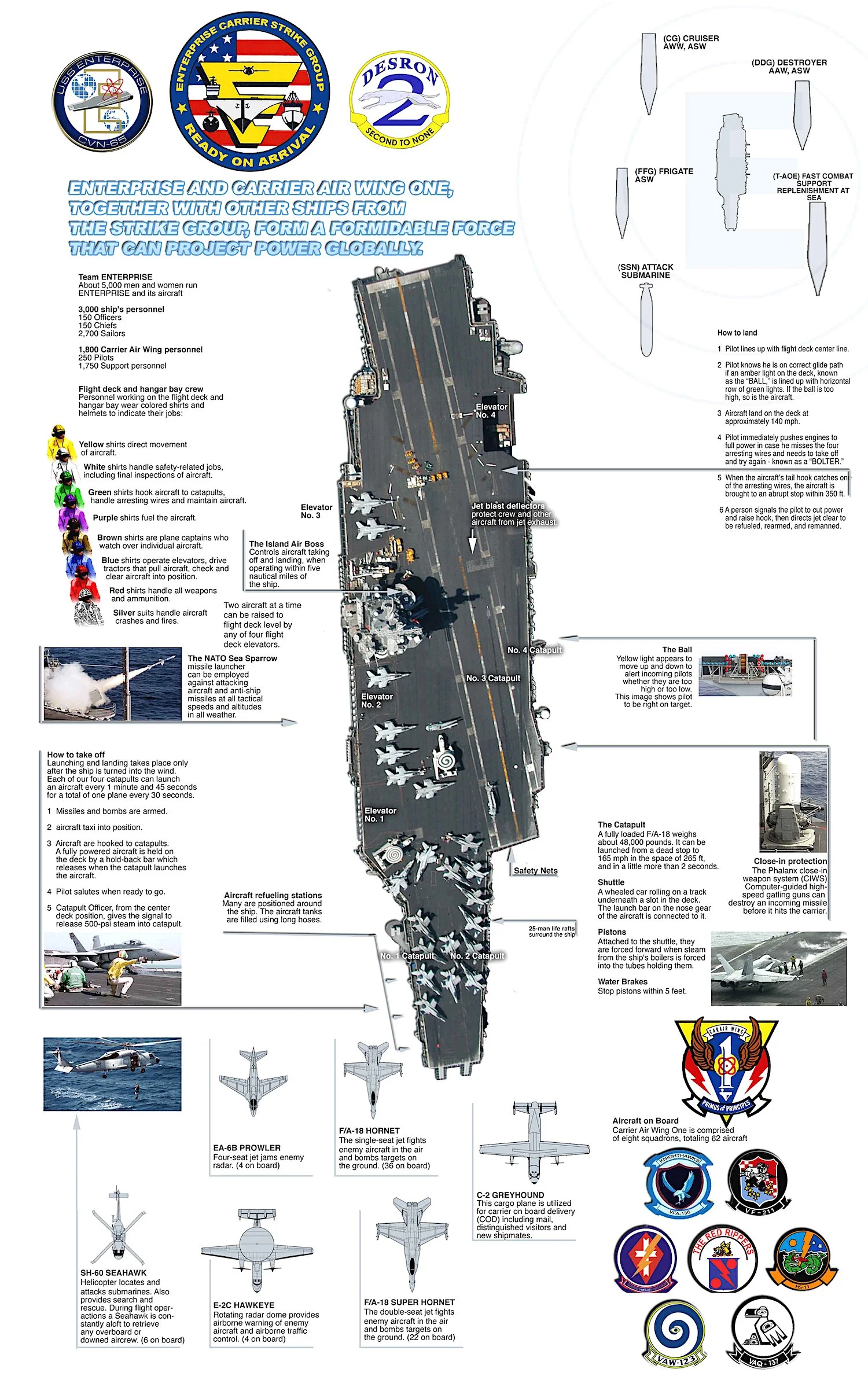
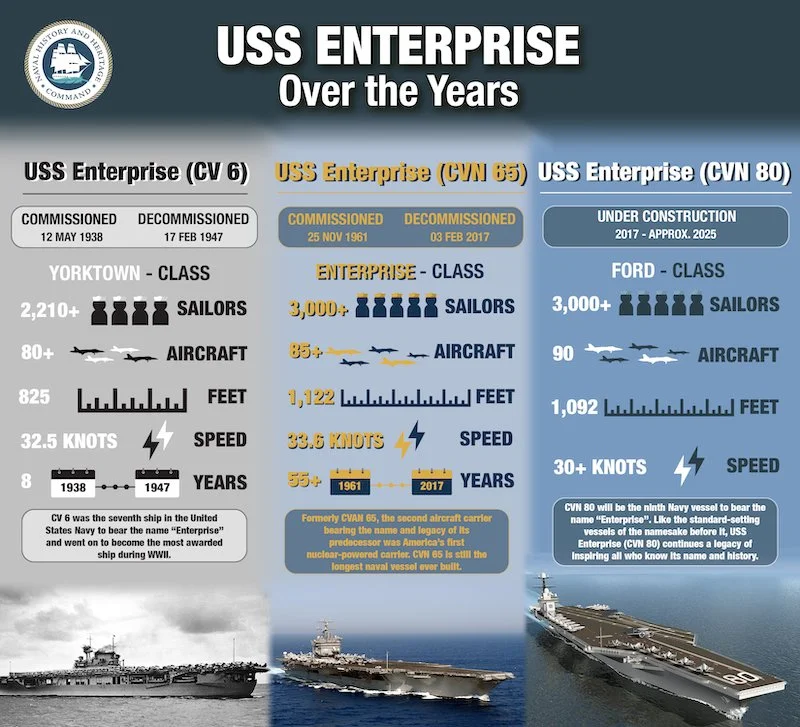
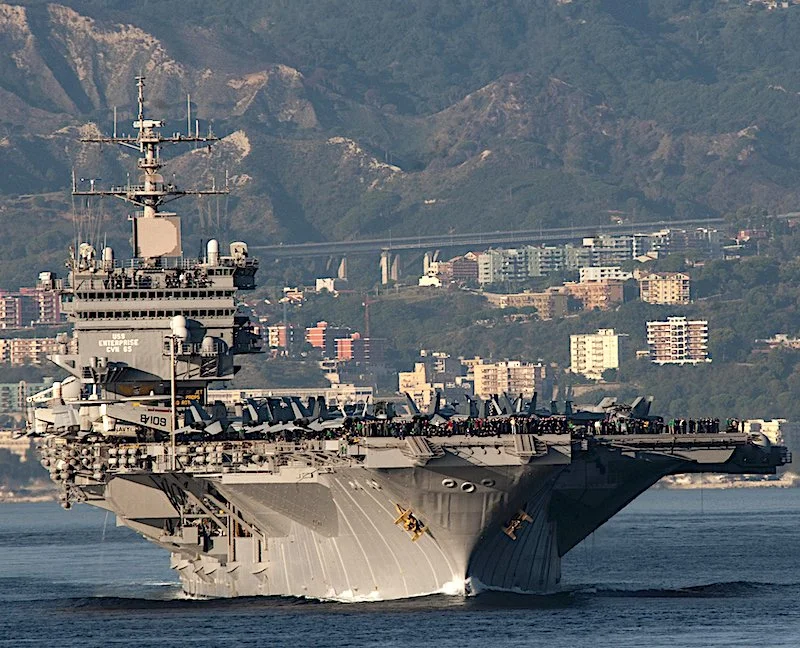
Above: The USS Enterprise (CVN-65) transits the Strait of Messina, 15 October 2012. Enterprise was deployed to the U.S. 6th Fleet area of responsibility conducting maritime security operations and theater security cooperation efforts. Photo: U.S. Navy by Mass Communication Specialist 3rd Class Jeff Atherton
The USS Enterprise was placed in commission on 25 November 1961, designated as CVAN-65, at Newport News, Virginia. On 30 June 1975, the CVAN-65 designation was changed to CVN-65. Until the USS Nimitz (CVAN-68/CVN-68) came on line on 3 May 1975, Enterprise was the Navy’s only nuclear-powered aircraft carrier. The vessel was deactivated in 2012, and was struck from the Navy’s list on 3 February 2017.
Graphics: U.S. Navy via the Naval History and Heritage Command
This article originally appeared in the 3rd Quarter 2013 print issue of LOGBOOK.
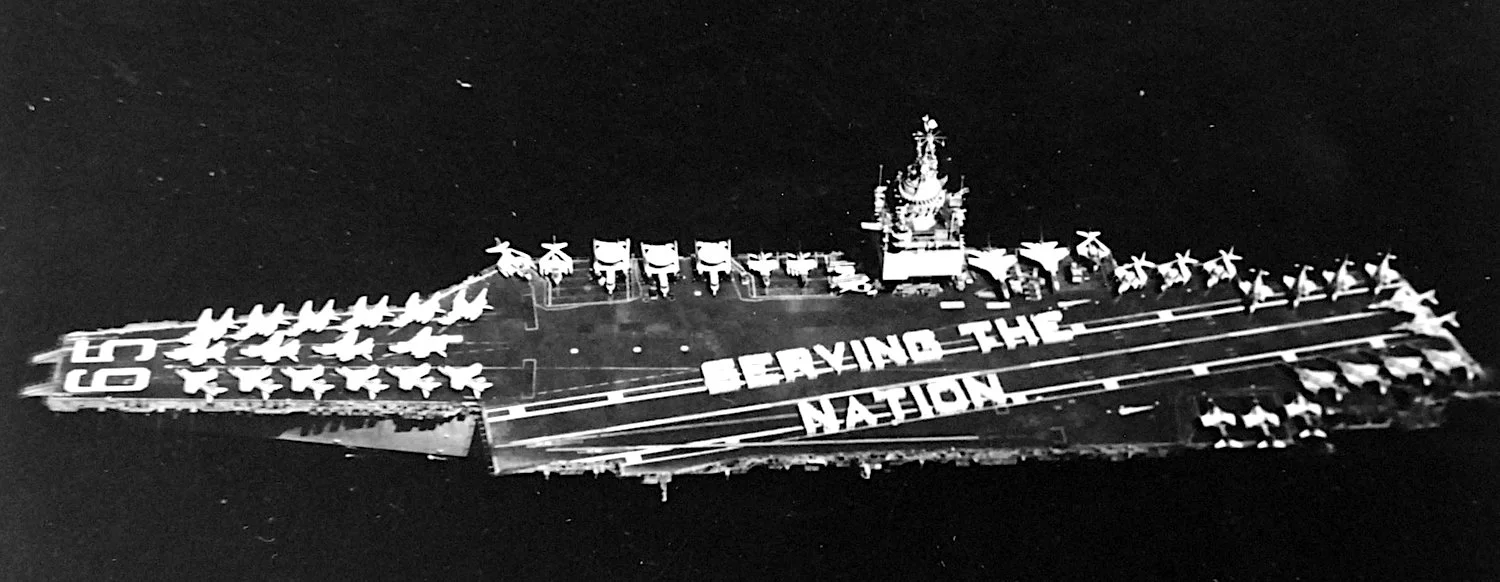
USS Enterprise (CVAN-65), 1973. Crew of the nuclear-powered aircraft carrier and Attack Carrier Air Wing Fourteen form the words “Serving the Nation” on the flight deck. Photo: U.S. Navy by PH1 Ronald C. Bartel, May 19, 1973.
Haitian Nocturn
by
Jerry B. Driver
The year was 1984; I was flying as captain for Trans Air Link, a freight airline out of Miami. Our fleet consisted of ten Douglas DC-6s and one DC7. To the best of my
knowledge, the DC-7 was the last one flying in commercial airline service in the U.S. The full capabilities of both aircraft were not attainable due to the lack of 115/145 avgas.
In addition to the DC-7, we also operated another unique aircraft, an ex Sabena swing tail DC-6 freighter. This aircraft was loaded by swinging the tail section to the side
of the aircraft and using the open fuselage as a door. These aircraft were well maintained and the crews were well trained. Trans Air Link was one of the best of the piston
engined freight haulers of the day. We flew scheduled and non-scheduled flights throughout the Caribbean, and Central and South America. Trans Air Link also provided
contract flights for Zantop International Airlines from our northern base at Willow Run airport in Ypsilanti, Michigan.
During this time I was flying a schedule which included three round trips a week to Haiti. In 1984, the country was under the control of "Baby Doc" Duvalier. His
dictatorship was coming under increasing scrutiny from the outside world, and pressure was building internally for change. As a flight crew, we dealt primarily with the
business people involved with the freight we carried. Most of those were of the Creole caste. In Haiti, the Creoles were considered high society. Our relations with
the freight forwarders were very good. I found them to be easy to work with and pleasant to be around. They even taught me how to order "Jambon et Fromage," a
ham and cheese sandwich, from the café in the passenger terminal. The laborers who loaded and unloaded our aircraft were friendly and hard working. If you are familiar
with flight operations in the Caribbean, you will know that this was indeed an unusual situation.
We often overnighted in Port au Prince at the Holiday Inn. The food was good and the people were friendly. Sometimes, we stayed over the weekend and on occasion,
we would travel to Cap Haitian, and a resort in the mountains overlooking the ocean. At no time had we encountered any difficulties with the people of Haiti. But that was
soon to change.
We had heard of unrest in Haiti, but really did not see any overt indication of this during our stays in Port au Prince. We did notice, however, an increase in the
number of armed troops at the airport. These troops were a combination of regular Army and paramilitary police. I later learned that the Army troops had, for the most part,
no ammunition. The paramilitary police were said to have full ammo clips.
On a previous flight, while unloading some plate glass from the aircraft, several of the sheets of glass were dropped. The sound was similar to gunfire, and everyone on the tarmac hit the deck. Most of the soldiers followed our example, although a number were seen running away from the airport property. I also noticed that the police troops had turned their weapons towards the Army soldiers when the glass first broke. Once the cause of the alarm was discovered, things returned somewhat to normal, but with increased levels of tension.
Haiti was and continues to be one of the poorest nations in the world. Voodoo and magic are still practiced by some of the populace. In 1984, these practices were even more prevalent. "Baby Doc" Duvalier used these superstitions to further his despotic rule. Duvalier's secret police force, the Ton Ton Macoute, was famous for using Voodoo to intimidate its victims. I would soon meet the very embodiment of this feared group.
For many years, a small liberal arts college in the Midwest had maintained a campus in Haiti. American students had been there with no problems for several decades. The students came and went on the streets of Haiti, with little or no problem. Then suddenly, it all changed. A white, female, student was murdered while walking to market. Haiti went from a place where crews overnighted at the Port au Prince Holiday Inn to a quick turn around destination, and then we left. The Ton Ton Macoute was very much in evidence at the airport, and there was a feeling of unease among the Haitian workers. Even the Creole business owners were on edge. Both the U. S. State Department and the government of Haiti wanted to keep this story quiet. They both believed that the murder had political overtones.
My company was contacted and asked to return the girl's body to the United States. We were chosen because we loaded from the freight terminal which was some distance from the passenger terminal. Eastern was the primary passenger carrier to Haiti at the time. It was hoped that no one would notice the operations of an old DC-6 down at the end of the airport. I was contacted by officials from the American Consulate and arrangements were made for an escort to accompany the body back to the States. I also spoke with Haitian representatives in regards to when the body would arrive at the airport.
Our scheduled departure time was late afternoon, and as that time approached I noticed an increase in the number of soldiers around our loading area. Airport workers and spectators began to drift away from the freight area. The sky which had been clear most of the day had now turned a sullen gray with lightning visible in the distance. I had previously checked the weather and I knew we were heading towards a low over Cuba, with heavy thunderstorms forecast. I wanted to depart as soon as possible in order to avoid the worst of the weather.
As I waited for the young student's body to arrive for loading, I heard the wail of sirens approaching the freight ramp. I looked up to see a group of black sedans come onto the airport property. I did not see a hearse. The cars pulled up around the tail of my aircraft and a very tall, very black individual got out of the lead vehicle. Other paramilitary types got out of the remaining vehicles. As they took up positions around the aircraft, the tall man came over and announced himself as the commander of the Ton Ton Macoute. He said that the girl's body would arrive shortly. I noticed that the other Haitians present seemed very hesitant to look this gentleman in the eye. I was later told that he was the most feared man in the country. Shortly thereafter, the hearse containing the young student's body arrived and we loaded it on the aircraft. As we loaded, I noticed that no one save for the soldiers and the Macoute was visible in this area of the airport.
We taxied to the end of the runway and, as I added power for take off, I could see a lighting filled sky awaiting the big Douglas. Our route to Miami took us a little to the east of the island of Cuba, and that appeared to be the area of the most severe weather. Approaching Cuba we ran into severe turbulence and were forced to a lower altitude and a course that took us closer to Cuba than I would have liked. I had visions of Migs checking my six. My co-pilot was having increasing difficulty maintaining radio contact with Miami, and was becoming concerned with our proximity to Cuba. The weather was getting even worse and forcing us to descend further and move closer to Fidel's Cuba. I knew from my own experience in Navy day fighters that it was extremely unlikely that any Migs were lurking about in these thunderstorms. I told my co-pilot to quit worrying about the Fidelistas and use the radar to find us a way out of this weather. After about forty minutes, the skies cleared and communications were restored. The rest of the trip was uneventful, and we landed in Miami and off loaded at customs.
I never heard or saw any mention of the incident in local news, and to this day I have been unable to find it in the records of the area newspapers. I did hear later that the girl had been killed by a common thief. After that incident, things gradually got worse in Haiti, and we eventually ceased service to the country. Baby Doc was overthrown in 1986.
This article originally appeared in the 1st Quarter 2005 print issue of LOGBOOK magazine.
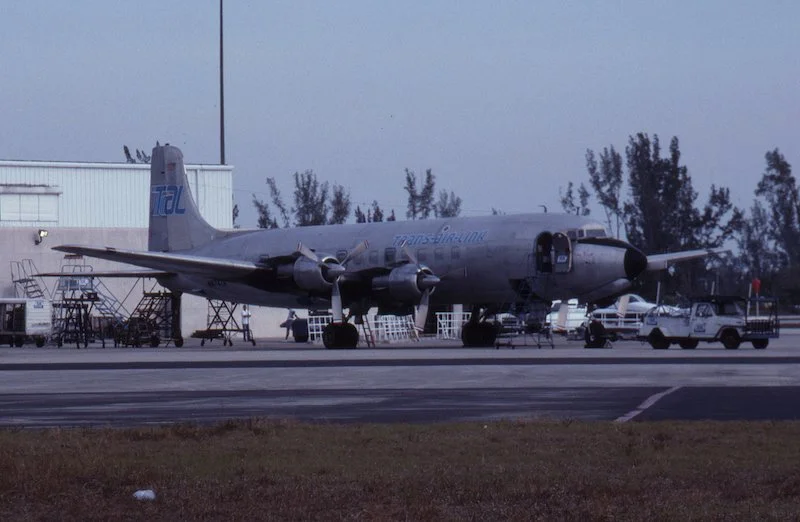
Somewhere out in the Bahamas, a Trans Air Link Douglas DC-6 awaits its next cargo run. The Company’s radio call sign was “Sky Truck.”
Photo: A.A.S. Collection
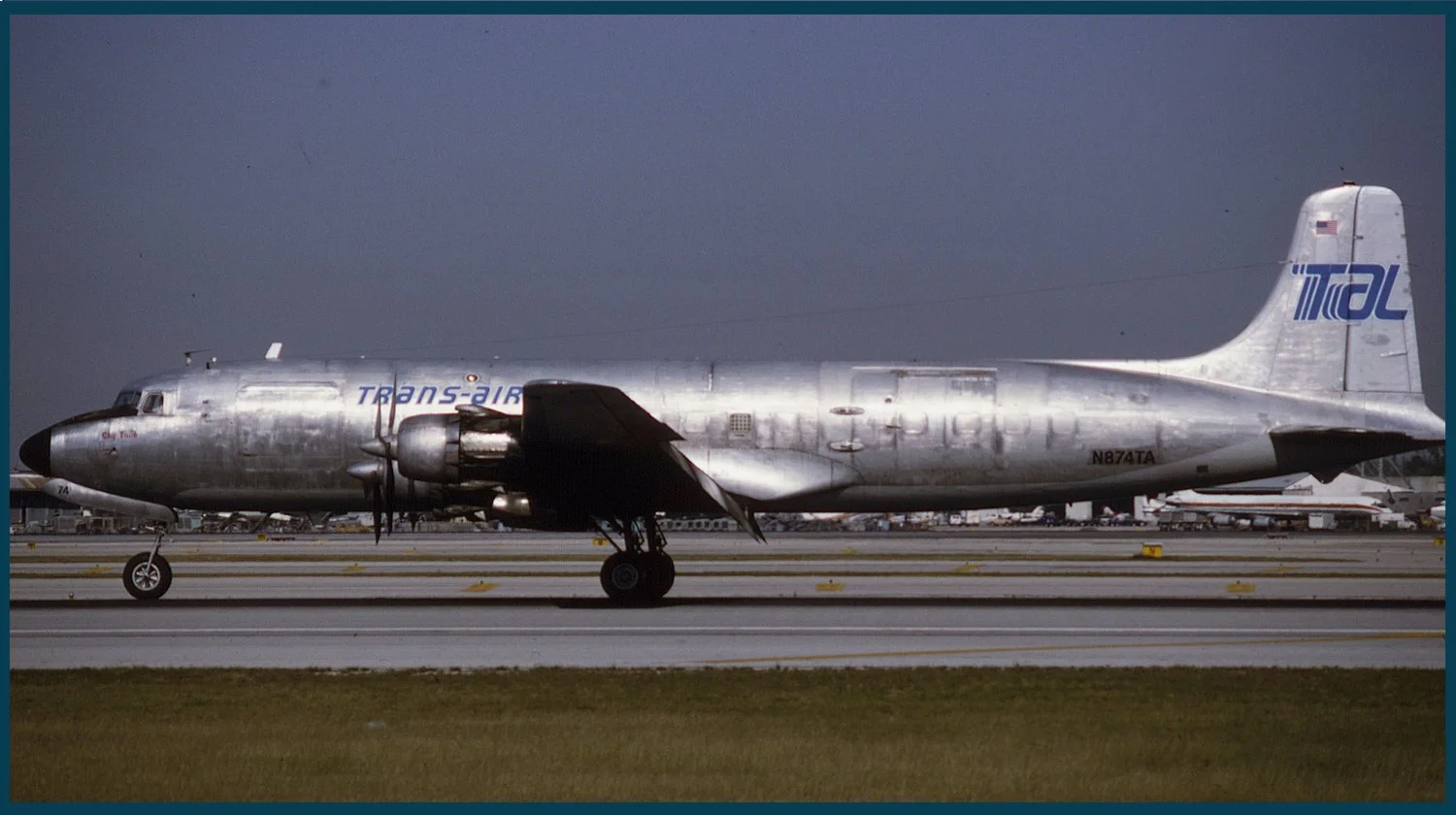
File photo of one of Trans Air Link’s Douglas DC-6A freighters - N874TA. This bird was originally delivered to the United States Air Force as a C-118A - Serial Number 53-3270 - in June 1955. Ten years later, in July 1965, it was converted into a VC-118A. In February 1975, it was stuck off charge from the Air Force, and began a life with a number of civilian operators, being converted into a freighter in 1978. Trans Air Link bought the aircraft in the late 1970s, and flew it into the late 1990s. It was reportedly sold for scrap in 2003. Photo: A.A.S. Collection
What’s in a Name?
by
The LOGBOOK Staff
At first glance, it would appear that the name of a Naval Air Station (NAS) – or a Marine Corps Air Station (MCAS), for that matter – is also the name of the airfield located
on that station. For example, let’s say two Naval Aviators are chatting about an upcoming weekend cross-country flight. One of the aviators inquires of the other, “Where do
you plan to stop for fuel?” Wherein the other replies, “I think I’ll make a quick stop at NAS Pensacola for gas.”
While the above reply is technically correct, a more accurate – and historically more interesting – reply would have been, “I think I’ll make a quick stop at Forrest Sherman
Field for gas.”
It is an often-overlooked tidbit of aviation history that most of the actual airfields located aboard an NAS carry of different name than the parent NAS itself. And,
most of these airfield names are steeped in aviation history.
In the above example, one of the air facilities situated aboard NAS Pensacola, Florida is named Forrest Sherman Field. On 2 November 1951, the old Fort Barrancas
Airfield was renamed in the honor of former Chief of Naval Operation Admiral Forrest P. Sherman. Another facility aboard NAS Pensacola was the Station Field,
a name that was changed to Chevalier Field on 30 December 1936. This change was to honor Lieutenant Commander Godfrey de Chevalier – Naval Aviator Number 7. Today
Sherman Field is still quite active, being the home of training squadrons, as well as being home plate for the Blue Angels. Chevalier Field has long been decommissioned, the
site now being used as a basic and advanced enlisted training facility.
With all that said, it should be noted that while most Naval Air Stations were named for the location – NAS Pensacola, for example – some were named for
historical figures and not necessarily for their location. NAS Cecil Field, Florida, comes to mind. It was named in honor of Commander Henry B. Cecil – Naval Aviator
Number 42 – who perished aboard the dirigible Akron (ZRS-4) when it crashed on 4 April 1933. It should be noted that NAS Cecil Field got its start as a Naval Auxiliary
Air Station (NAAS), associated with NAS Jacksonville. Many NAASs were later upgraded to full NAS status, however they kept their original names. Another quick example
of this policy is NAS Whiting Field, Florida, which was originally an auxiliary field associated with NAS Pensacola. NAS Whiting is named in honor of Captain Kenneth
Whiting – Naval Aviator Number 16.
So, knowing that most airfields carried a different name than their parent NAS, here is a little quiz. Listed below are a few airfield names – can you match them with the parent NAS or MCAS? Some are simple, while others are rather more obscure.
Admiral A. W. Radford Field
Cunningham Field
Chambers Field
John Rogers Field
Hensley Field
Munn Field
Bordelon Field
The Answers:
Admiral A. W. Radford Field – NAS Cubi Point, Philippines. Dedicated on 21 December 1972, this field honored Admiral Arthur W. Radford, a former Chairman of the Joint Chiefs of Staff. Today, this field is closed.
Cunningham Field – MCAS Cherry Point, North Carolina. This airfield was dedicated on 4 September 1941, in honor of Lieutenant Colonel Alfred A. Cunningham, who was designated Naval Aviator Number 5, and Marine Corps Aviator Number 1.
Chambers Field – NAS Norfolk, Virginia. One of the only airfields not dedicated to an aviator or aircrewman, Chambers Field was named on 1 June 1938, in honor of Captain Washington I. Chambers, and early and enthusiastic advocate of Naval Aviation.
John Rogers Field – NAS Barbers Point, Hawaii. Named in honor of Commander John Rogers, an early pioneer Naval Aviator. Dedicated on 10 September 1974.
Hensley Field – NAS Dallas, Texas. Interestingly, this airfield is not named for either a Naval nor Marine Corps Aviator, but rather for an early pioneering U.S. Army Aviator – Colonel William N. Hensley. In August 1930, the airfield, which was then an Army flying field, was named in his honor. The airfield retained this name, even after it became primarily a Navy facility. It is no longer an active military field.
Munn Field – MCAS Camp Pendelton, California. Munn Field was designated on 12 January 1987, in honor of Lieutenant General John C. Munn, a former Assistant Commandant of the Marine Corps, and the first Marine Corps Aviator to command Camp Pendelton.
One thing common among all the above listed fields is the fact that they are all named after officers. This raises the question – Were any fields named for enlisted men?
Bordelon Field – associated with NAS Hilo, Hawaii. This field may not exactly meet the criteria listed above, but it is certainly worth mention here. Prior to the outbreak of World War Two there was a small civilian airport at Hilo, on the island of Hawaii. With the start of the war in the Pacific, the airport was taken over by the government, first by the U. S. Army Air Corps, and then in 1943, with an every expanding Navy presence. Eventually, the Navy portion of the field was commissioned a full NAS. On 19 April 1943, the airfield was named General Lyman Field in honor of U. S. Army Brigadier General Albert Lyman, a native Hawaiian and West Point graduate. Meanwhile, the Marine Corps carved out a small airstrip approximately 30 miles northwest of NAS Hilo, near the town of Kamuela, to be used as a liaison strip for the training that was being conducted in the area. This small 3,000-foot strip, which was under the control of NAS Hilo, was called Bordelon Field. It was dedicated in honor of Sergeant William J. Bordelon, an enlisted Marine who was killed on 20 November 1943, during the battle on the island of Tarawa. For his gallantry under fire, and his unwavering support of his fellow Marines, Sergeant Bordelon was posthumously awarded the Medal of Honor. Semper Fi. After the war Bordelon Field was soon closed, although there are vestiges of the field that can still be seen today. The Marine Corps continues to honor this fallen hero, as several facilities, structures, streets, etc… are named for Sergeant Bordelon.
How did you do? In another issue of LOGBOOK, we will bring you more interesting and sometimes little known names of airfields around the world.
This article originally appeared in the 4th Quarter 2009 print issue of LOGBOOK magazine.
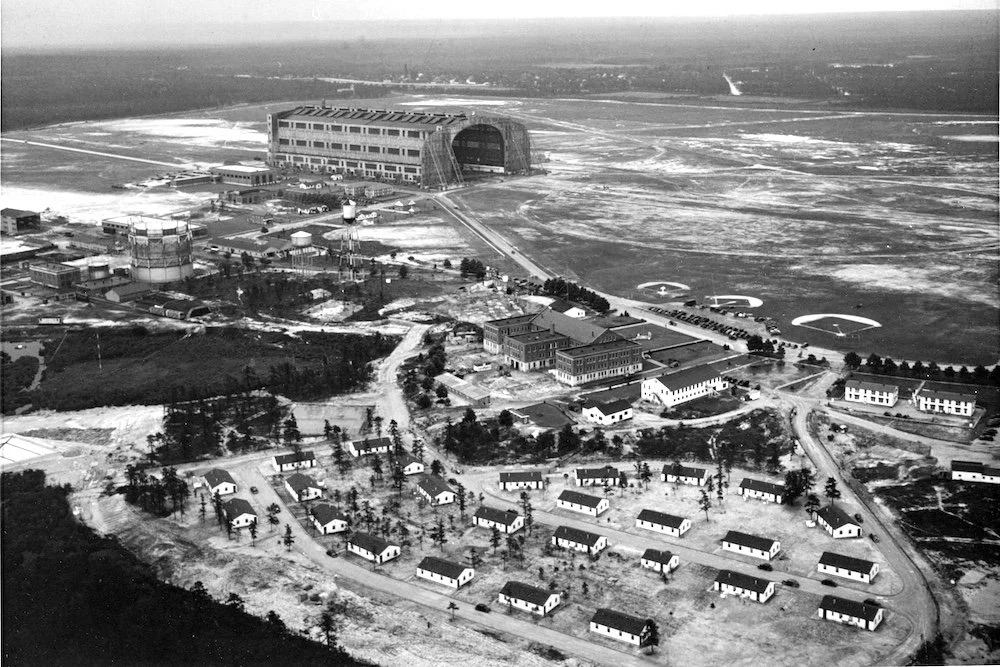
The airfield aboard NAS Lakehurst, New Jersey - seen here during World War Two - was named on 6 January 1944, in honor of Commander Louis H Maxfield, who had perished back in 1921, in the crash of the dirigible R-38. Photo: U.S. Navy
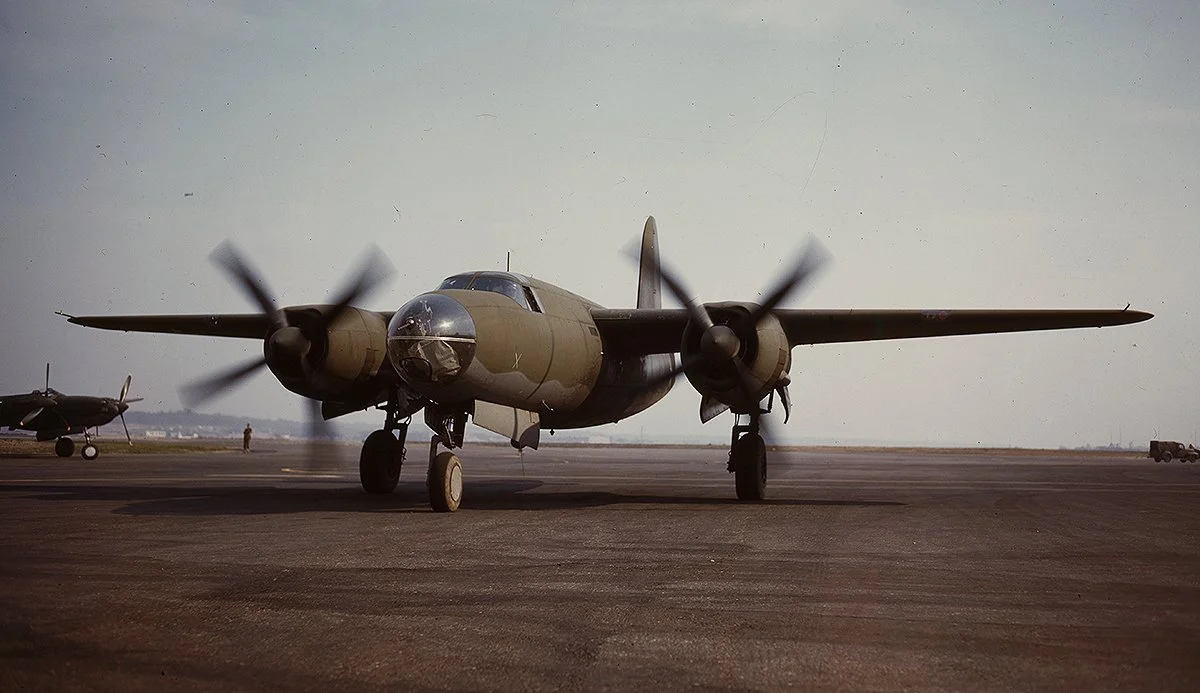
Intelligence Narrative No. 51
Day Operations - 17 July 1943, 320th Bombardment Group
Mission: Bomb Central Railroad Yards, Naples, Italy
Aircraft: Martin B-26 Marauder
They’re Old and Slow, But These Two Old Veterans Are Dearly Loved By The Pilots At The Yuma Proving Ground
By
Phillip T. Washburn
Photos: Kimberly Connaway
R.T. Foster’s artwork is now curated by his daughter Heather Foster. She can be reached at:
R.T. Foster Art
405.632.8658 or rtfosterart@gmail.com
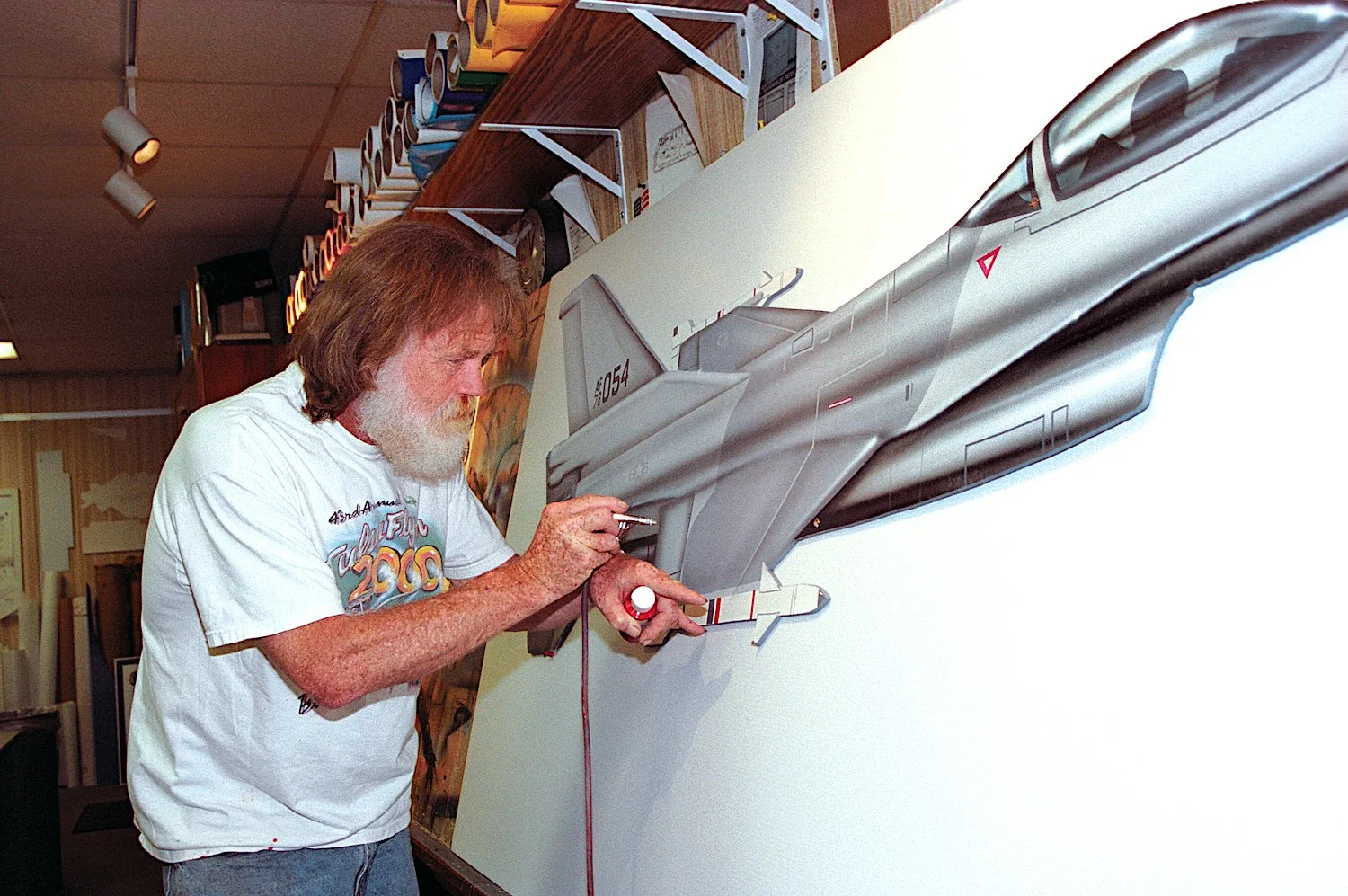
R.T. Foster - seen here in 2003 - airbrushes an illustration of an F-16 Fighting Falcon. Three paintings by the longtime illustrator are on permanent display at the Oklahoma state capital, and his work also hangs in galleries from the Smithsonian Air and Space Museum to the San Diego Air and Space Museum. Photo: U.S. Air Force
Hidden (now gone) Artifact in San Juan
by
Dave Powers
During a recent (2014) layover in San Juan, Puerto Rico, I decided I needed to walk off a particularly large
dinner, so I left my hotel on the Laguna del Condado and headed east on Avenida Ashford. About a mile
or so up the road, which is dominated by high-rise hotels and new condominium buildings, I saw tucked
away in a corner and somewhat obscured by a fence, what appeared to be the tail of an airplane. Not a real
tail, but rather an impressionistic image of an airliner's empennage on the wall of a building. I crossed the
avenida for a closer look.
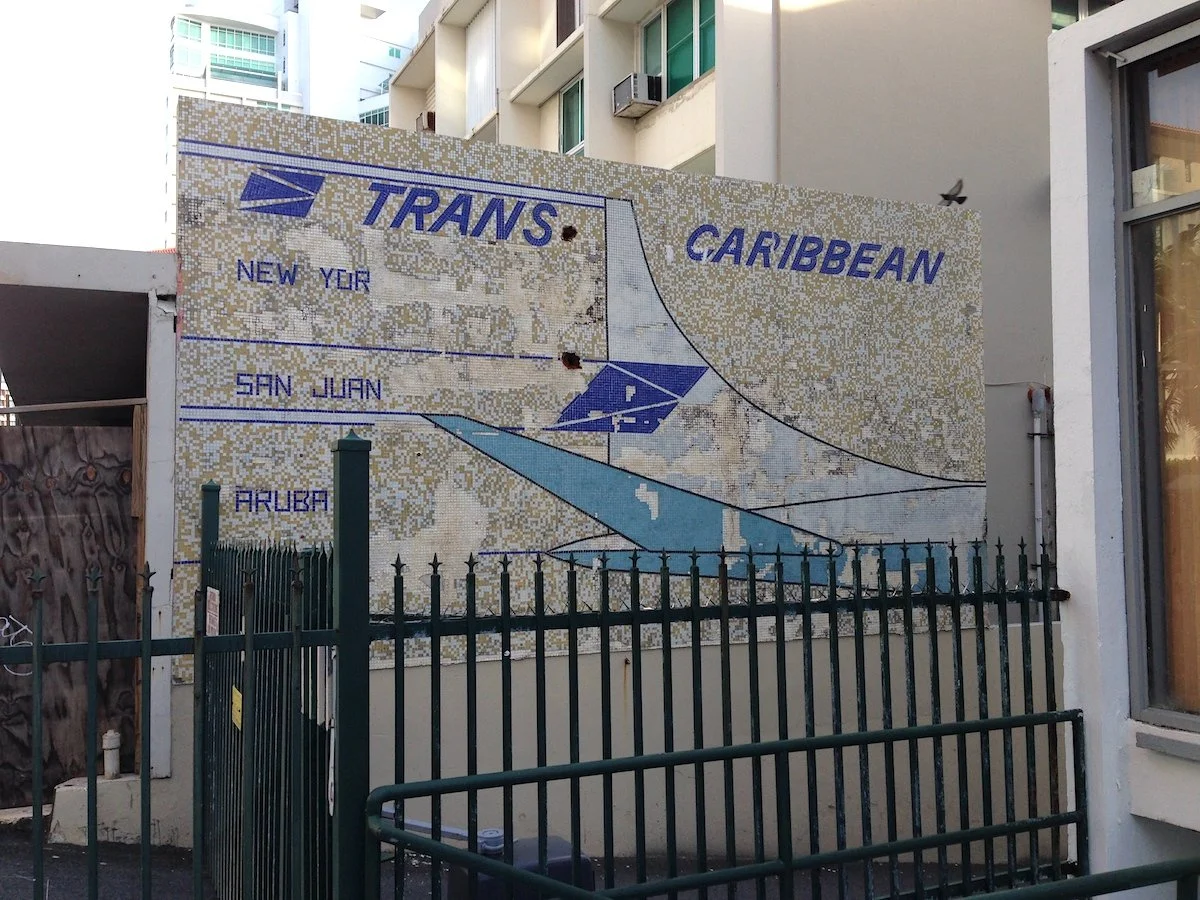
What I found was a crumbling advertisement, actually a mosaic tile billboard of sorts, for the old Trans
Caribbean Airways, which noted the fact that the airline serviced New York, San Juan and Aruba. The billboard,
nearly 12 feet tall, was part of an exterior wall of a small shop or office building. Perhaps in the old days this
was Trans Caribbean's ticket office, as some unconfirmed references state. Today, many of the tiles are
missing, and with the amount of construction going on in the vicinity, the future of this rather unique old
artifact of airline history is certainly in question.
Trans Caribbean Air Cargo Lines was formed in May 1945, by O. Roy and Claire Chalk, with its main offices
in New York City, and its operational hub based at San Juan. In 1948, the name was changed to Trans
Caribbean Airways. Over the years the airline operated a variety of airliners, including Curtiss C-46s, Douglas
DC-3s, DC-4s and DC-6s, while later equipment including the Boeing 727, a number of versions of the
Douglas DC-8, and occasionally a Boeing 707 under lease. In addition to the above noted destinations, Trans
Caribbean also variously flew into Newark, New Jersey, Washington DC, Curacao, Haiti, and most of the U.S.
Virgin Islands. Passenger, mail and air cargo flights were flown, and both scheduled and chartered operations,
the latter often for the U.S. Military Airlift Command (MAC), were offered. In 1971, Trans Caribbean Airways
was absorbed in to American Airlines.
I don't really know if there is any interest in trying to preserve this piece of airline history, but it would be a pity to see it go, all the same. Like I said, there is a lot of demolition and construction going on this area, so its future is probably in some doubt.
Update: In April 2024, I did a walk - a digital walk via an online map service - up the Avenida Ashford looking for that mural. Alas, I found the building in question but the mural was gone. Perhaps it was just covered up, to be re-discovered another day. If it was removed I am not certain where it went. Most likely it is just gone. Pity
And speaking of DC-4s in San Juan ... please see the short article in the sidebar below.
The original version of this article appeared in the Volume 12, Number 3 - 3rd Quarter 2014 - print issue of LOGOOK magazine.
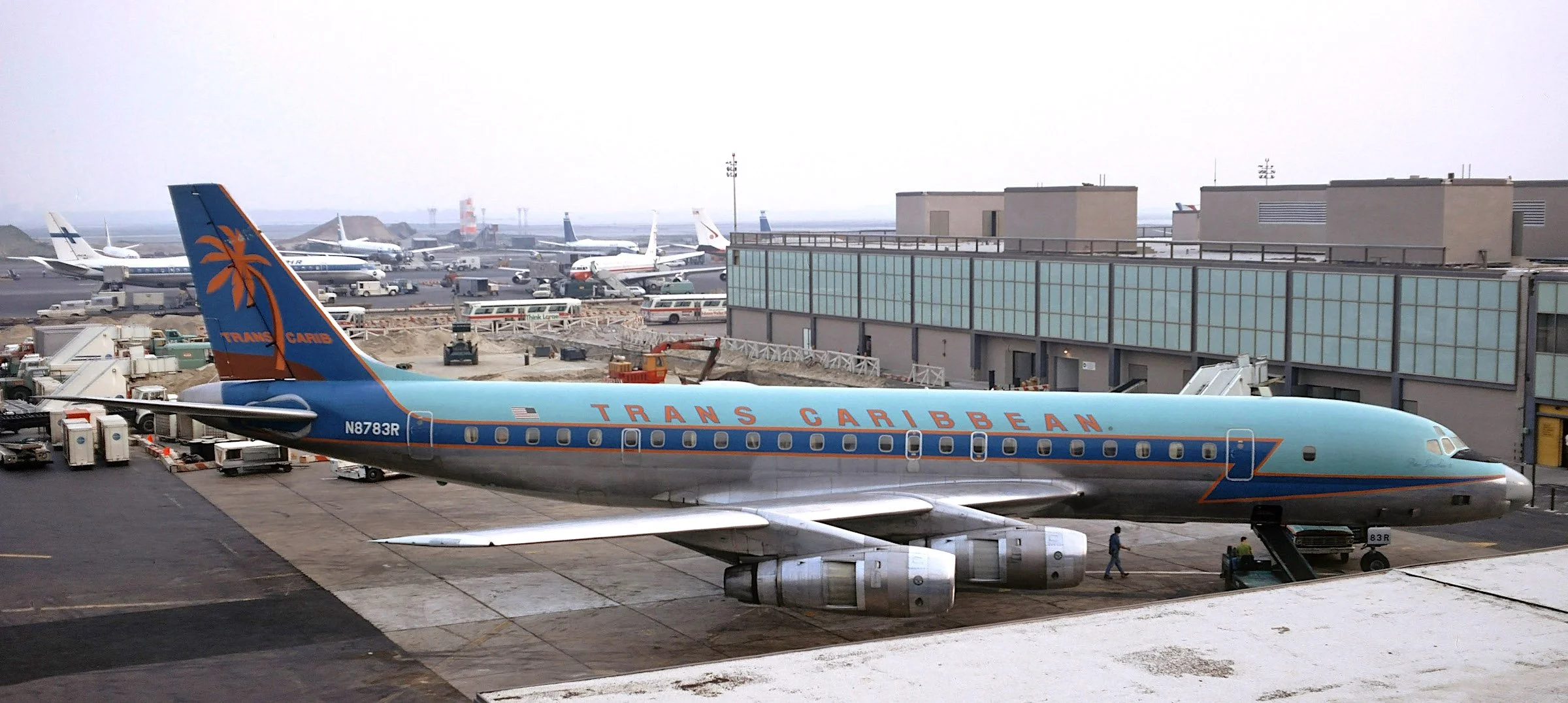
A wonderful period photo of a Trans Caribbean Airways Douglas DC-8, on the ramp at John F. Kennedy International Airport in 1970. A DC-8-54CF - (MSN 45684) - it was delivered new to Trans Caribbean on 16 December 1963. It was titled: Peter Jonathan II. The DC-8-54CF - the “CF” meaning Combi-Freighter, or alternatively Convertible Freighter was marketed by Douglas as a DC-8-54JT - the “JT” meaning Jet Trader. In any case, the airframe could be configured as pure passenger, pure cargo, or a combination of both. When Trans Caribbean was absorbed by American Airlines in March 1971, this DC-8 was placed in storage. Sold off in 1975, it flew for several years as a pure freighter before being scrapped in 2001. Photo: With the kind courtesy of Steve Williams
And Speaking of DC-4s in San Juan...
I have been flying in and out of Luis Muñoz Marin International Airport, at San Juan, Puerto Rico, for nearly
thirty years now (well at least through 2014). Although I was never based there, I always enjoyed passing
though San Juan's airport, either on a quick turnaround or for a few days of welcome layover. One of the
things I particularly liked about this airport was seeing a vast array of round-motored airliners still hard at
work. There were birds from such manufacturers as Douglas, Convair, Lockheed, Curtiss, Beechcraft and
others, all powered by various round piston engines. These birds were no pampered hangar queens trotted
out on a sunny day, but rather viable commercial aircraft that had to fly to make a living. The ramps were
oily and the air was full of blue exhaust smoke. Neat!
Well, over the years the number of these machines working out of San Juan has decreased dramatically.
Today, I am still flying into San Juan, but, while there are still a few left, it is harder to find any round-motored
aircraft.
A couple of months ago, we were pulling into the south cargo ramp, a ramp that used to be full of DC-3s
waiting to take our cargo out the smaller islands, when I saw a image from the past. Sitting on the eastern
edge of the cargo ramp was a Douglas DC-4 freighter, looking quite nice in the noontime tropic sun. After
we shut down, I asked our local mechanic about the DC-4. He said it was recently a frequent visitor to the
airport, tramping general cargo around the islands.
So here's the story: This bird is a Douglas C-54G-1-DO Skymaster, which was delivered to the United States
Army Air Forces on 19 June 1945, with the Serial Number 45-0491 (MSN 35944). After a long career, it was
retired from active duty in January 1972, and placed in storage at Davis Monthan Air Force Base. Over the next
few years the airframe changed hands several time, first being bought by Dross Metals on 13 November 1975,
who sold it to WAIG Aircraft on 10 November 1976. On 30 March 1979, WAIG Aircraft first placed this C-54G
on the civilian register as N406WA. In 1981, WAIG Aircraft was dissolved, with several of the company officers
forming ARDCO, Inc., based in Tucson, Arizona. On 15 January 1982, ARDCO purchased the aircraft, and
converted it for aerial firefighting with the addition of a large ventral suppressant tank. It was called Tanker 119.
After the turn of the century, U.S. Forest Service officials began to question the future of these large
recip-powered tankers. With the future of aerial firefighting clearly going to newer turbine-powered aircraft,
N406WA was pulled off the line, and ultimately sold to Florida Air Transport in December 2007. The
suppressant tank was removed and a cargo floor installed. Based at Opa Locke, Florida, N406WA began
flying cargo from Florida out the islands. Then, on 28 October 2011, the aircraft was again sold, this time to
Jet One Express, of Davie, Florida, where it continued general cargo runs throughout the Caribbean.
As the mechanic and I walked over to N406WA, to take a few photos, he asked me if I had heard what had
happened to the bird. I confessed that it looked as if the old C-54 was rather inactive, but I had not heard any
news. Well, on 22 March 2012, while taxing in from a normal run, the nose landing gear collapsed and the aircraft settled down on to its nose. When I took these photos, repairs were currently underway, however as of this publication, N406WA has not yet returned to the air.
Anybody out there see N406WA back in the air? Please drop us a line - thanks.
The original version of this article appeared in the Volume 12, Number 3 - 3rd Quarter 2014 - print issue of LOGOOK magazine.
Update: Sometime after its untimely accident in 2012, inspections indicated that main wing spar corrosion was advanced to the point where repairs were beyond economical consideration, and the airframe was scheduled to be scrapped. In the meantime, when Hurricane Maria rolled through Puerto Rico in September 2017, the airframe was picked up and unceremoniously tossed into a nearby drainage ditch, further sealing its fate. In 2020, N406WA was scrapped at San Juan.
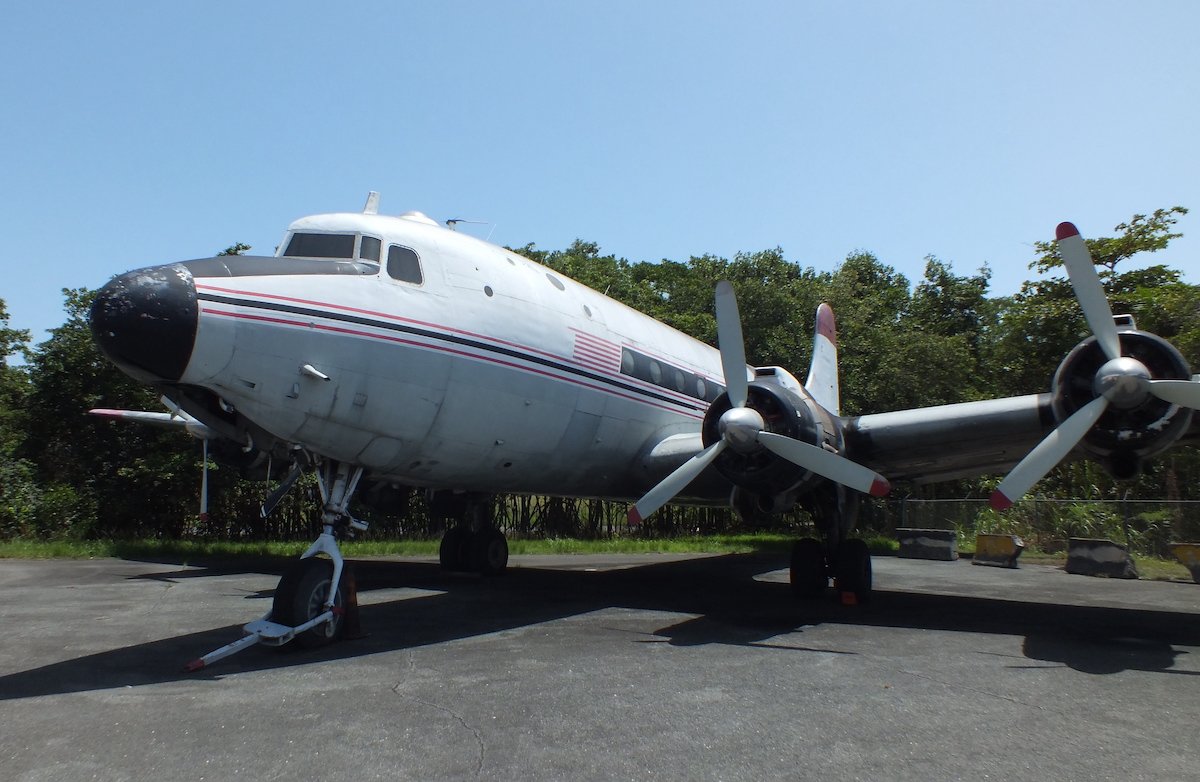
Above: Douglas C-54/DC-4 on the cargo ramp at San Juan, Puerto Rico, as I saw it on 12 June 2014. This was after the bird had suffered a nose gear collapse, and I was told that repairs were underway. History would show that it never flew again. This aircraft was familiarly known as a “Super 4.” Along with at least one other DC-4 in the ARDCO fleet, it as modified when the original Pratt & Whitney R-2000 twin wasp engines were replaced by a set of Wright R-2600 Twin Cyclone engines. Although there was a modicum of increased performance, the main advantage was the relatively large number of spare R-2600 engines then available. Photo: A.A.S.
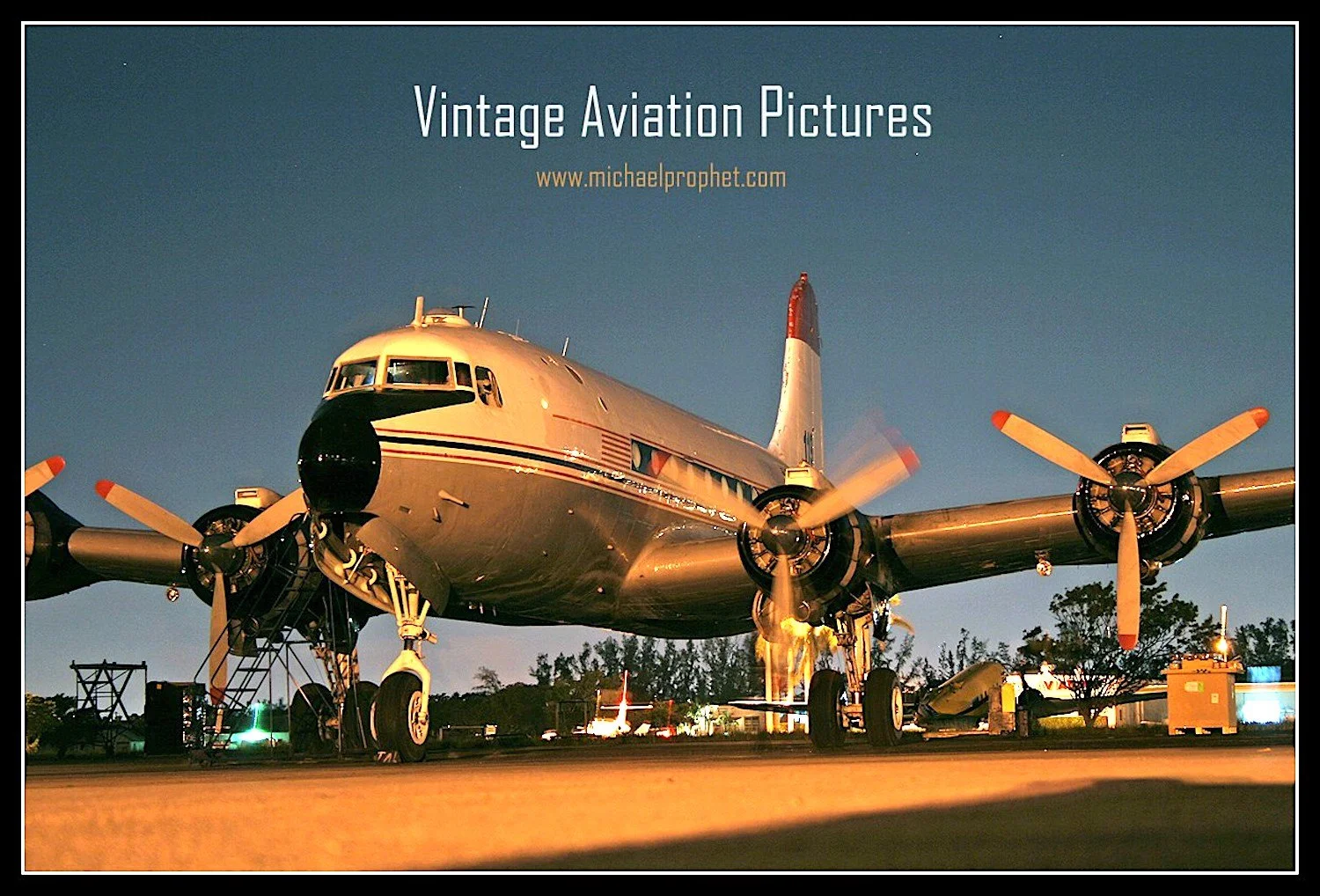
Below: better days - a great photo of N406WA on the ramp at Opa Locka, Florida, firing up for a hop down to the islands. Photo by Michael Prophet, ace photographer, round propliner enthusiast, and LOGBOOK contributor. Thanks Michael
A Flying Dumpster?
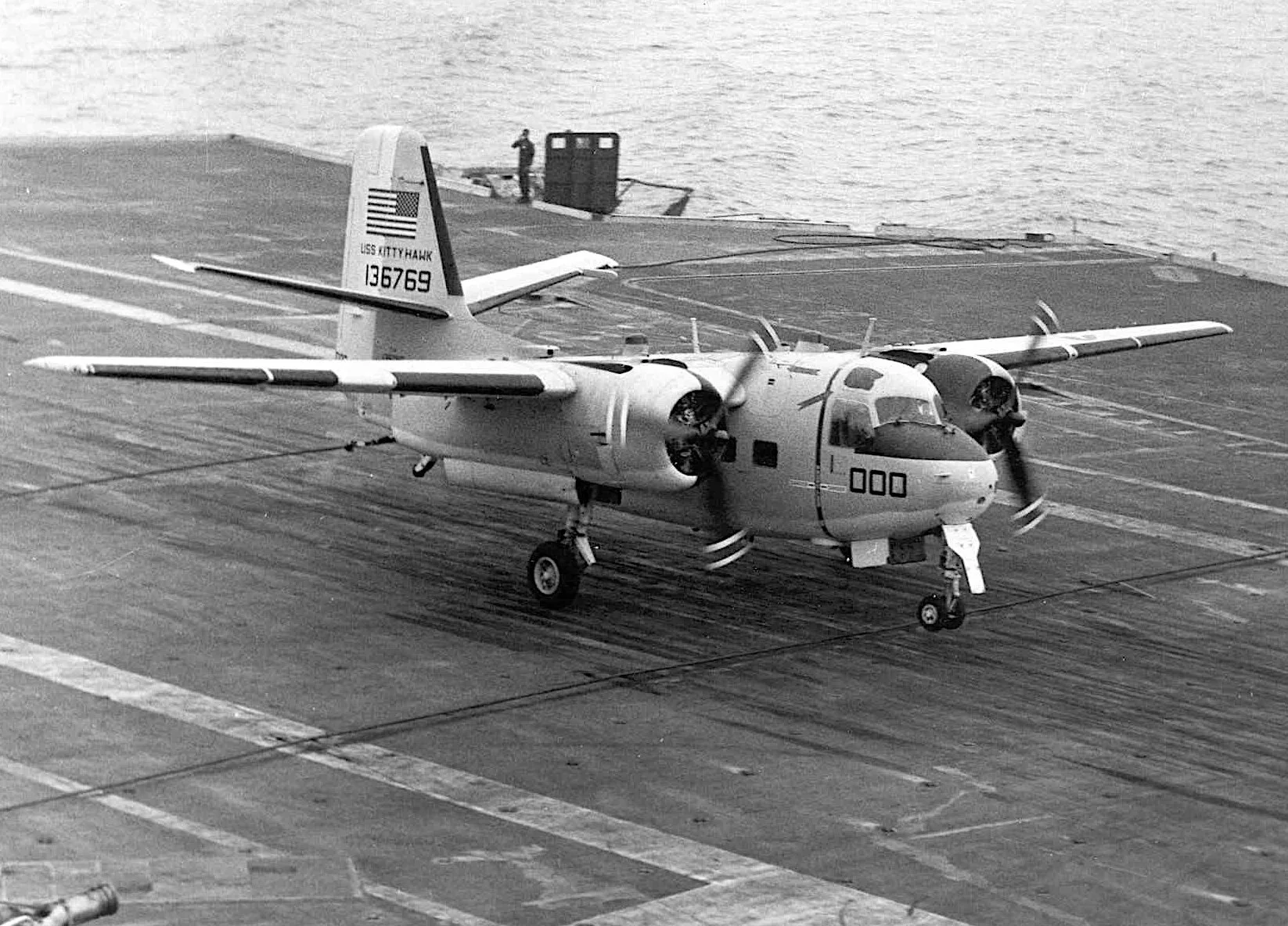
The North American T-28B/C Trojan was powered by a Wright Cyclone R-1820 radial engine. The Grumman TF/C-1A Trader was powered by two Wright Cyclone R-1820 radial engines (as were the S2F/S-2 Tracker, the WF/E-1 Tracer, the TS-2 multi-engine trainer and the US-2 utility bird). Those old timers out there - like me - who flew the T-28B/C Trojan used to quip that the C-1A was nothing but two T-28s flying in really close formation.
Not long ago I received a note from Deke, an old Navy buddy of mine, a former T-28B/C pilot like myself, and now a senior captain at American Airlines. Deke wrote: “Hey Dave, as a fellow Hog Driver [referring to the Trojan] you will appreciate this. I was flying with a guy who was one of the last C-1 Trader Drivers in the Navy. When I mentioned that it had the same motors as our T-28s he replied, ‘Yup, the C-1 was basically two T-28s bolted to a dumpster.’”
Ha! Good one, Deke!
Fly Navy,
Dave Powers
The original version of this article appeared in the Volume 14, Number 3 - 3rd Quarter 2020 - print issue of LOGOOK magazine.
Above: A file photo of a Grumman C-1A Trader - BuNo 136769 - trapping aboard the USS Kitty Hawk (CVA-63). Photo: National Naval Aviation Museum, click HERE to stop by.
Soviet Taran*
by
Dave Powers
You just never know when you are going to stumble upon a bit of aviation history. Sometimes just a simple mention of a person,
airplane or event can send you off on a quest for more information and you end up digging up facts on a flying story that you have
never heard of before. And, if there is a little “cloak and dagger” involved, well that’s ok, too.
A few months back I was at my doctor’s office on a routine visit. My doc was born in Argentina, but his family emigrated to the
U.S. when he was still a baby. After med school he served as a U.S. Air Force doctor, and as such has always had a more than
passing interest in flying. Knowing that I was well into all aspects of aviation, every visit we had was accompanied by rousing
conversations on flying - much to the consternation of his nurses, who were trying to keep is appointment book on schedule. It
was during this visit that he told me about a flying episode that I had never heard of before.
I really don’t know how our conversation turned to the topic, but soon we were talking about clandestine flights - all hush hush,
spooky, spy game stuff. He then mentioned that his father had a very close friend who was long ago shot down over the Soviet
Union during a cargo flight. Although unverified, my doc said that the cargo carried, and the flights themselves, were all somewhat
dubious, and had more than just a hint of covert ops about them. The incident took place nearly 40 years ago, and my doc could
not recall any more specific details. So I started digging, and this is what I found out.
On 18 July 1981, a cargo airplane from a little known Argentine cargo airline crashed just inside the border of the Soviet Union.
The freighter did not simply crash, nor was it shot down. Instead it was brought down after it was rammed by a Soviet fighter.
The cargo bird in question was a Canadair CL-44D4-6, a big, four-engine turboprop freighter, one of 39 examples built. Registered
as LV-JTN - construction number 34 - this particular airframe was one of two of the type in the fleet of a charter cargo outfit called
Transporte Aereo Rioplatense (TAR). LV-JTN was first delivered to Slick Airways - as N605SA - back in October 1962. After a number of various operators, it was finally bought by TAR on 10 April 1971.
Despite all my digging, the back-story to this incident has remained elusive, so the following may be open for discussion. It appears that in the early 1980s, certain “intermediaries” for the Israeli government contracted TAR to fly a number of cargo flights from Tel Aviv, Israel to Tehran, Iran. It should be pointed out that this was a practical application of the concept of “always support your enemy’s enemy,” since during this time Israel, although not overtly, tended to support Iran because Iran was then fighting Israel’s even worse enemy, namely Iraq. The flights clandestinely loaded in Tel Aviv, but would then fly first to Larnaca, Cyprus, before flying on to Tehran. Officially, the flights were round trips between Larnaca and Tehran, hopefully eliminating any connection with Israel, and at least on this flight, the cargo manifest reportedly read “tires.” What was actually being carried is open to supposition.
Captain Hector Cordero was in command of the flight, assisted by co-pilot Hermete Boasso and engineer Jose Burgueno, the latter being the friend of my doctor’s father. Also on board was a mysterious Scotsman by the name of Stuart McCafferty, who was listed as a “purser,” but was thought to be a representative of whoever was sponsoring the flight. He was supposedly on board to keep an eye on his cargo. This was the third such flight for this crew, and the inbound leg and cargo drop was completed without incident.
Flying northbound out of Tehran, as he had done twice before, Captain Cordero guided his freighter along the border of Iran and what was then Soviet Azerbaijan, thus avoiding any unpleasantness stemming from flying too close to the Iran/Iraq conflict. Once in Turkish airspace it would be an easy turn to the west and back to Cyprus. What happened on this northbound leg is really anybody’s guess, as all details came rather one-sidedly from the Soviets. The TAR CL-44 crashed within sight of the Araks River - the border between Turkey and Azerbaijan - and just inside Soviet territory.
What caused the crew to allow the aircraft to stray off course is anybody’s guess, probably just a small navigational error. The result, however, was that Soviet air defense launched several fighters from the 166th Fighter Regiment, although only one actually managed to catch the wayward freighter - a Sukhoi Su-15TM Flagon, piloted by Soviet Air Force Captain Valentin Kulyapin. It is from his report, certainly heavily edited by Soviet officials, that we learn of the last moments of the TAR CL-44.
Captain Kulyapin, who one source notes was the squadron’s political officer - the zampolit - and was more of a Soviet ideologue rather than a good pilot, states that he used all the normal, internationally accepted, procedures to intercept and communicate with a civilian aircraft. He states that rather than following his signals the crew of the CL-44 either ignored his instructions or responded with aggressive maneuvers. The freighter then made a sharp turn to the west, in an apparent attempt to flee Soviet airspace. Since Kulyapin’s fighter was not equipped with an internal gun - the Su-15 could carry gun pods, but apparently Kulyapin’s aircraft was not so equipped - and there was no time to drop back for a missile shot, he decided, in the spirit of a true Soviet hero, to simply ram the intruder. Which he did, causing catastrophic damage to both this fighter and the CL-44. Kulyapin ejected, and survived, while all four aboard the CL-44 perished in the resultant crash.
After the incident there was a minor diplomatic confrontation between Argentina and the Soviet Union, which the latter managed to initially brush off by saying that the fighter pilot - Captain Kulyapin - had also perished. Since there were no eyewitnesses left to corroborate why the CL-44 went down, the Soviets said it was a simple accident, and that was the end of that. The CL-44 was flying empty, so there was no nefarious cargo to implicate the crew. The bodies of the crew of the CL-44 were returned to their respective countries and the whole episode was soon forgotten.
Of course, Soviet propagandists could not pass up the chance for a good patriotic story. Several years later Captain Kulyapin’s tale of his interception and downing of the TAR CL-44 was chronicled in a two page spread in the 6 April 1986 issue of the Soviet military journal Krasnaya Zviezda - the Red Star - which prominently displayed a photo of the hero fighter pilot. The article was peppered with lines like: “The intruder aircraft’s shadow fell on our territory - an evil nasty shadow.” Captain Kulyapin remembers asking himself, “Who would dare cross our border?” And, when the CL-44 turned to the west he concluded, “He won’t get away.”
Of course, there could be another version of the story. Some commentators in the West posited that the crew of the CL-44 never even saw the Soviet Flagon, and perhaps not knowing they were in Soviet airspace simply made the normal left turn to fly west over Turkey. Captain Kulyapin could have interpreted this turn as either an evasive or an aggressive maneuver. Perhaps, Captain Kulyapin, when trying to flying in close to the freighter got caught up in the propwash of the CL-44’s four big Rolls-Royce Tyne turboprop engines, and got tossed into the freighter. Maybe, due to poor airmanship, the Soviet fighter pilot just hit the CL-44 by mistake. In any of these scenarios, only Captain Kulyapin was left to tell the truth.
* Taran - A Russian word for "battering ram."
The original version of this article appeared in the Volume 14, Number 3 - 3rd Quarter 2020 - print issue of LOGOOK magazine.
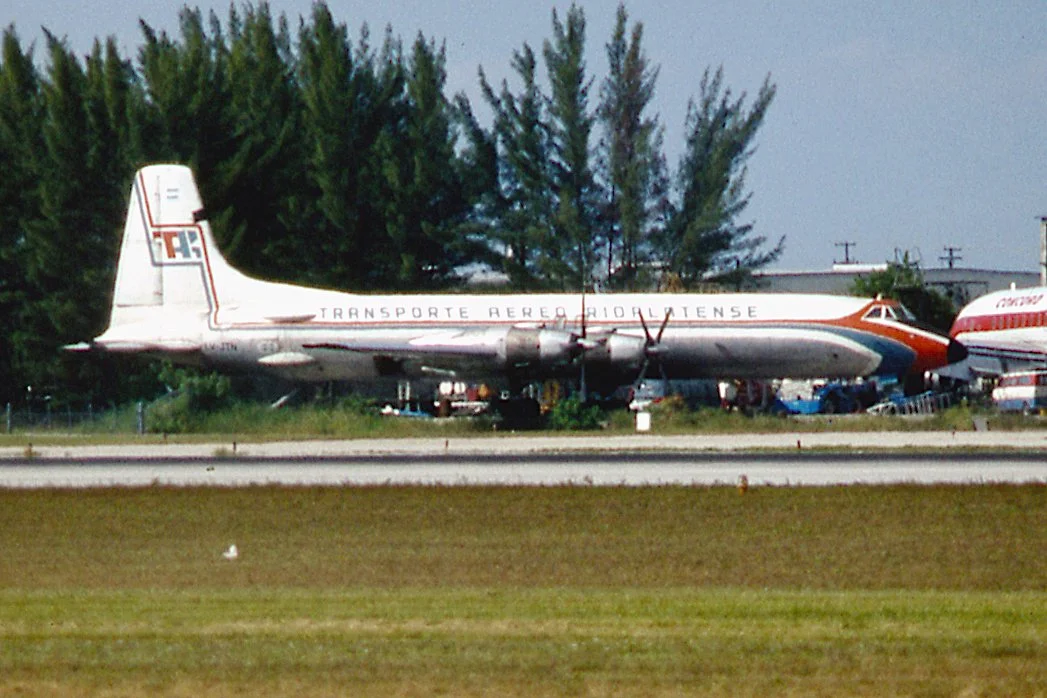
Long range shot of Transporte Aereo Rioplatense’s (TAR) Canadair CL-44 - LV-TJN - seen on the ramp at Miami International Airport - October 1979. TAR was founded in December 1969, by Carlos F. Martinez Guerrero, and was headquartered in Buenos Aires, Argentina. By the start of the 1990s, TAR had ceased operations. Photo: Charlie Stewart via Air-Britain
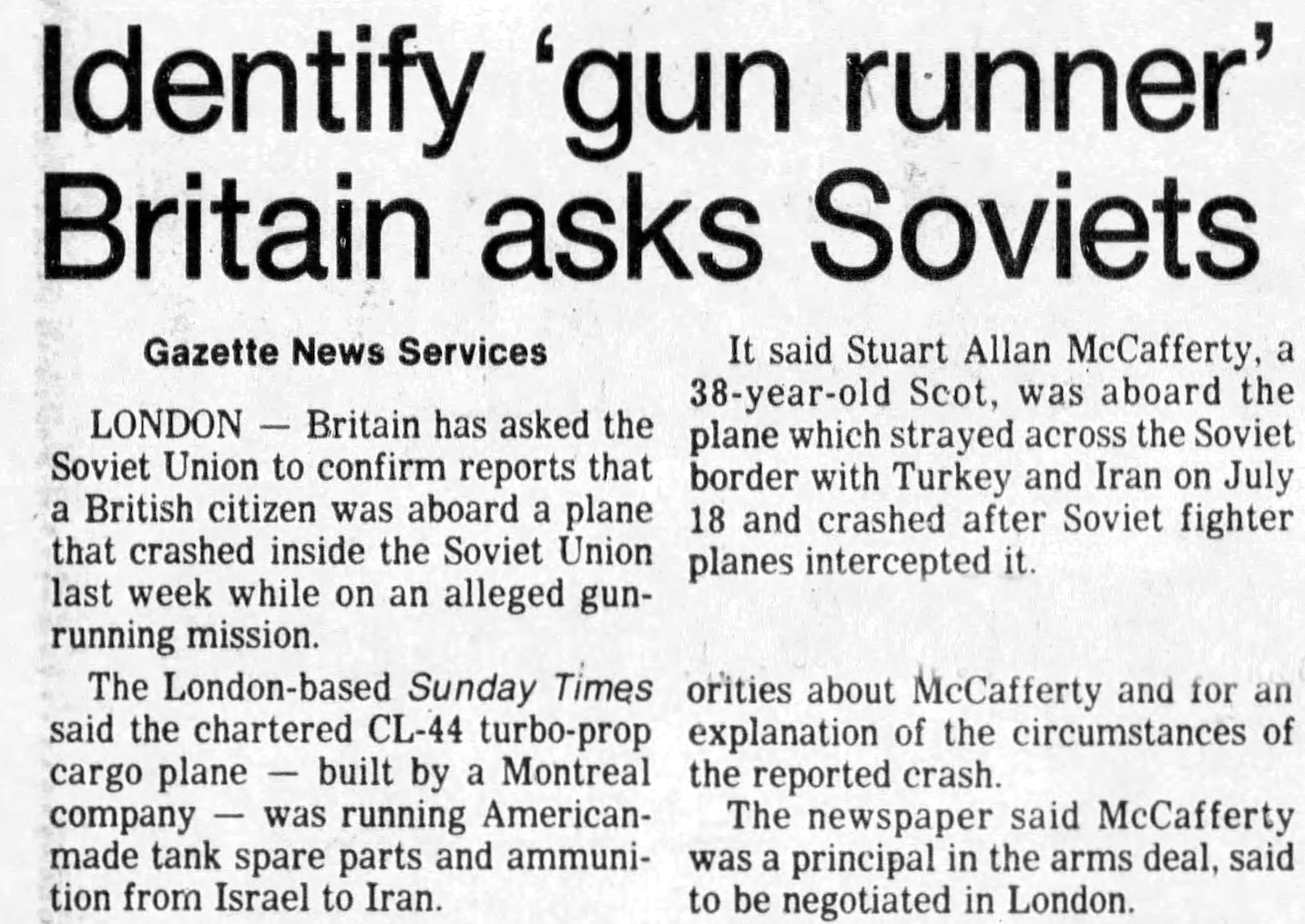
A headline from the Montreal Gazette - 28 July 1981.
Photo: U.S. Air Force
Preservation
Lockheed SR-71A Blackbird “Big Tail”
Serial Number 61-7959
U.S. Air Force Armament Museum
Eglin Air Force Base, Florida
Few, indeed, are the aircraft - actual production aircraft, not one-off prototypes - that when the type is finally fully retired from
active service each and every airframe that was built is preserved in a museum. In the civilian world, probably the best example of
this would be the Anglo-French Concorde. When this airliner was ultimately withdrawn from service there was sort of a mad
scramble by museum curators to get one of the few airframes built donated to their institution. And, of course, all of NASA’s
extant Space Shuttles (STS or Space Transportation System) are preserved. In military aviation, when the Lockheed SR-71 was
retired, save those airframes that were lost in accidents, each airframe was donated to a museum and is now preserved. None were
put under the scrapper’s torch.
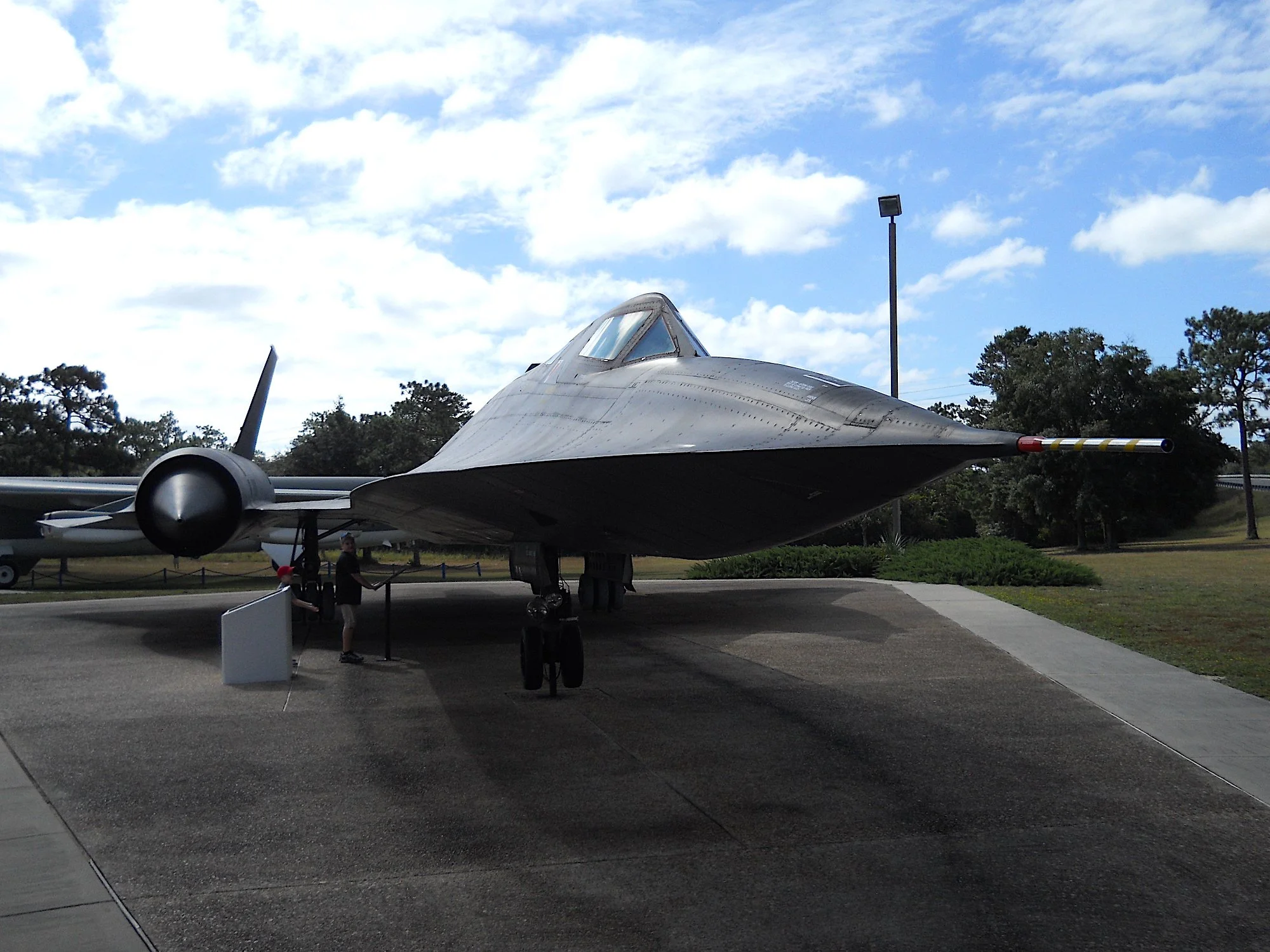
One Lockheed SR-71 that is on display is the A-Model airframe - Serial Number 61-7959 - that today can be seen at the U.S Air
Force’s Armament Museum, located aboard Eglin Air Force Base, Florida. Even a cursory examination of this bird would reveal
that this is not a “stock” SR-71A, as it has an unusual, extra long tail. It was this extended tail fairing that would give this SR-71A
the unofficial moniker of “Big Tail.”
The Blackbird has always been a highly capable aircraft, a super-fast, high flying reconnaissance platform that has never been
equaled by any other, even to this day. In 1974, long after the Blackbird had proved its worth, U.S. Air Force officials wanted a bit
more. Even though the airframe was already filled with either aircraft systems or reconnaissance gear, these officials looked for a
way to pack more into or onto the airframe. In addition to more spy-gear, the Air Force wanted to mount more sophisticated
Electronic Counter Measures (ECM) equipment to counter a perceived growing threat.
Several ideas were forthcoming, including various modifications to the airframe, basically bumps, fairings or protrusions
appended onto the fuselage, as well as removable belly pods. In the end it was decided to extend the fuselage aft of the
tail. At some 13 feet, 9 inches long, with a volume of 49 cubic feet, this extension, essentially just a large tail cone, certainly fit the
bill. Aerodynamically, it was also the most appropriate.
Blackbird “959” - the tenth airframe built - was selected to be the test bed, mainly because of the fact that since it was part of the stable of test and development birds, it would not require removing an operational aircraft from a front line reconnaissance squadron. Due to the fact that the extension would drag on the ground as the aircraft rotated for take off, and during landing, the whole assembly was articulated and could be repositioned up some 8.5 degrees. During the landing phase, once the aircraft was one the ground and level, the extension would quickly be repositioned back down so the aircraft’s drag chute could be deployed. First fight with the “Big Tail” installed was logged on 3 December 1975, and was kept subsonic. On 11 December the first sonic flight was logged, with no apparent degradation in performance or handling. On 28 January 1976, “959” was flown at Mach 3+, at 75,000, and everything looked good.
Some 36 Lockheed/Air Force test flights were made with the new tail, carrying various ECM gear and camera set ups, and although everything worked as envisioned, the Air Force terminated the project. On 29 October 1976, “959” logged its last hop, have recorded 866 hours during 304 missions. The airframe was then placed in storage and used as a source of spares for the rest of the SR-71 fleet. Finally, in 1991, it was put on display at the USAF Armament Museum.
The address of the USAF Armament Museum is technically on Eglin Air Force Base, however the museum is actually located in an area that is open to public access. So, although increased base security measures will be in force for the foreseeable future, limiting access to non-military folks to the actual base, getting to the museum is easy, with no additional security protocols. The museum is located less than one hour south of Interstate 10, that runs east/west through the Florida panhandle, so it’s an easy detour on your travels through the state.
The original version of this article appeared in the Volume 14, Number 3 - 3rd Quarter 2020 - print issue of LOGOOK magazine.
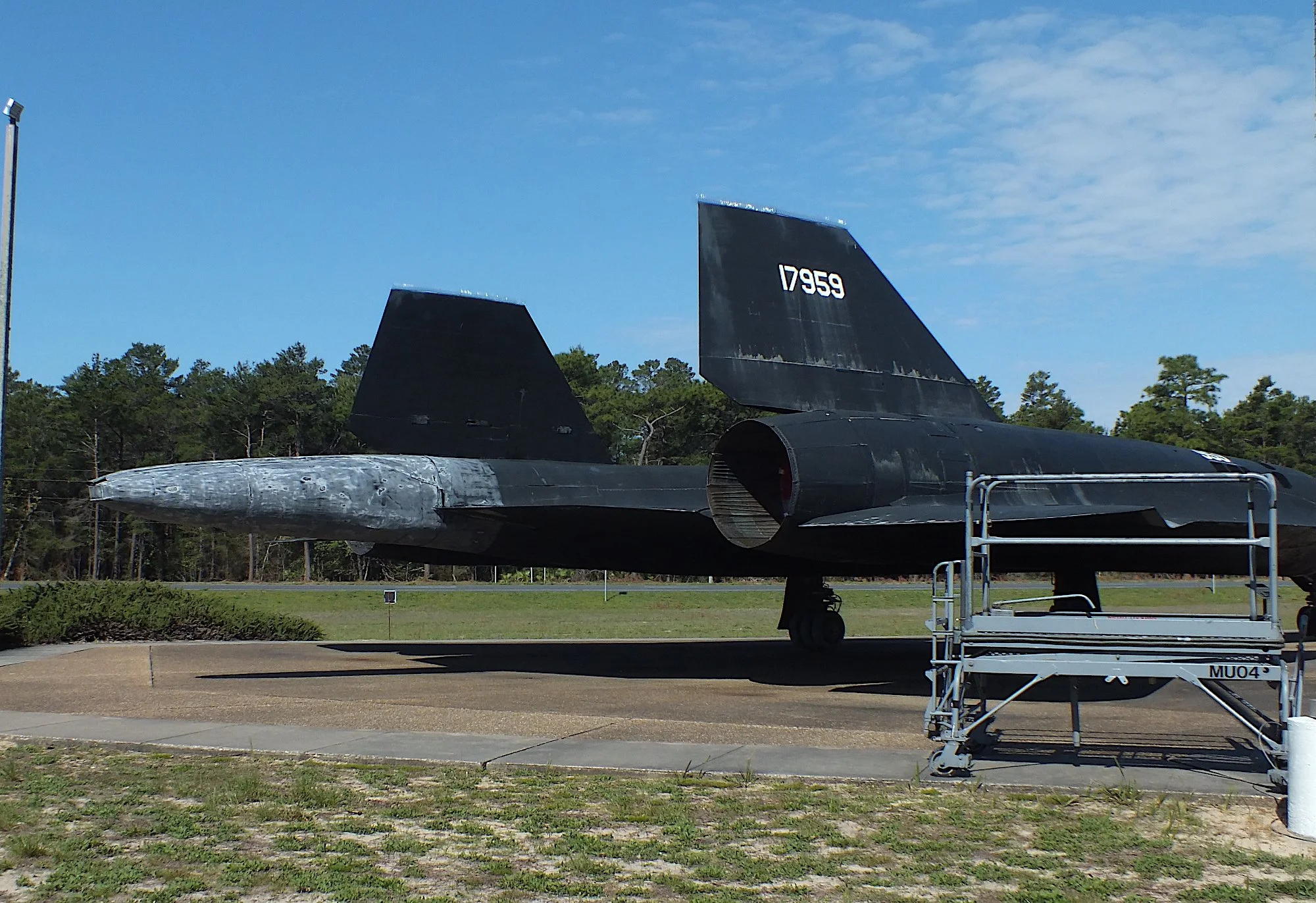
Top: Lockheed SR-71A Blackbird “Big Tail” - Serial Number 61-7959 - on display at the USAF Armament Museum at Eglin Air Force Base.
Above: A close up of the articulated tail cone extension. The idea was to fill this extra space with various cameras and/or defensive electronic gear. Both Photos: A.A.S.
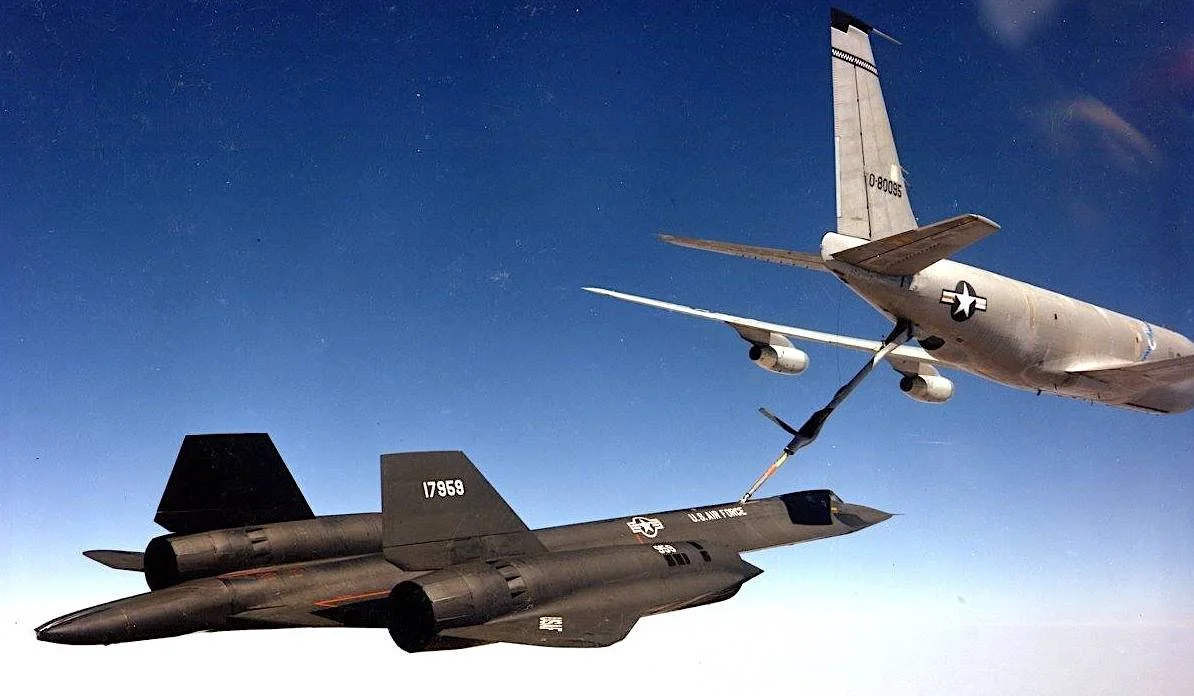
Blackbird “959” being refueled by a Boeing KC-135Q Stratotanker - Serial Number 58-95. The “Q” model KC-135 was a modified KC-135A with special fuel tanks to carry the unique JP-7 jet fuel required by the SR-71’s Pratt & Whitney J58 engines. Photo: U.S. Air Force
Preservation
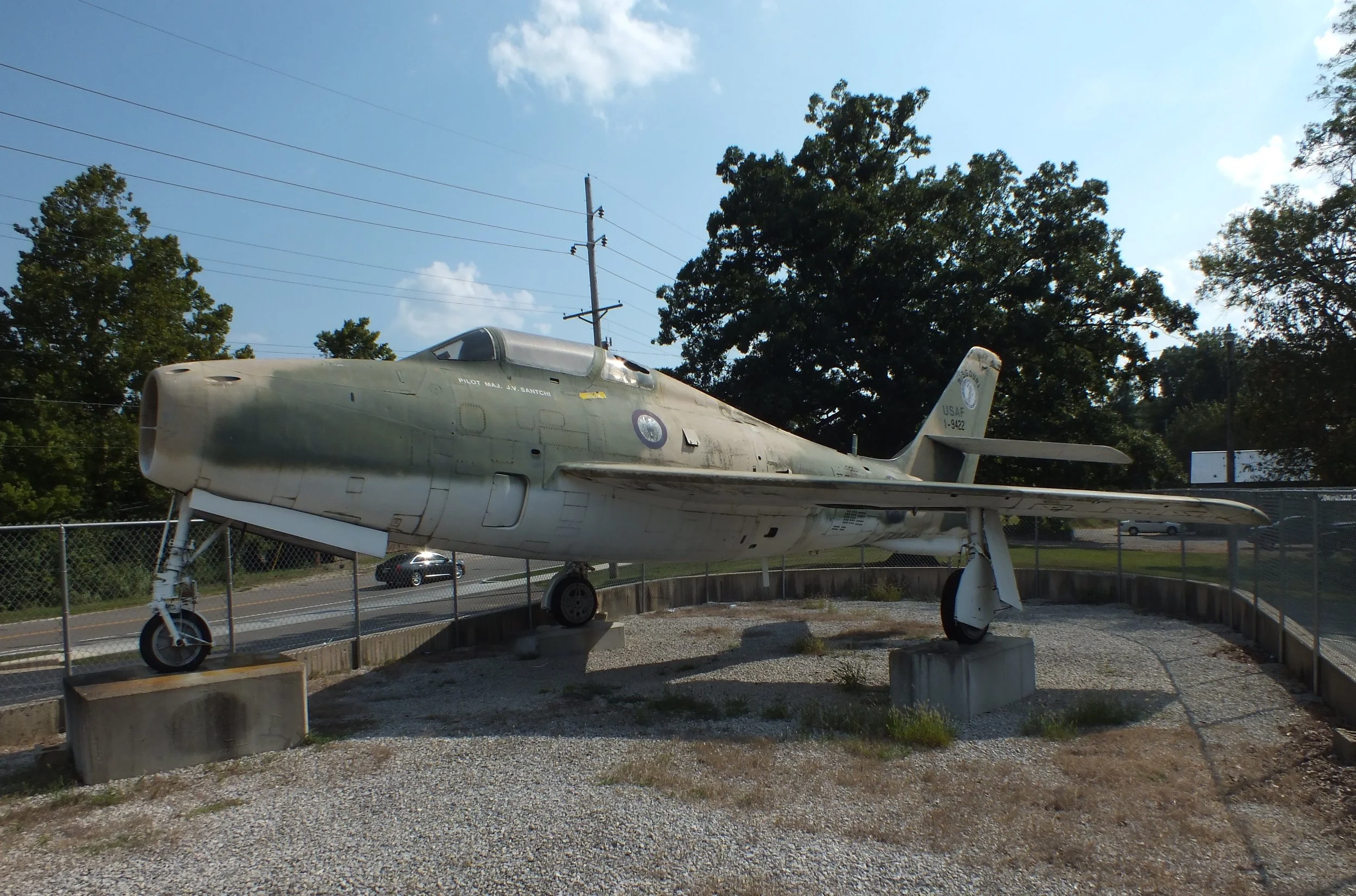
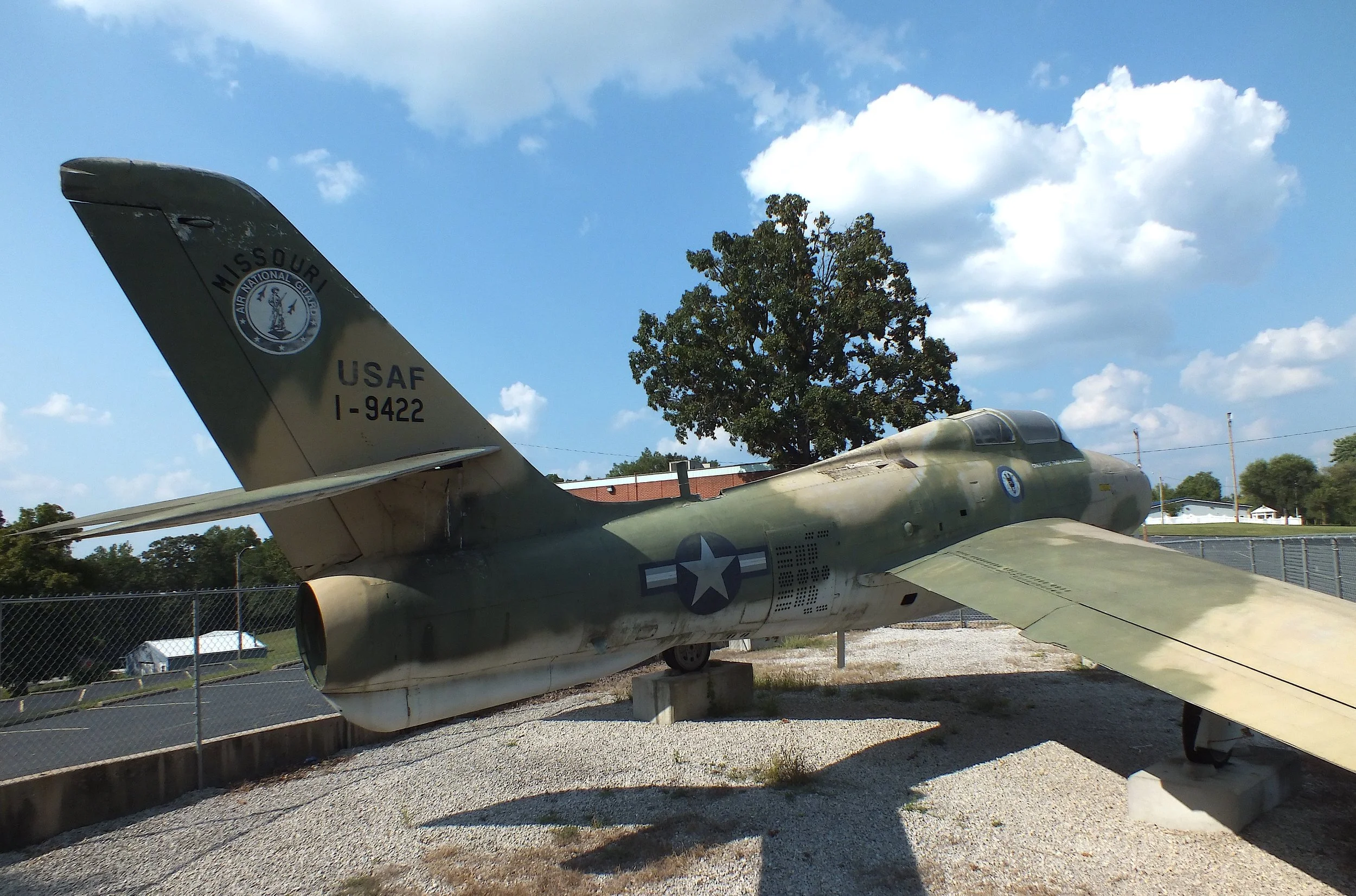
Republic F-84F Thunderstreak, Serial Number 51-9422
American Legion Post 253
Festus, Missouri
Mounted on pylons just outside the American Legion Post, this Republic F-84F Thunderstreak is dedicated in the name of Major Julius V. Santschi (1923-2005), a local Festus, Missouri veteran. As a young man, Santschi joined the U.S. Army Air Corps during World War Two, flying missions in both Europe and in the Pacific, and receiving four Air Medals and two Presidential Unit Citations. After the War, he worked as a mechanical engineer, while also completing a career in the Missouri Air National Guard.
These photos were taken in 2015.
This article originally appeared in the 2nd Quarter digital edition of LOGBOOK magazine.
There are no 611s in HS-7
by
Dave Powers
My old Navy fleet squadron was the World Famous Helicopter AntiSubmarine Squadron Seven (HS-7), official name the
”Shamrocks”, call sign the “Dusty Dogs.” We flew the mighty Sikorsky SH-3H Sea King. At the time all aircraft on an aircraft
carrier were assigned side numbers (modex numbers) denoting their squadron and mission. These numbers were the same
throughout the fleet, regardless of individual squadron or ship. HS squadrons were all given side numbers starting with the
numerals 61. Since an average HS squadron had six aircraft, that would mean the numbering sequence would start with 610
and go through 615.
Now talk about superstitious. When I first checked into HS-7 back in the early 1980s they had just had an accident. The aircraft
was lost but the crew was Okay. The aircraft had the side number 611. About two years into my tour, in May 1986, we had another
accident, a ditching off the coast of Puerto Rico. Again, the aircraft was lost but the crew was fine. And again, the aircraft’s side
number was 611. When we got a replacement aircraft it was numbered 616. The side number 611 was just too unlucky.
You may think that the U.S.Navy is above superstition, but have you ever wondered why there is no HS-13?
Continue reading below.
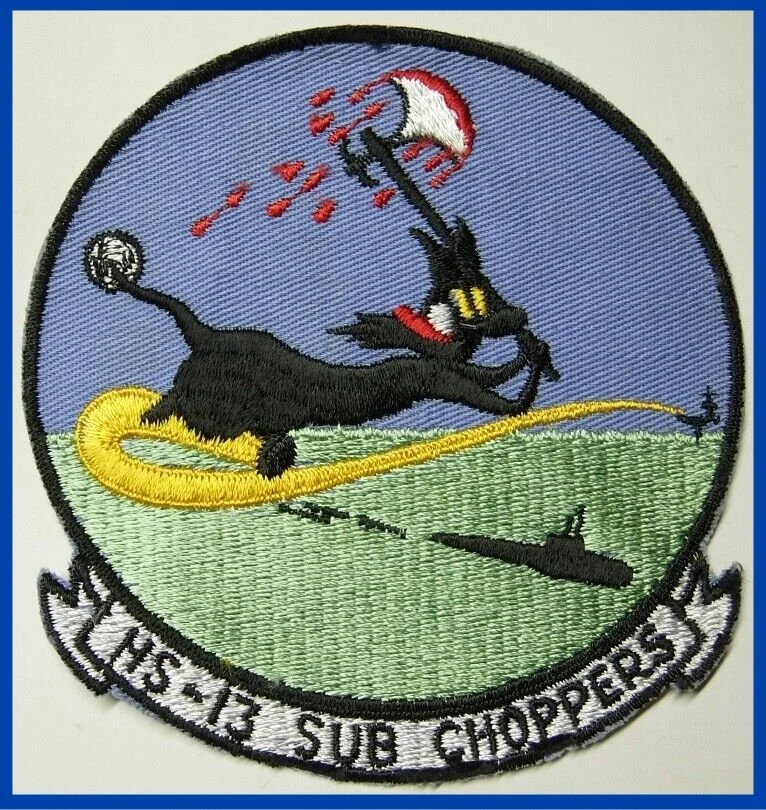
The Sub Choppers of HS-13
For as long as HS squadrons have been in existence, the US Navy has based the even numbered squadrons on the West Coast
and the odd numbered squadrons on the East Coast. Thus HS-1, HS-3, HS-5, HS-7, HS-9, HS-11, HS-15 and HS-17 have always been East Coast squadrons. Many believe that there never was an
HS-13, which had something to do with the unlucky connotations of the number 13. Despite the harbingers of doom associated with the number, there was an HS-13 in existence in the early
1960s, if only for a few days over one year.
Helicopter AntiSubmarine Squadron THIRTEEN (HS-13) was established on 25 September 1961, as part of Anti-Submarine Carrier Air Group SIXTY-TWO (CVSG-62), which itself was stood
up on the same day. Shore based at Naval Air Station (NAS) Quonset Point, R.I., HS-13 was authorized a strength of up to 16 Sikorsky HSS-1N Seabats. The N model Seabat was optimized for
night and all weather operations. Also assigned to CVSG-62 was fixed-wing Anti-Submarine Squadrons TWENTY (VS-20) and FORTY-TWO (VS-42), both flying the Grumman S2F-1 Tracker.
Although HS-13 was authorized up to 16 HSS-1Ns, the squadron rarely had that many on strength. In September 1961, only 2 airframes were listed on hand, with four more arriving the next
month. At the close of 1961, HS-13 had 11 Seabats. Finally, in June 1962, the squadron had a full compliment of 16 Seabats. The exact date of the announcement that CVSG-62, and all its
squadrons, would be disestablished is not certain. However, the end was certainly clear because in July 1962, HS-13 had only one airframe still on the books. Indeed, VS-42 was completely
gone. By August 1962, the final HSS-1N was gone and HS-13 ceased to be listed as a viable squadron in September 1962. CVSG-62, along with HS-13, was officially disestablished on 1 October 1962.
There is one reference that questions whether or not HS-13 even existed, positing that the squadron was simply formed on paper. However, the January 1962 issue of the Navy’s Naval
Aeronautical Organization (OPNAV 05400) states that HS-13 was on board NAS Quonset Point, and had 49 officers and 262 enlisted personnel. Throughout its short existence, HS-13, nor
CVSG-62 for that matter, never deployed to sea.
HS-13 was nicknamed the Sub Choppers. The squadron patch showed a cartoon cat, equipped with a tail rotor and flying off an aircraft carrier. The cat is carrying a bloody axe and is poised to
take a swing at a submarine.
Some squadrons are disestablished on one day, only to be reestablished later in the future. This never happened to HS-13. Perhaps the number 13 was indeed, unlucky.
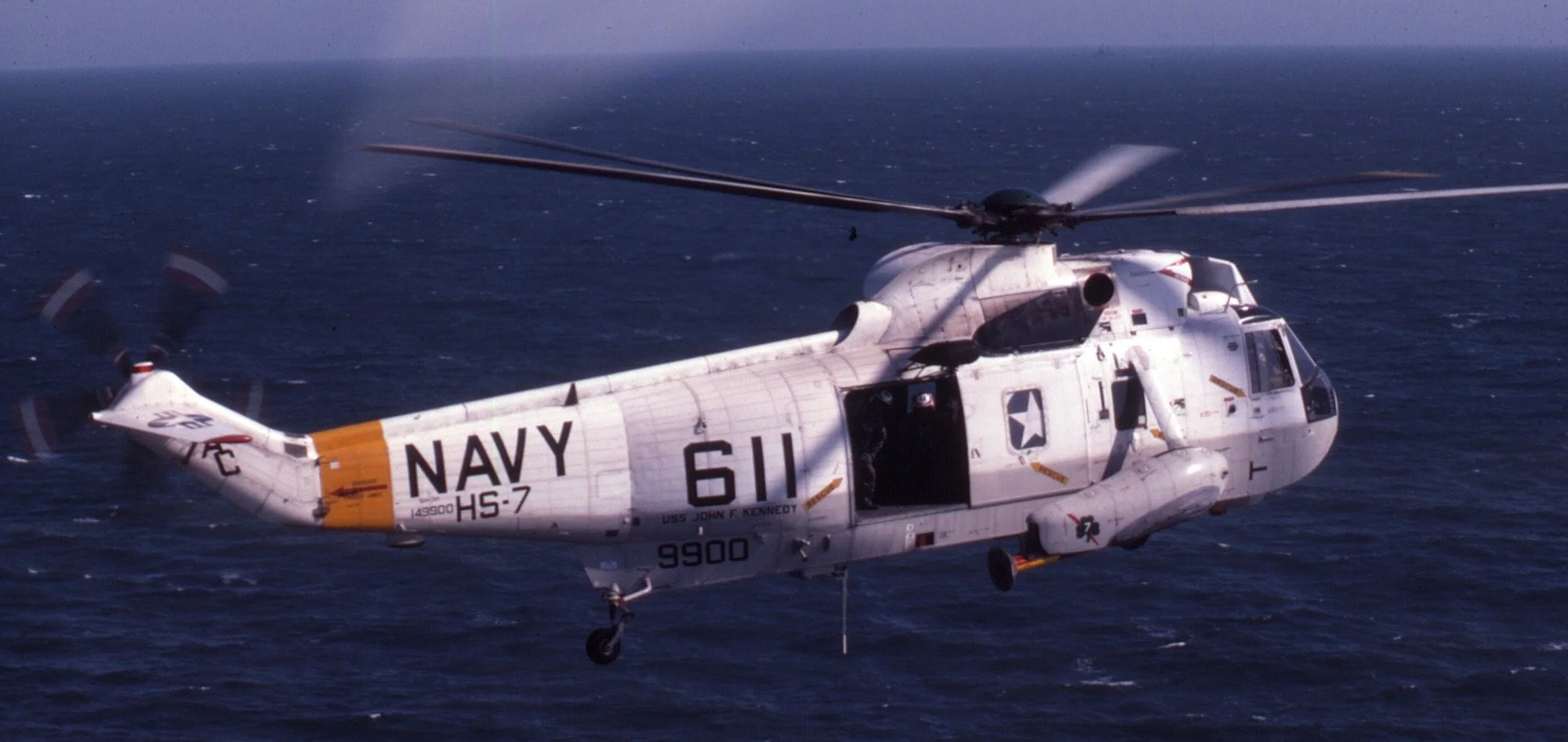
This Sikorsky SH-3H Sea King - BuNo 149900 - today rests in a couple of thousand feet of water off the coast of Puerto Rico. Photo: A.A.S.
Coco Solo Ferry Flight
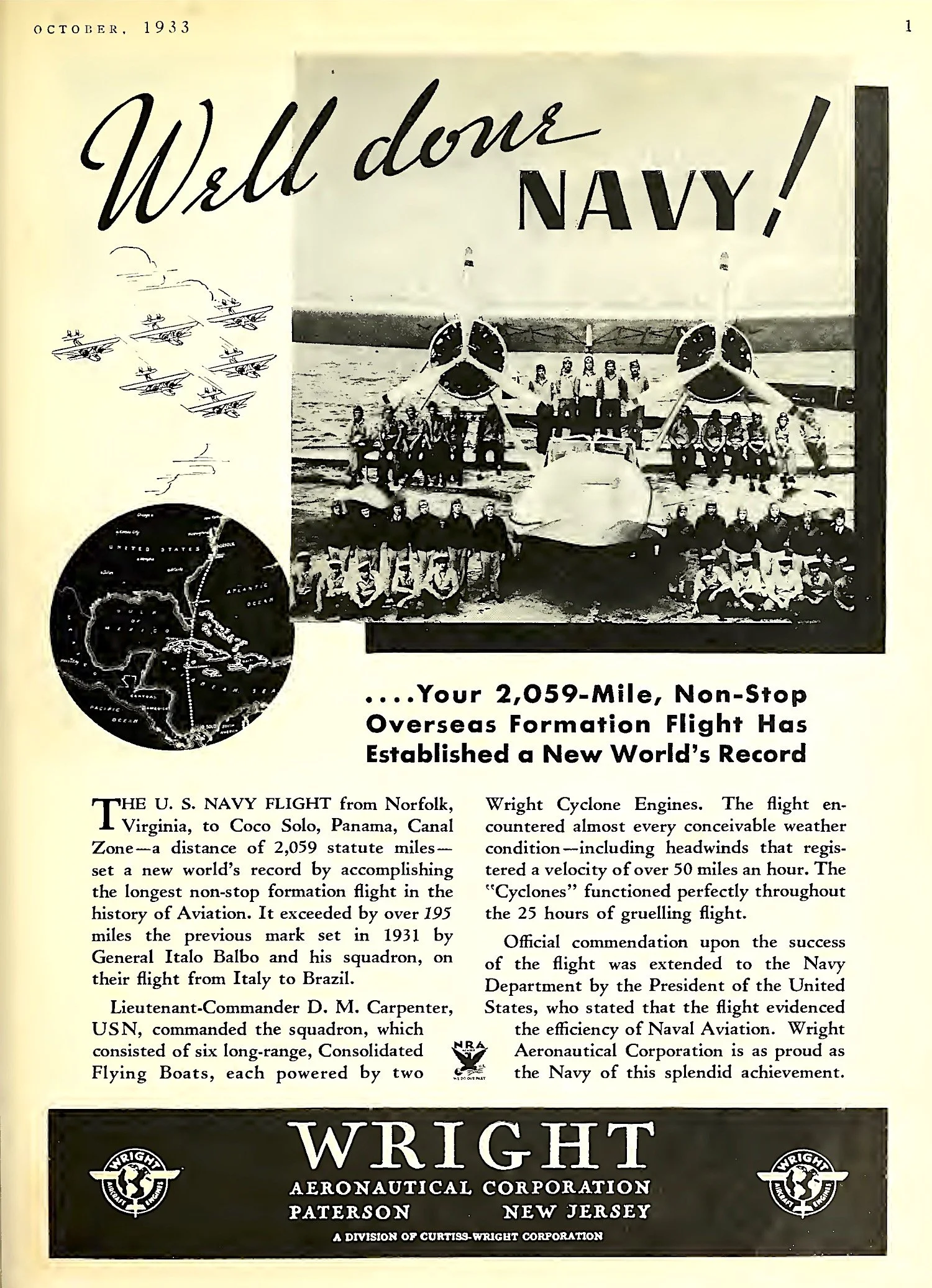
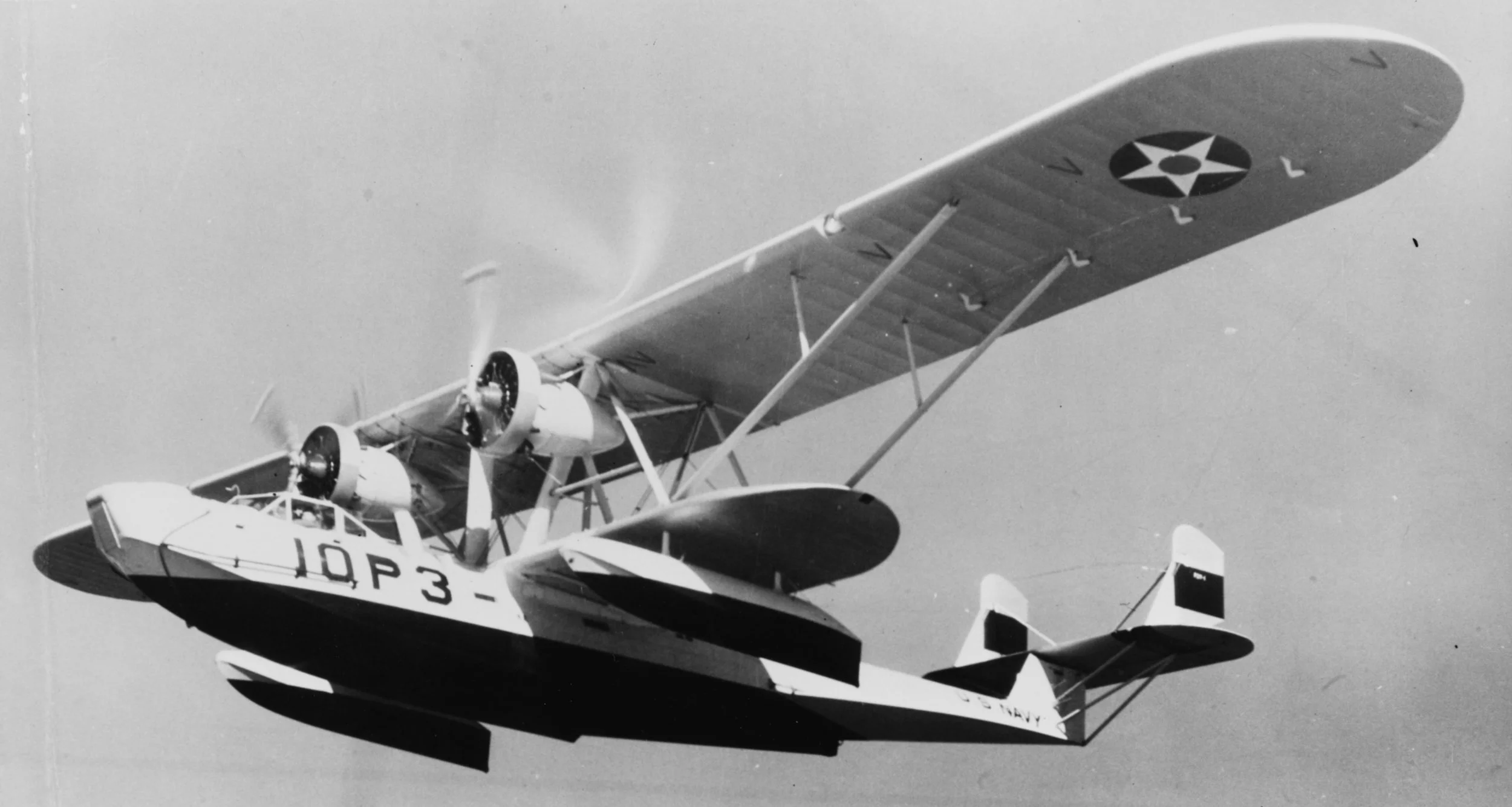
In the late afternoon of 7 September 1933, six Consolidated P2Y-1 flying boats, assigned the Patrol Squadron FIVE FOX (VP-5F), and under the command of Lieutenant Commander D. M. Carpenter, departed from Naval Air Station Norfolk, Virginia. Their destination - some 2,059 statute miles away - was the Fleet Air Base at Coco Solo, Panama Canal Zone. When they landed they had bested the then current formation distance record, set in January 1931, by the Italian Flight Squadron led by General Italo Balbo, by 195 miles.
References: Aviation magazine - October 1933, and Aero Digest - October 1933.
Right: A file photo of a Consolidated P2Y-1 flying boat, this example assigned to Patrol Squadron TEN (VP-10). Photo: NHHC
Left: An advertisement that appeared in Aero Digest magazine, from the Wright Aeronautical Corp., celebrating the flight. Image: A.A.S.
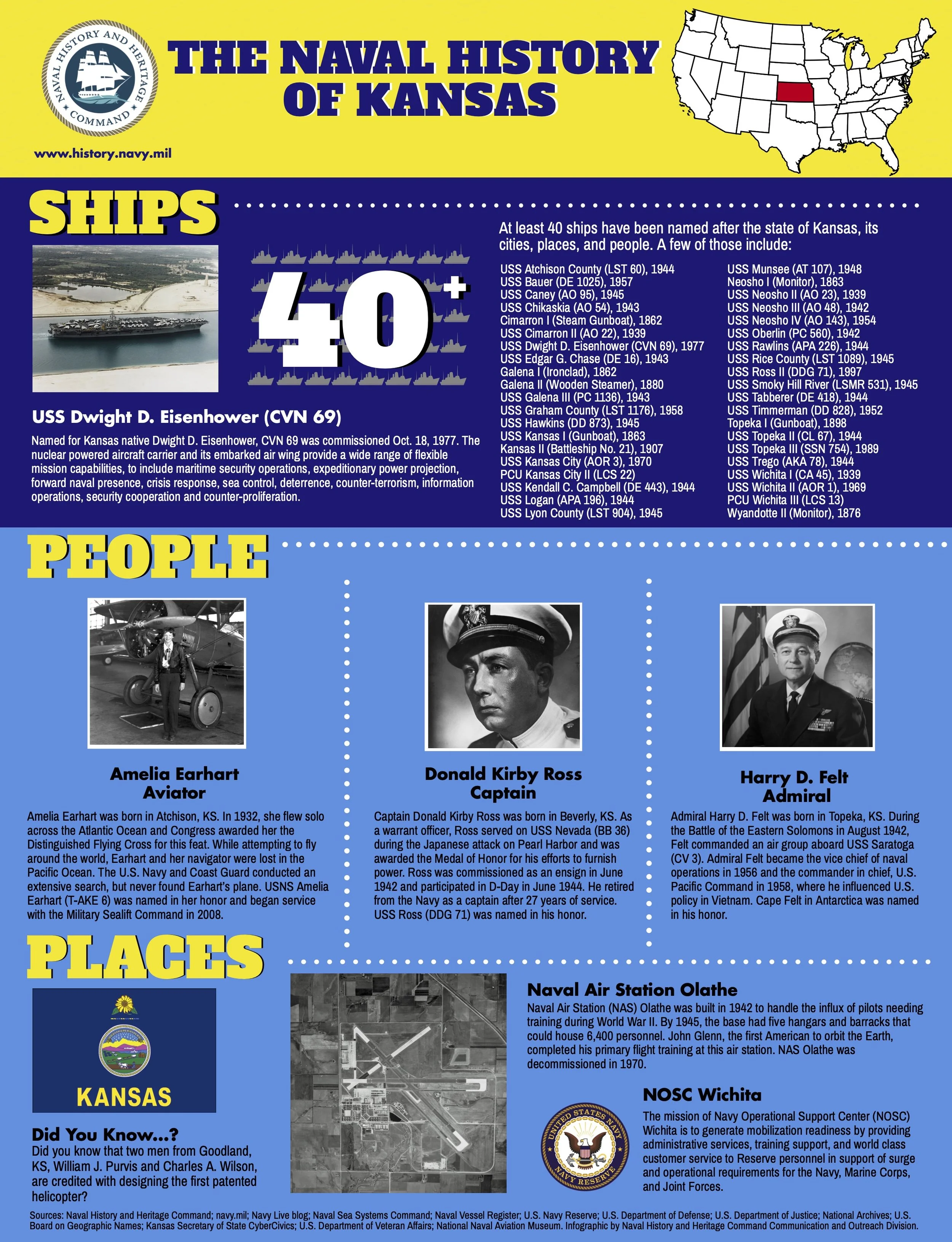
Graphic Courtesy of the Naval History and Heritage Command
Stop by at:
Naval History and Heritage Command
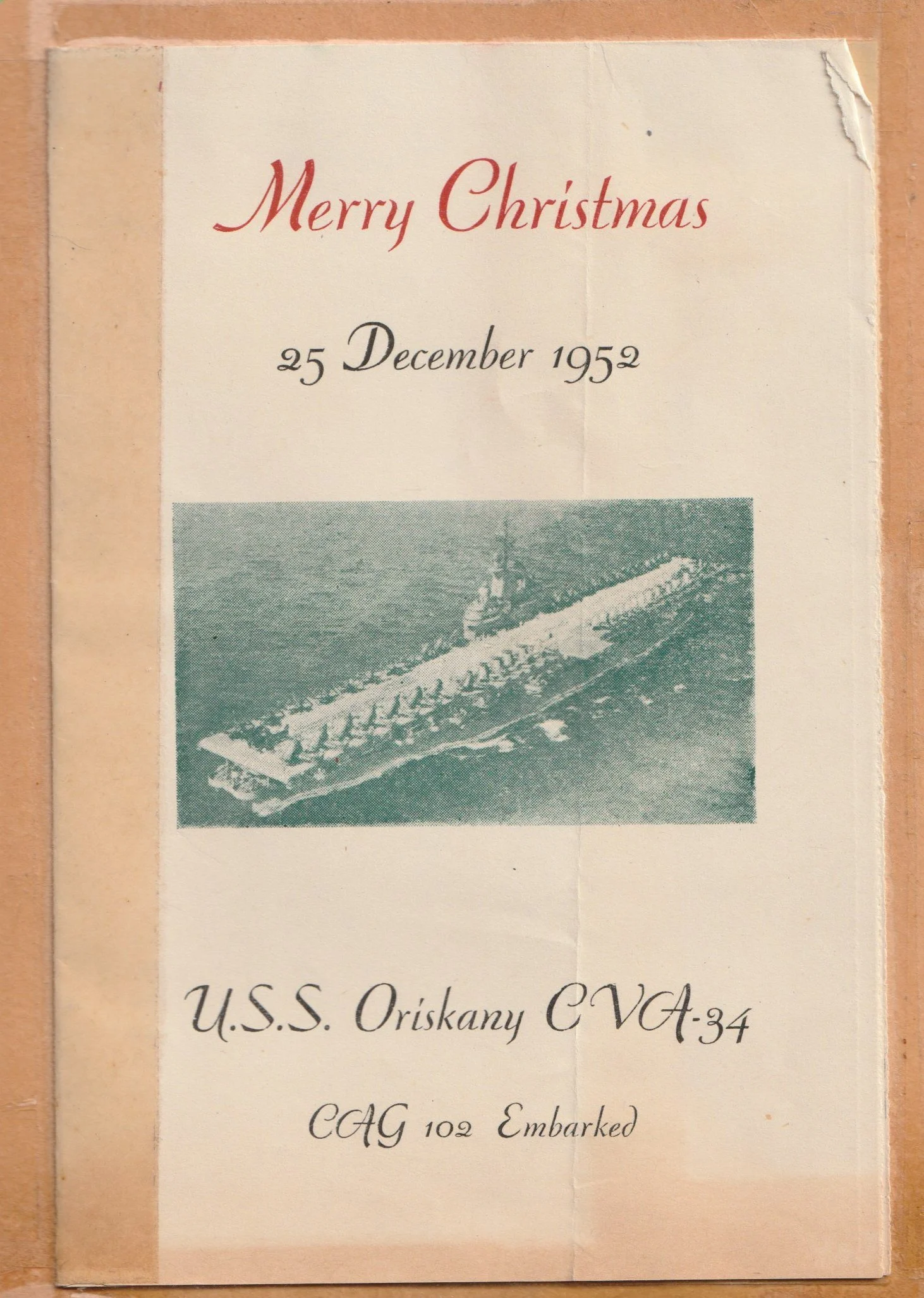
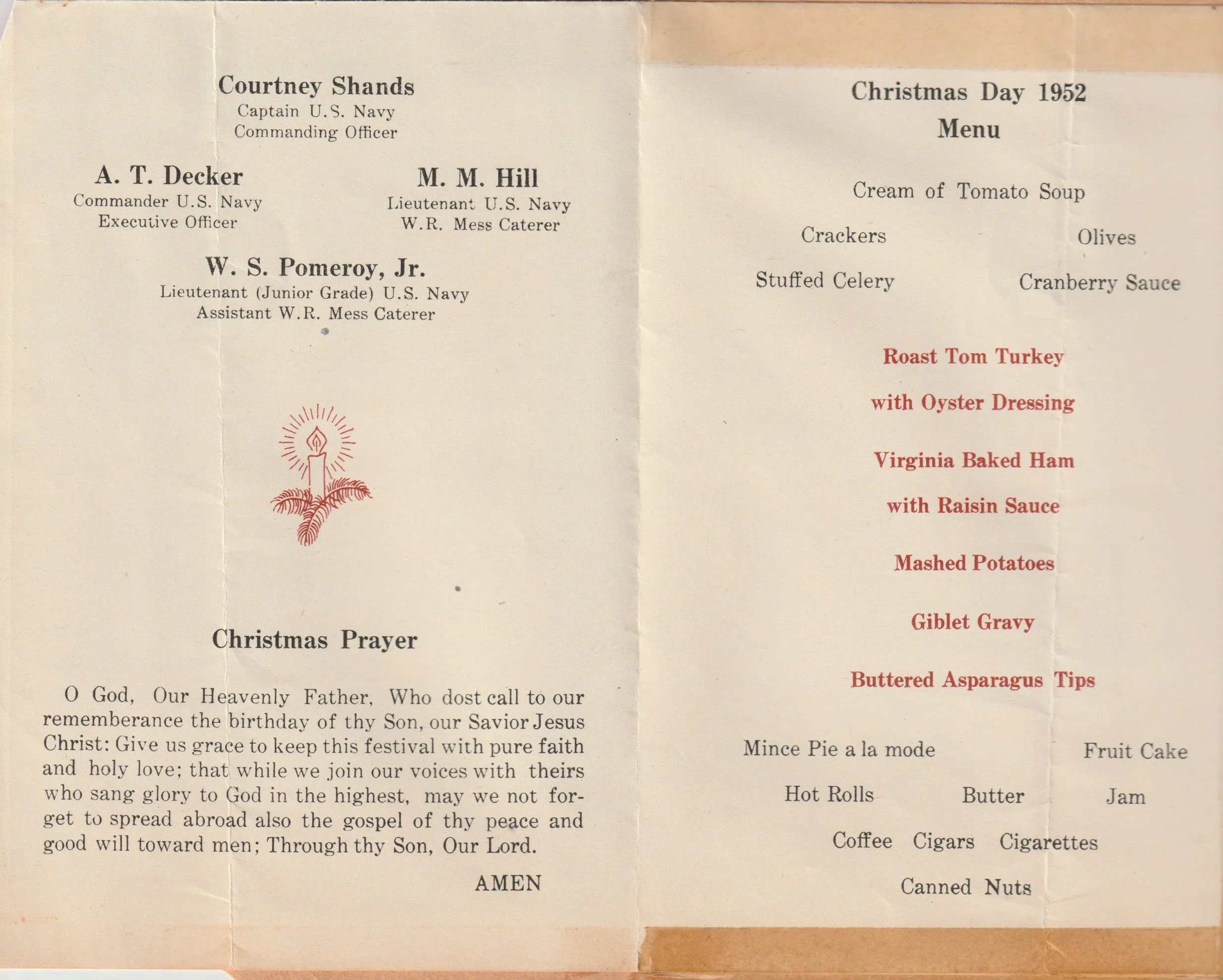
On 25 December 1952, the USS Oriskany, with Carrier Air Group 102 embarked, had just completed its second - of five - Korean War line periods, and was en route to Yokosuka, Japan.
From the Commander James L Brown, Jr. Collection (Jim was aboard with VC-3, Det. George, flying the F4U-5N Corsair night fighter)
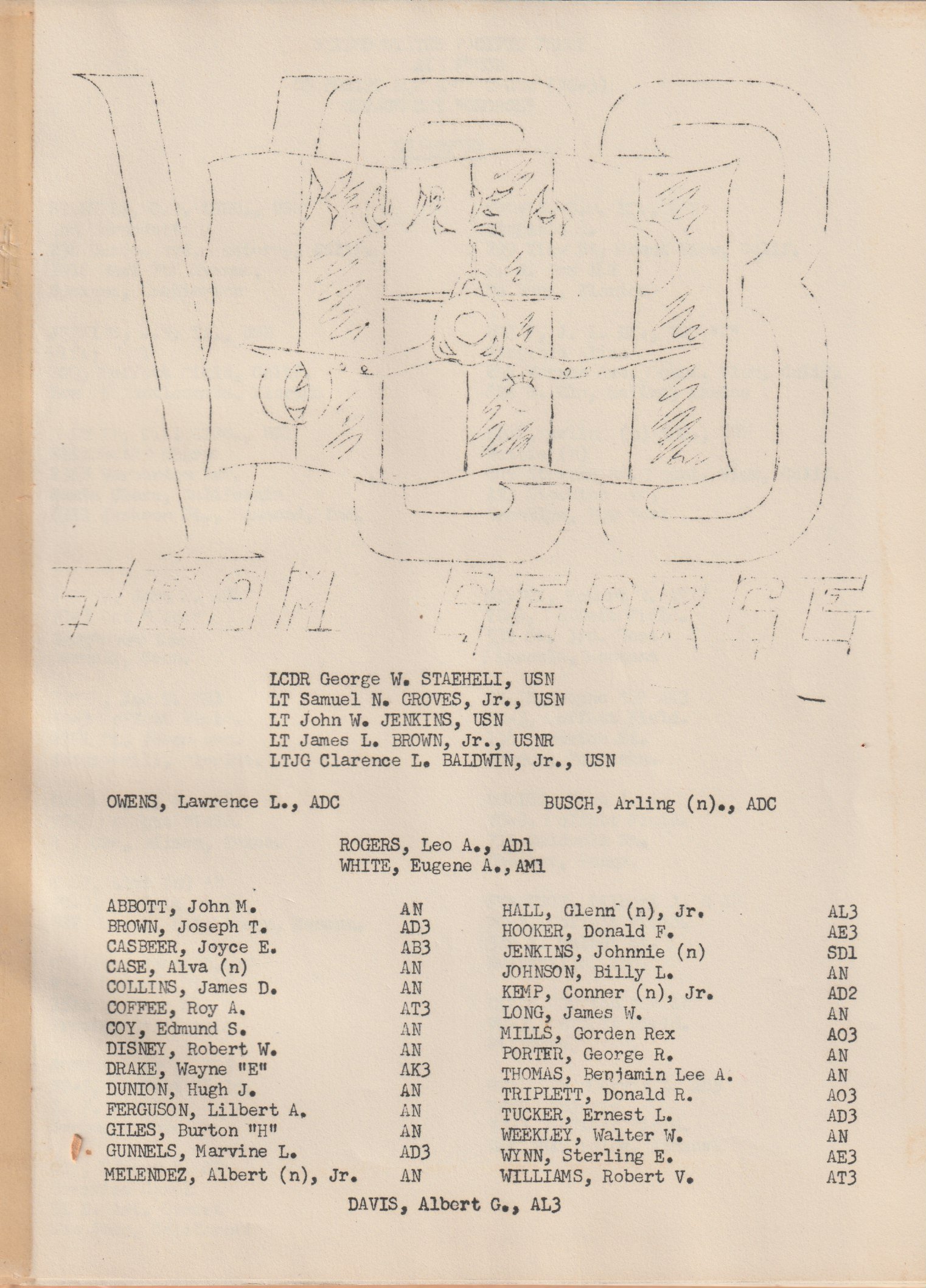
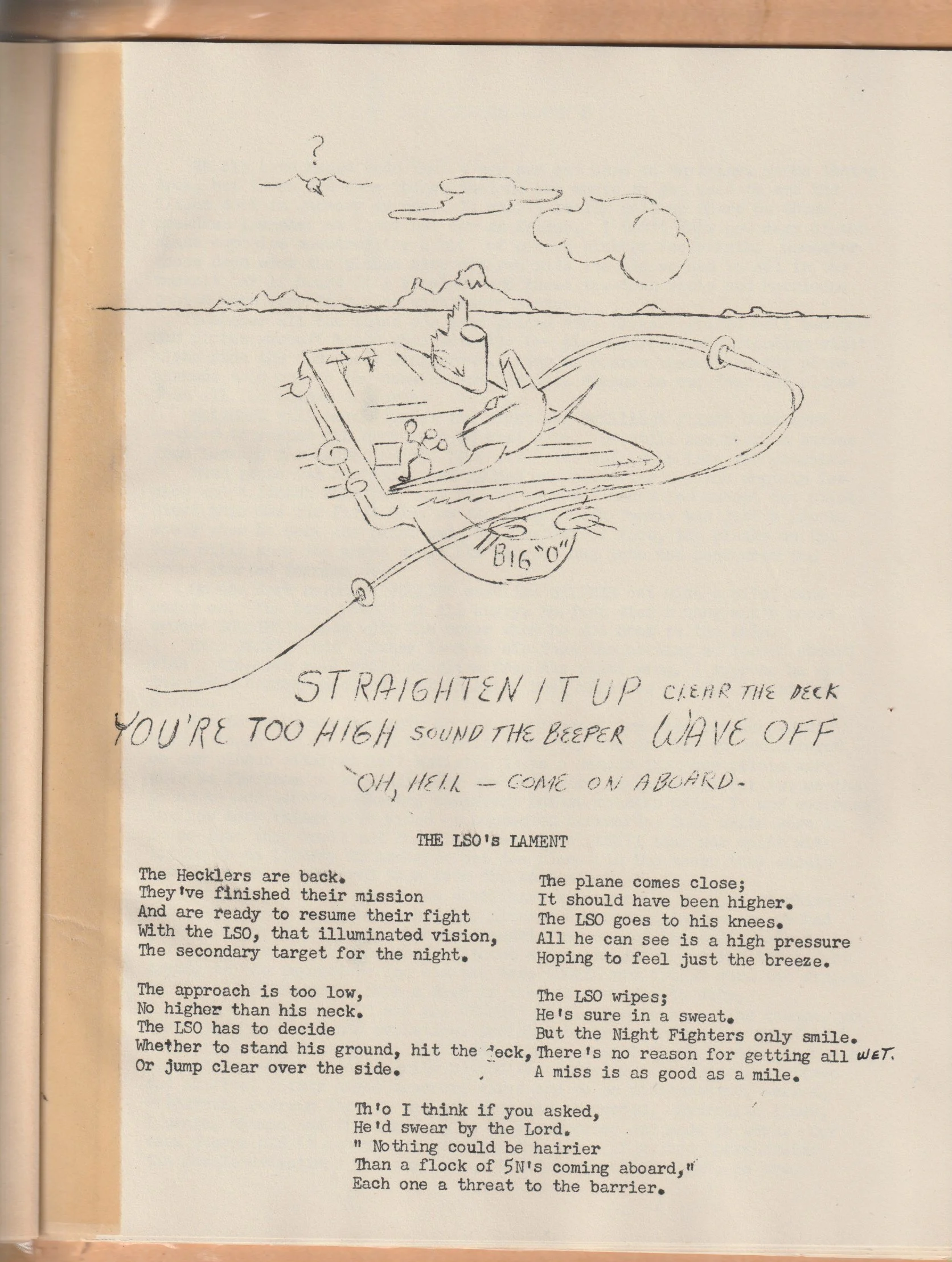
From an informal history of VC-3, Team George’s Korean War cruise aboard the USS Oriskany (November 1953 to May 1953) - A poem about the trials of the Landing Signal Officer (LSO) bringing aboard the Team’s the Vought F4U-5N Corsairs.
From the Commander James L Brown, Jr. Collection (Jim was aboard with VC-3, Team George, flying the F4U-5N Corsair night fighter as a night heckler)
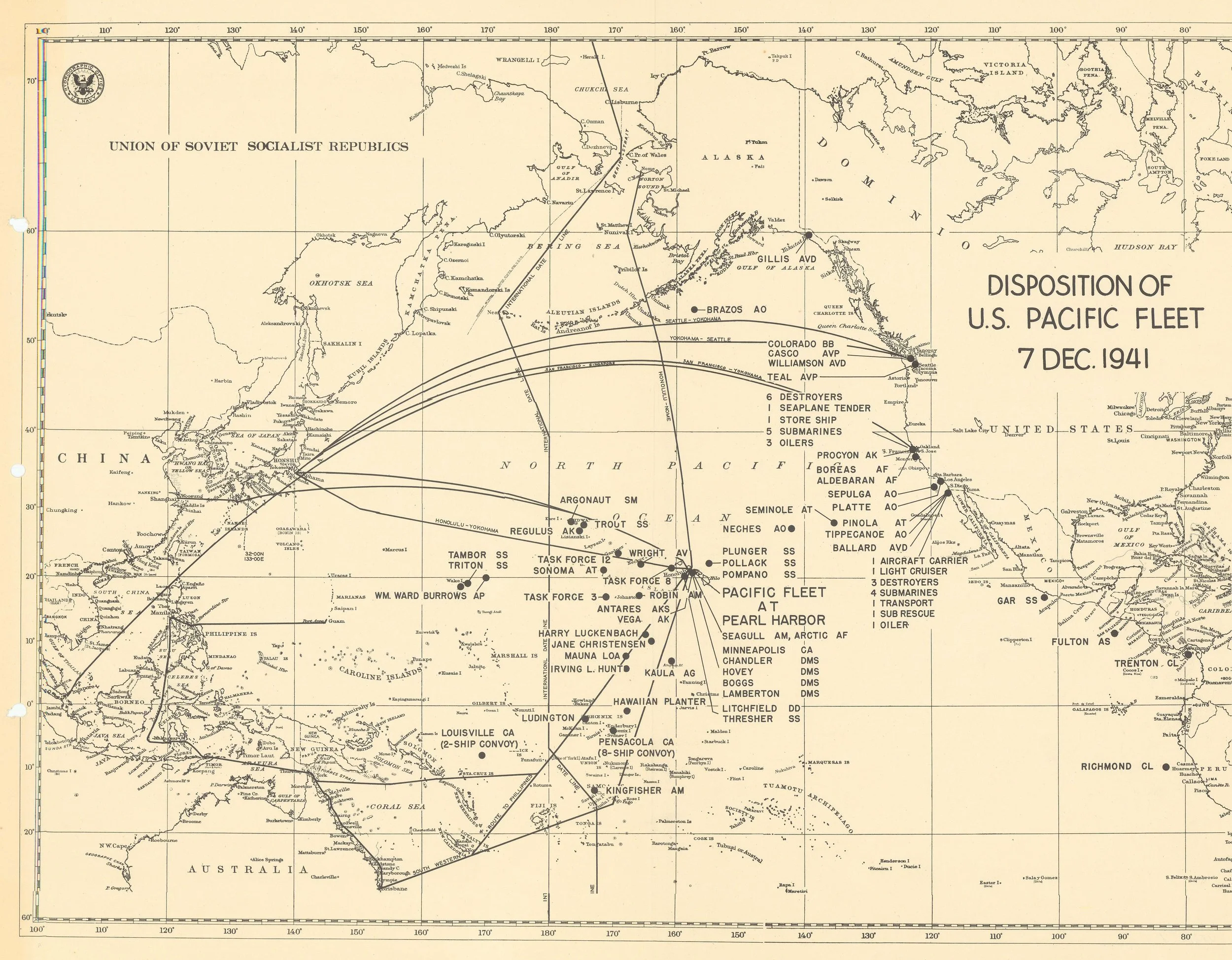
Disposition of the U.S. Pacific Fleet - 7 December 1941
The above map is an excerpt from a report promulgated by the U.S. Navy shortly after the Japanese attack on Pearl Harbor. It shows the location of all the fleet vessels in the Pacific Ocean.
For a complete list of the vessels, as well as a breakdown of each of the Task Forces, please click HERE.
Source: U.S. Navy via the NARA
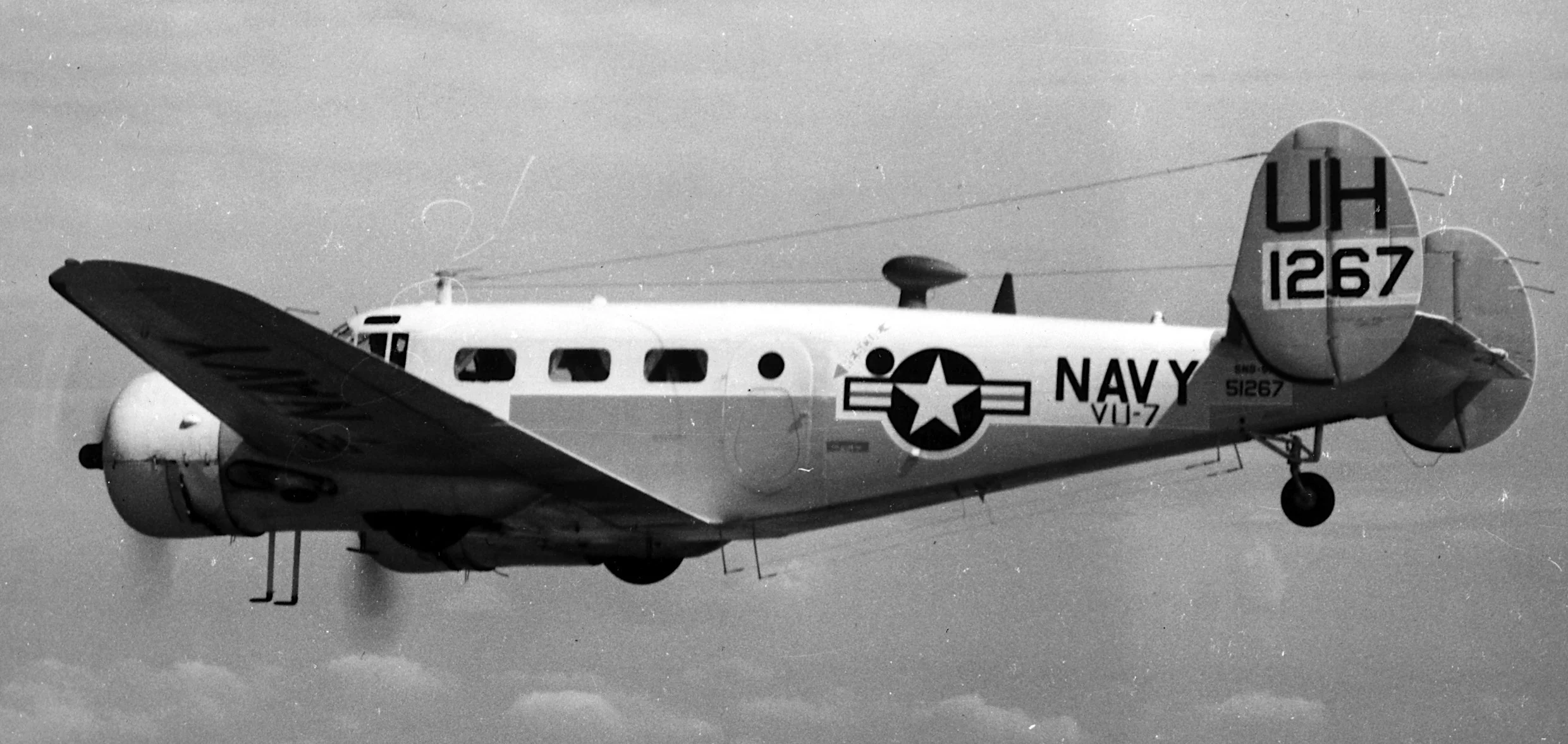
SNB or SOB?
When Naval Air Station Patuxent was in its infancy and the tower radio was not yet in operation, the skipper of one of the units based there was cleared by green light for flight south in an SNB [a twin-engined Beech]. Five minutes later the tower operator spotted what he thought was the same plane returning and cleared it to land. In reality it was an Army Air Forces AT-11 [the Air Forces’ version of the SNB].
The tower man notified Operations that the Captain had returned, starting a chain reaction which resulted in a telephone call to the skipper's wife, who hurriedly drove the five miles to the station from home. By that time her husband was well south of Norfolk. After diligent search without success she was informed of the true state of affairs. The good lady, unfamiliar with Navy plane designations, frustratedly declared, "But he must be here. The Duty Officer phoned me that the SOB had returned.”
Naval Aviation News - May, 1949
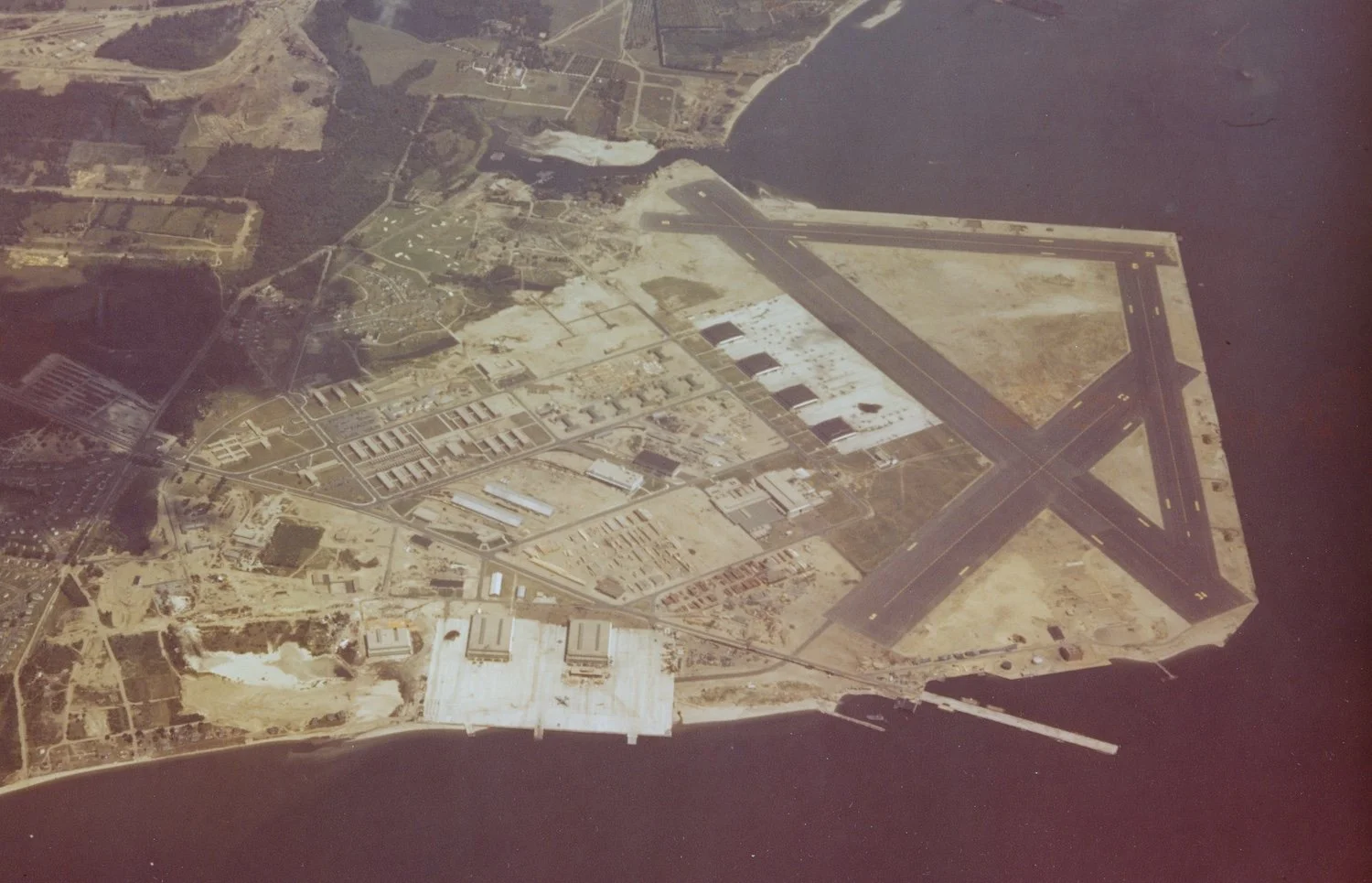
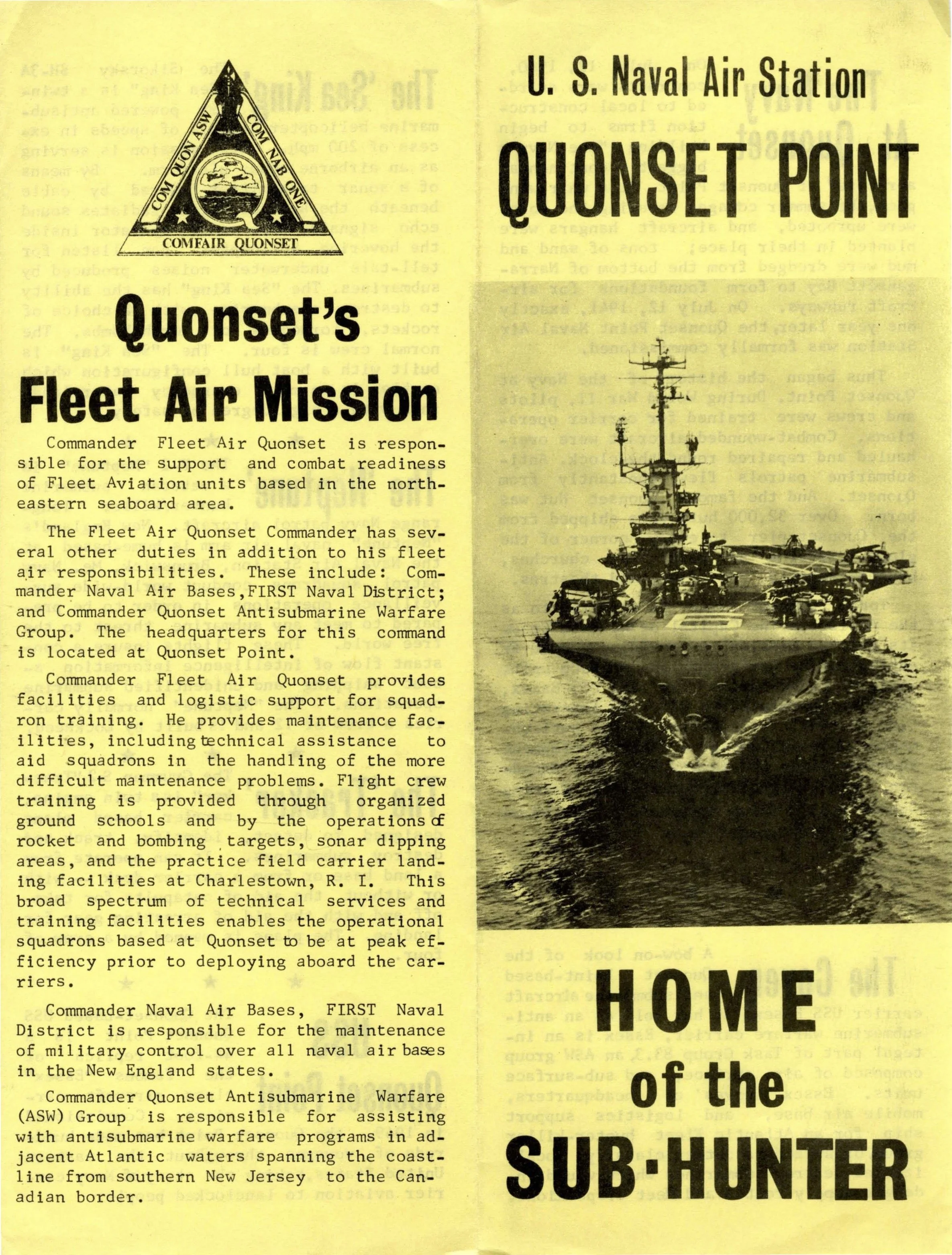
U. S. Naval Air Station Quonset Point, Rhode Island
Quonset’s Fleet Air Mission - circa 1960
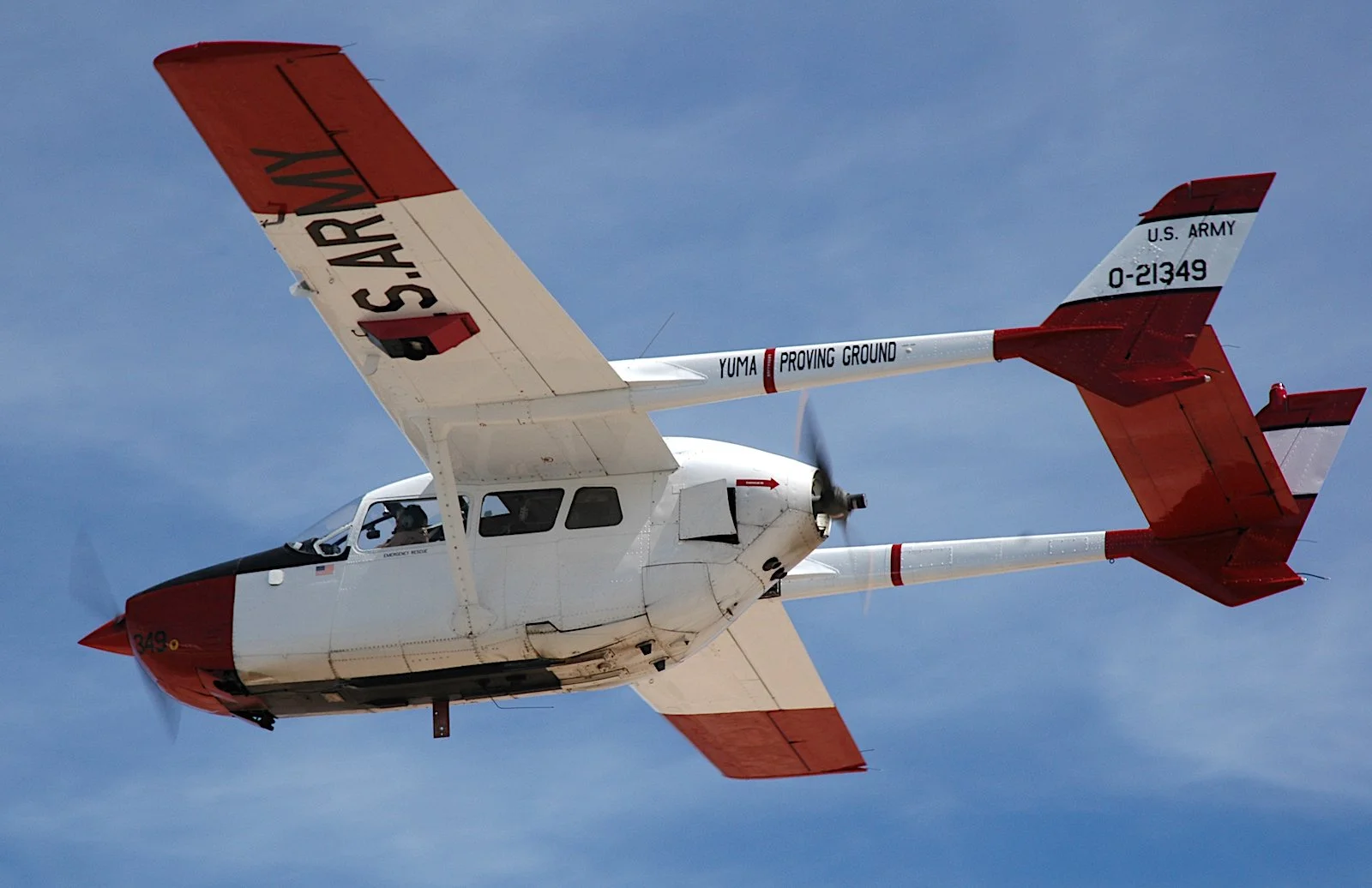
A couple of old veterans, one shot five times in combat, are the last of their kind in America’s
military and they are still on duty at Yuma Proving Ground. These are the low and slow
Cessna 0-2A aircraft flown in and out of Laguna Army Airfield in support of a variety of test
missions. They are the last two O-2A’s in the Department of Defense inventory and, the pilots
here who fly them, like them. The ‘O’ designation is for observation and the ‘2’ signifies these
aircraft were the second aircraft designated for that purpose, replacing the famed but aging
O-1 Bird dog aircraft. The ‘A’ identifies them as the first model of the airplane. They are called
the Oscar Deuce and are known for their unique in-line engine design where one engine is
mounted in the traditional front position but the other is behind the cabin.
“It’s a fun little aircraft, it really is,” says pilot Mac Rowell. “It's reliable. You’re not going to fly to
the moon, but it’s a great aircraft.”
Rowell, who has since changed duty stations and is flying out of Fort Bragg, N.C., remembers
the O-2 from Vietnam, where he was an infantryman with the 199th Infantry Brigade in 1968-69.
“If we had enemy contact and needed air support, the first thing that showed up overhead was
the O-2. We’d give him an approximate position, and then he would come in and find the
enemy … marking the position with a white phosphorous rocket. Then the jets would come down
and make their bombing runs on those targets. Rowell, who was twice wounded and is a former
Army Ranger, says although they were slowly going about their business of finding the enemy,
he never saw an O-2 shot down. But one he flies today must have come close. Aircraft Number
67-21414 bears the scares of five bullet holes, with one just below the front cockpit windshield
where the pilot sits. The “67” is the year model. These two aircraft both entered into the Air Force system in 1969. The “21” is an Army standardized number for this particular airframe.
Aircraft Number 67-21349 was never in Vietnam, but the Aircraft Historical Logbook kept by Freddie Munoz at the airfield shows this 0-2 has been around. It served in California, Texas and Korea before finding its way in 1991 to Fort Huachuca in southeast Arizona, says Munoz, production control supervisor for Seair Transport Services, Inc., which provides contract aircraft maintenance at Laguna. Part of Munoz’s job is to keep the O-2’s up in the air and on the job. His records show both aircraft were at Fort Huachuca with the Electronic Proving Ground in 1997, when that organization lost its aviation assets. On 17 November that year, 414 and 349 landed at Laguna and reported for work.
Rowell, along with pilots Ralph Arnold and Art Booth, cruise the skies in the Oscar Deuce supporting the proving ground’s testing activities, including unmanned aerial vehicle (UAV) testing that is critical to YPG’s support of Operation Enduring Freedom in southwest Asia. At times, they are also used to conduct range reconnaissance before live firing of artillery and during long range communication testing. And, they make excellent communication relay platforms during testing over far distances, Rowell says. In Vietnam, the O-2 fired its targeting rockets from four “hard points” under the wings. Today, those points can be used to attach sensors and instrumentation for gathering test data. The aircraft cruises at about 140 knots airspeed and has a surface ceiling of 21,000 feet. There is no on-board oxygen and it takes over half an hour for the 210-horsepower engines to reach 18,000 feet.
“The highest I’ve ever been (in the O-2) is 17,900 feet and I had an oxygen bottle with me,” Rowell recalls. It took him 35 minutes to reach that altitude.
One reason for the lack of power is the O-2 has recipirocal engines, not the more powerful turbines. The recipical engines use aviation gas, not jet fuel, and that makes it very cost effective to testers.
“It’s a great aircraft for the mission it performs,” Rowell says, adding, “The two in-line engines are really great because some of the missions we fly are low to the ground in limited visibility.”
Because the engines are in a line and not on separate wings, if one goes out, there is no yaw or sudden uncontrollable movement left or right so the pilot can maintain rudder control and current heading, says Arnold, who will shortly become YPG’s second qualified instructor pilot on the 0-2. Rowell is currently the only instructor pilot here on the aircraft.
“It’s actually safer than the side-by-side planes,” Arnold says. “But, the in-line design never caught on, maybe because it was such a radical redesign.”
But they do generate some interest among pilots, Rowell says. “We have all these pilots that fly in and out of here. When they see these aircraft they come over to get a close look because they don’t know what they are. They’ve never seen this before.”
“It’s unique, flying an aircraft that has such a colorful history, it really is,” Rowell says,
Those pilots had better look now, because, like old Soldiers, these two are slated to fade away sometime in the future when the proving ground gets new Cessna Caravans, a single-engine turbine with updated avionics that can carry more cargo. Rowell says there is nothing on the schedule at this time for receiving the new aircraft. When they do retire, 414 and 349 will looking for what will probably be their final landing place.
This article originally appeared in the 2nd Quarter 2005 print issue of LOGBOOK magazine.
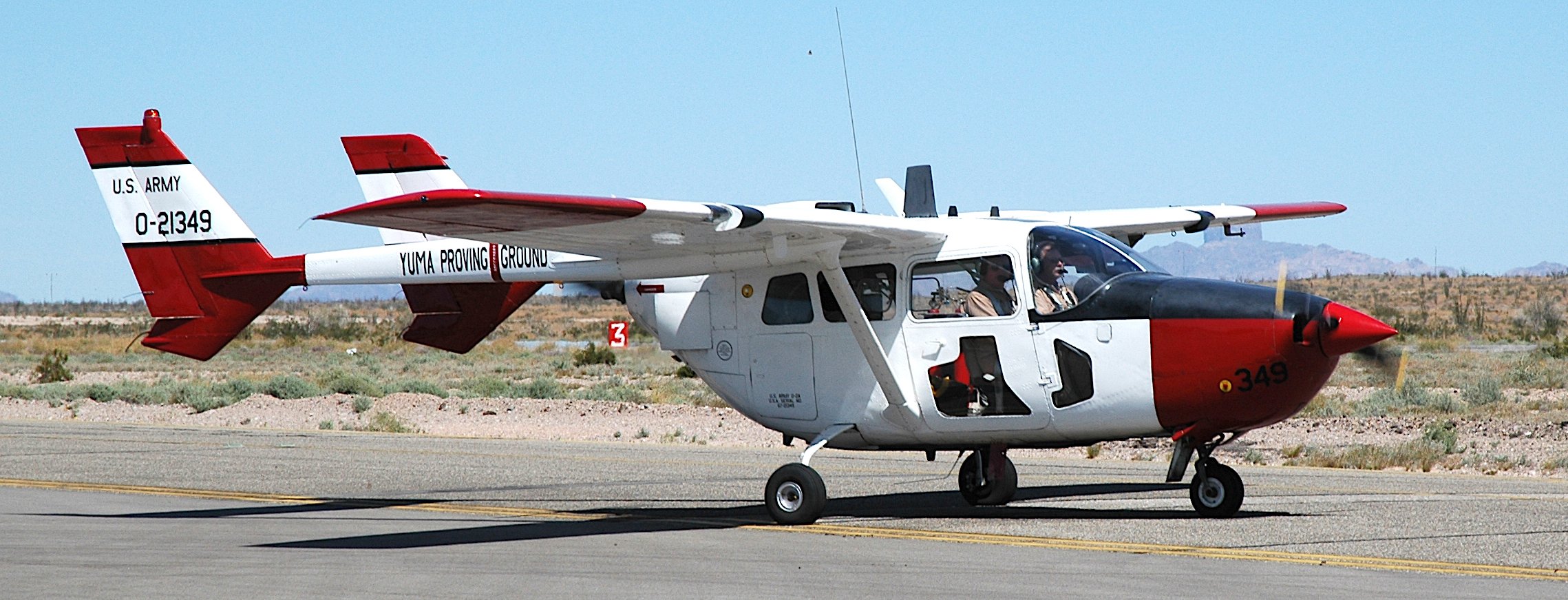
A Foggy Pilot Story
by
Bill Nash
In previous issue of LOGBOOK you had a couple of stories about cross-country flying, which reminded me of one I flew when I was 20 years old, before World
War Two, and flying every light aircraft I could get my hands on. On this particular flight I was flying a Piper Cub, from Atlantic City, where I lived, to Baltimore to
see a friend there, and back again to Atlantic City.
I overnighted in Baltimore, and the next day, on my return flight I was approaching the Boulevard Airport [Atlantic City Municipal Airport, also called Bader Field,
now closed] at Atlantic City, and found it was covered by a thick sea fog. From stuff sticking up through the fog I found the seawall bulkhead at the end of the
main runway, which was oriented 90-270 degrees. For its full length this runway was limited by water on each end. I was delighted to see the first 50 feet of
the runway sticking out of the fog, on the west end of the runway. Flying slowly, I approached the part of the runway I could see, plopped down on the gravel
surface, and rolled east. Holding the 90 degree heading I entered the fog while still rolling, kept that heading carefully, and eased to a stop.
I could not see more than a few feet in any direction, but this was my home airport and I knew it well. Moving slowly, I managed not to taxi off one side or the
other of the runway, and then found what I was looking for - the north/south runway. I turned right on this runway - also made of gravel - and managed to find the square white markers on the runway edge. I stuck to the west side of the runway until I found a small taxiway that paralleled the east/west runway. Now turning east I knew I would find a small taxiway that ran to the main ramp in front of the hangars. Very slowly, I found this taxiway and turned towards the main ramp, where the gravel becomes concrete. On the ramp, I turned south and slowed my taxi speed even more. Suddenly, I had to slam on the brakes as right in front of me an office window appeared. Fortunately, the prop did not hit the hangar, and I shut down the engine.
Immediately, I was surrounded by pilots and other observers, some of whom had been in the office I had almost struck. They were all jabbering at once, and stretching to look in the cockpit. When I climbed out they looked at me in wonder.
"How did you get in here?" "We haven't been able to fly at all today."
I told them I lined up on the WPG Radio station tower, which was sticking up through the fog, with it where I remembered it to be when approaching the runway. When I was abeam of a particular electric pole I knew, I began a minimum rate of decent, and then I just lucked out. They thought I was nuts to try such a thing, and the talk went of for days about me - the nut who guessed where to land in a dense fog. I never told them that there was some runway sticking out of the fog. They just tapped their heads.
This article originally appeared in the 4th Quarter 2006 print issue of LOGBOOK magazine.
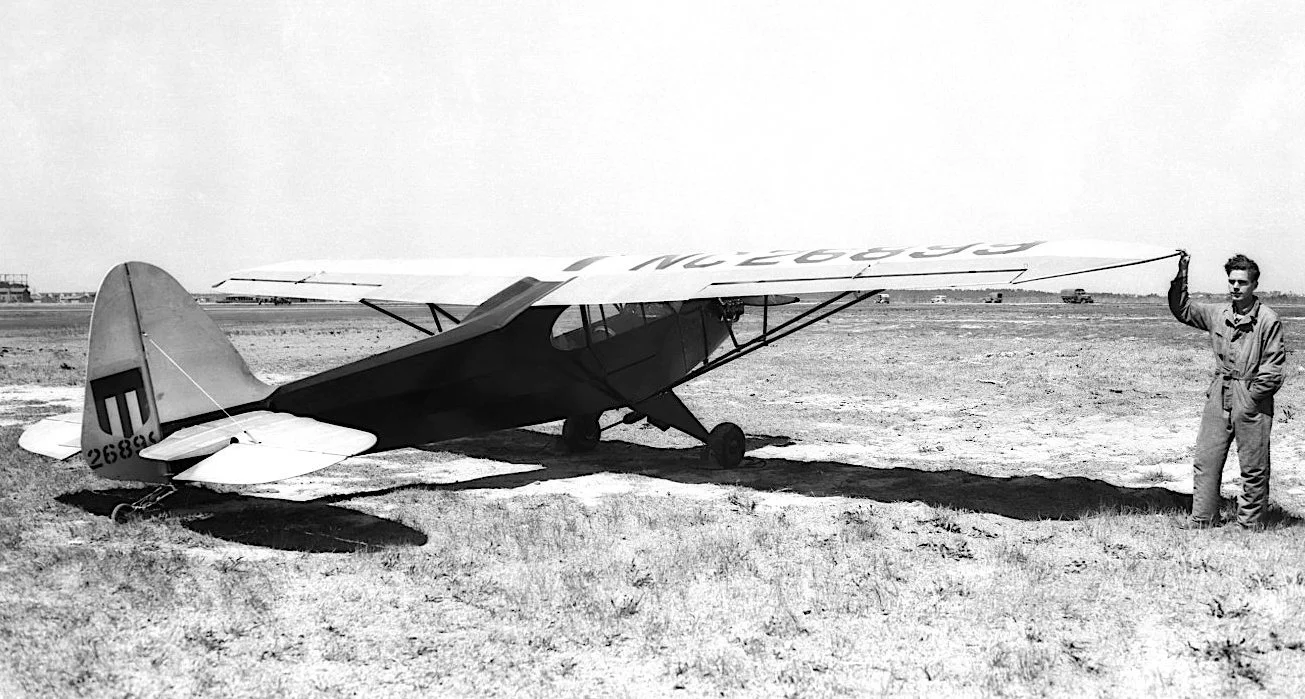
A file photo of a Piper J-3 Cub, certainly one of the simplest airplanes ever built. Photo: NASA
Welcome to Angola
by
Gregg W. Watts
I’ve heard many stories over the years, most started with lines like “Once upon a time” or “there I was…” but mine always seem to begin with “ I was flying out of…” and so begins today’s aviation tale.
I was flying out of Luanda, Angola in October of 1991 for Southern Air Transport (SAT) as First Officer on the L-382, a stretched version of the Lockheed Hercules. It had been a “normal” trip to Luanda, Houston to London on British Airways then continuing to Luanda on TAG Airlines. Flying TAG was always an adventure; I have to liken it to riding a bus in the underdeveloped countries. The locals were likely to do just about anything from smoking their favorite herb to firing up a Sterno can to cook lunch. Flight Attendants stayed alert on those flights.
This was my first of many trips and months in Angola, a charming little war torn country about twice the size of Texas. At the time, Government troops and the National Union for Total Independence of Angola (UNITA) under the command of Joseph Savimbi were mired in a struggle for control. Southern Air Transport had operated in war zones across the world with great success. In this case SAT had made agreements to carry supplies for both sides of the war. One day we flew for the Government and the next we served the UNITAs. This had the effect of reducing the number of attacks on our aircraft as neither side was sure whom we were working for on any given day. They had to be concerned that if they shot us down they might be destroying their own supplies.
Decades of civil war had destroyed most of the infrastructure left behind by the Portuguese. This was a situation tailor made for SAT; War, Famine, and Pestilence, were our stock and trade. In addition to our support of the troops, diamond mines had very few ways to move their product to market as well as great difficulty in getting supplies to the mines. This
necessitated our flying into the backcountry to places like Chitato Portugalia (PGI), the only
place in the world where I have been shot at and hit. Since these were “unfriendly” places we
always flew at 20,000 feet or greater enroute to the airfields then made a tight spiraling
descent to land. I noted that the captains always spiraled down using right hand turns, making
my side of the aircraft vulnerable to ground fire. Developing oil fields at Cabinda and Lobito
also provided work for us carrying oil field tools and supplies.
My first tour in Angola would be flying out of Luanda, the capital city. I was yanking gear for
an ole timer named Pat Coffman, the “oiler” or flight engineer was a young guy named Dan
Hawk. Coffman, a former Air America pilot was a throw back to a simpler time, when PIC meant
Pilot in COMMAND. There was no democracy on his flight deck, no CRM [Crew Resource
Management], no BS. Pat was in charge and of that there was no doubt. He had worn the paint
off more aircraft than I had seen, let alone flown. I was still a “new hire” and as such was still on
probation. I needed to make a good impression to ensure that my evaluation from Pat would be
a good one. Upon meeting Pat I told him that this was my first tour in Angola and would do the
best I could. I also asked that he point out anything I needed to do differently. His answer to this
was a string of profanity that would make a fence post blush, ending with “ I can’t believe they
sent me a green F/O”. And so began the toughest three days of my flying career.
Day one begins with Pat turning to me and saying, “my smoking is not going to bother you … is it!”
The company had just recently passed a smoking ban on the flight deck that Pat was, shall we
say, hesitant to comply with. In the micro second it took me to evaluate my situation as a
non-smoker, I cheerfully said “not at all Sir”. The stub of a cigar never left Pat’s stubby fingers for
the entire day. By the time I flew with Pat he was nearly 60 years old and ready to do other things
with the rest of his life but he clearly enjoyed the flying and had seen and done things I could only imagine. We departed Luanda on our first trip to one of the diamond mines, just one of the many dirt strips that we worked out of. The herc is a wonderful machine of incredible durability and utility. As we neared the strip I was working feverishly to cancel our IFR flight plan via the HF radio. I could get no answer but continued calling in the hope I might reach someone. While I made radio calls Pat and Dan had a running conversation about the condition of the runway and how many goats were in the way for our landing. After a few minutes of my radio calls Pat turns to me and says “ Will you just shut up! We’re trying to talk here!” I made the mistake of saying “ But Pat I’ve got to cancel IFR!” Needless to say I got a colorful description of why ATC didn’t care and how I should just sit there and shut up. This pattern continued for the next three days, I’d do something and then I would be chewed on for doing it all wrong, I couldn’t do anything right.
By day three I’m walking out to the wingtip at every stop to take deep breathes and keep telling myself I needed a way to get along with this guy. The Flight Engineer even came out to me during one of these stops and said, “Man, you’re doing great! By now most guys are throwing clipboards at him!” Later that afternoon Pat offered a gouge on how to figure true airspeed at any altitude. It looked like a handy gouge so I pulled out my notebook and wrote it down so I wouldn’t forget it. From that moment on everything changed, I guess he just needed to see that I could take the abuse and wanted to learn. The rest of this 30-day trip went smoothly and I left the trip with a glowing evaluation describing what a great captain I would be someday. Pat had been flying in Africa for many years and simply didn’t want to have to break in another new guy. I guess most of us become specialized at what we do, Pat could land the Herc within 20 feet of his target, never wasting any runway. This is an important skill when operating from many short grass/dirt runways. It would be wrong to leave you with the impression that Pat didn’t use his entire crew, he accepted input from everyone confident enough to offer it. He taught me that the front seat of a aircraft is no place to be meek.
I worked with Pat a few more times through the years and always enjoyed learning from him. In this day of political correctness and extreme sensitivity, I miss guys like Pat. He was a Captain, in charge, not needing nor asking for approval from anyone. If you liked him that was fine, if you didn’t that was fine too! He was there to run an operation that had killed many a lesser man. Guys like Pat remind me of a line from the movie “Midway”, Vice Admiral “Bull” Halsey Jr. is giving advice to Rear Admiral Raymond Spruance. Halsey says “When you’re in Command….COMMAND!” Now, I don’t know if I ever became as good a Captain as Pat thought I might but I have to believe that I am the Captain I am due in part to Captains like Pat Coffman.
For those Crew Resource Management and Sensitivity instructors, sorry… facilitators, I’ve offended here, don’t worry. There are several of generations after mine that love all that touchy feely, I’m OK you’re OK stuff.
This article originally appeared in the 3rd Quarter 2004 print issue of LOGBOOK magazine.
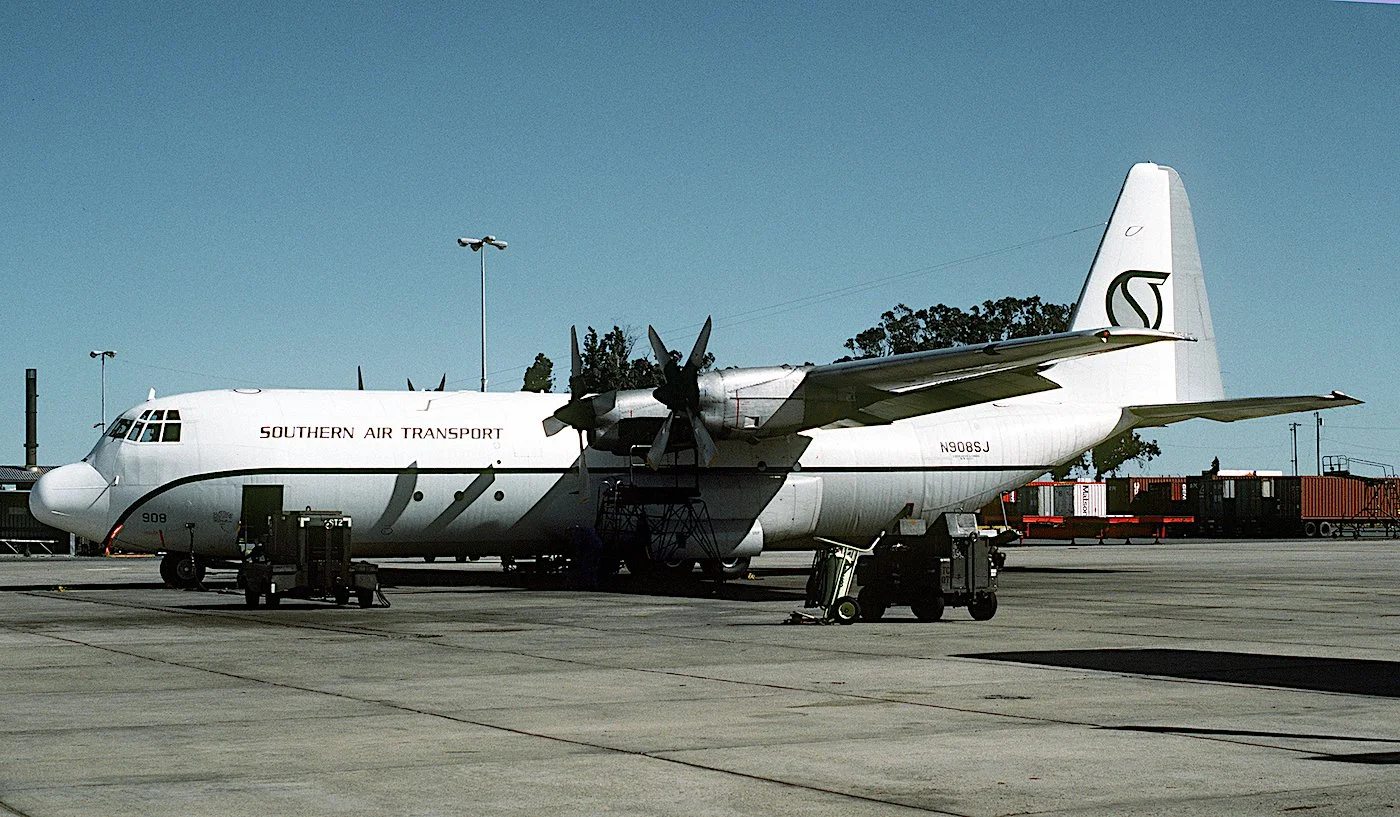
One of Southern Air Transport’s “Herks” - Lockheed L-100-30 (Model L-382G) Hercules - N908SJ. It was built back in 1968, as an L-100-20, and later, in September 1978, was stretched to L-100-30 specifications. SAT bought the airframe in September 1987, and flew it for just over a decade. Photo: DOD
Aviation in Florida.
Pensacola News Journal - 19 September 1909
The Tampa Tribune, Pensacola [News] Journal and other leading papers of the state urge the idea that Florida offers an admirable field, so to speak, for experiments and contests in aviation. Our sky has plenty of room and fine breezes for airships of every description, biplanes, monoplanes and dirigible balloons. Let all the aviators come here, where there are no mountain tops to tangle up their propeller blades. Punta Gorda Herald.
Low-Flying Planes Make Cows Nervous
The Racine [Wisconsin] Journal Times - 17 July 1929
KANSAS CITY - (AP) - Aviation may be to blame if Kansas cattle are lean and haggard this year. Cattlemen have complained to the Kansas City Livestock Exchange that planes fly so low over cow pastures that the animals are kept in a constant nervous condition, preventing them from making normal gains in weight. “In one instance a herd ran a mile after a plane passed over them,” an objector wrote.
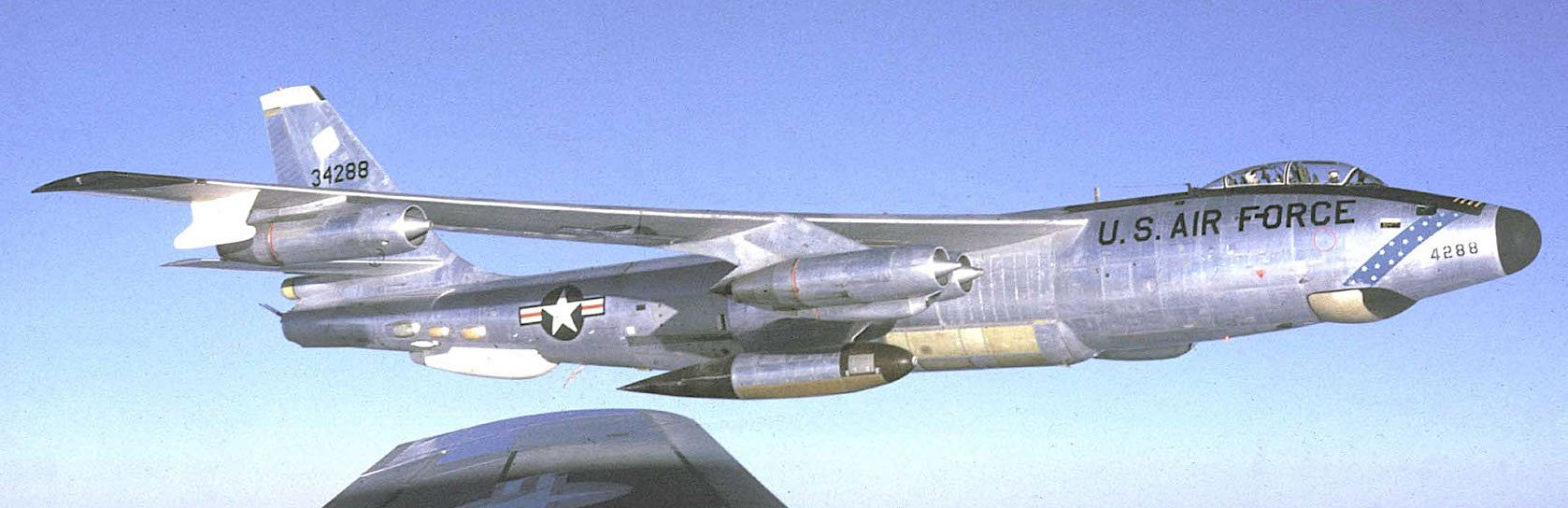
Provocative Equipment and Blackmail
(About the roles of US aerial reconnaisssance)
by
B. Aleksandrov
Editor’s Note: What appears below is the concluding paragraph, presented here in unedited form, of an article written by one B. Aleksandrov, that appeared in the 5 December 1957 issue of “Soviet Aviation.” The article is a highly subjective treatise (propaganda, perhaps?) on U.S. aerial reconnaissance aircraft and operations in the late 1950s. It is an interesting bit of aviation history from the depths of the Cold War. To read the entire article, click HERE.
Excerpt: All of these and other reconnaissance means of the Army Air Force, U.S.A, reenforces the ready American commands for military aggression. The provocation by the Invasion by American reconnaissance planes of the aerial space of other governments is related to the elements of political blackmail and threats of the politics of the "cold war" which is seen in the reactionary circles of the U.S.A,, and which are fraught with serious consequences.
The Soviet people, and strength of the Armed Forces, will be vigilant to follow the intrigues of the enemies of world peace, ready for the favorable moment to give a worth resistance to the amateur military adventurers.
The full document is courtesy of the CIA FOIA Reading Room.
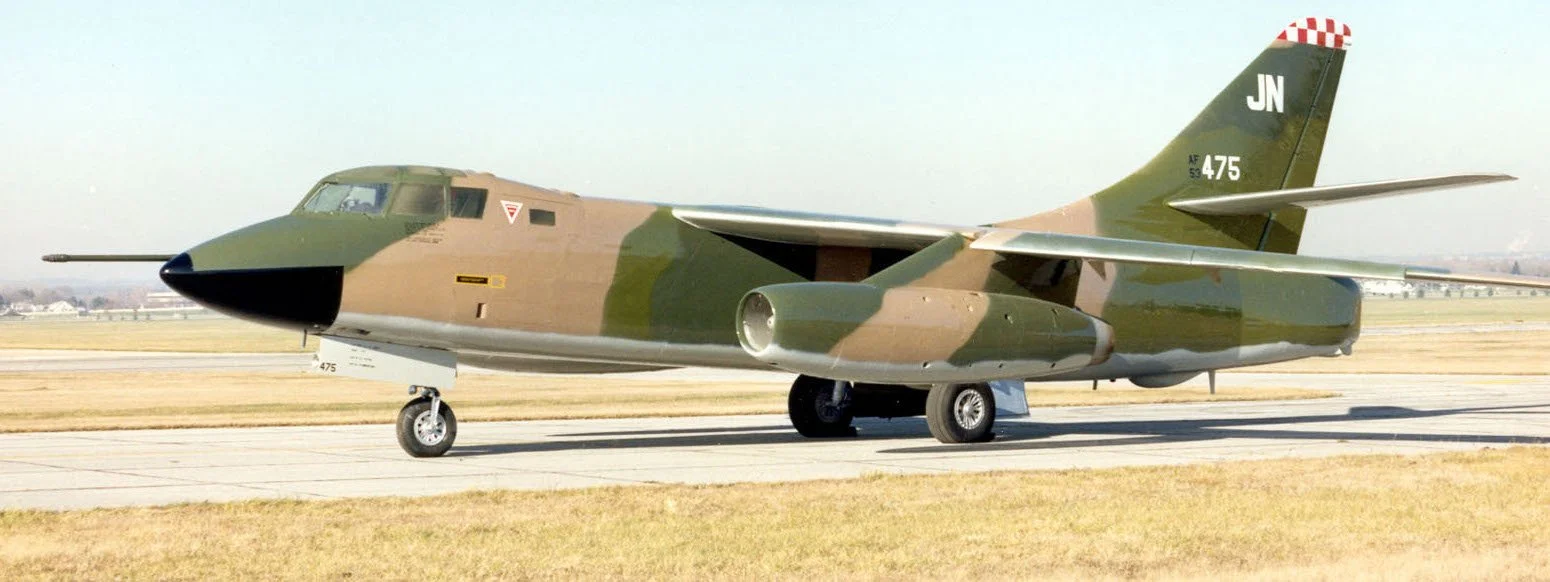
File photos of a few of the reconnaissance birds mentioned in Mr Aleksandrov’s article. Top: A Boeing RB-47H-BW Stratojet - Serial Number 53-4288. Note the pods and domes on the fuselage, and the enlarged bomb bay. Above: Derived from the Navy’s A3D Skywarrior, this Douglas RB-66B-DT Destroyer - Serial Number 53-475 - is preserved in the collection at the National Museum of the USAF. Below: Mis-identified in the article as a “Thunderbolt,” this RF-84F-10-RE Thunderflash - Serial Number 51-1879 - flew with the Iowa Air National Guard. All Photos: USAF
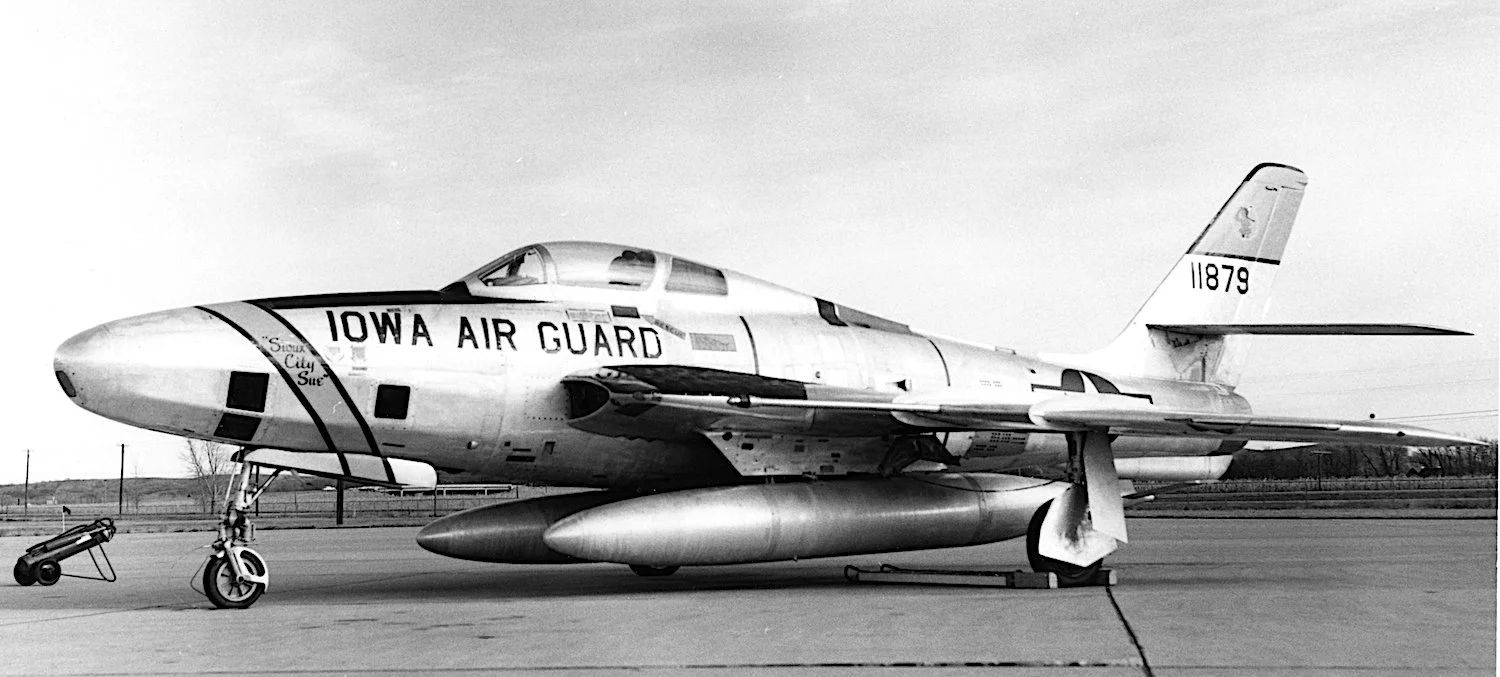
This Month's AIR FORCE Quiz
From the January 1943 issue of AIR FORCE Magazine
Here it is again! This month's AIR FORCE Quiz is a little tougher. Score 5 points for each question answered correctly. From the grades made by a group of officers and enlisted men-100 is perfect; 90 is excellent; 80 is good; 70 is passing; 60 is-well, you can do better. Answers to the right - no peeking!
This quiz originally appears in the 4th Quarter 2021 print issue of LOGBOOK.
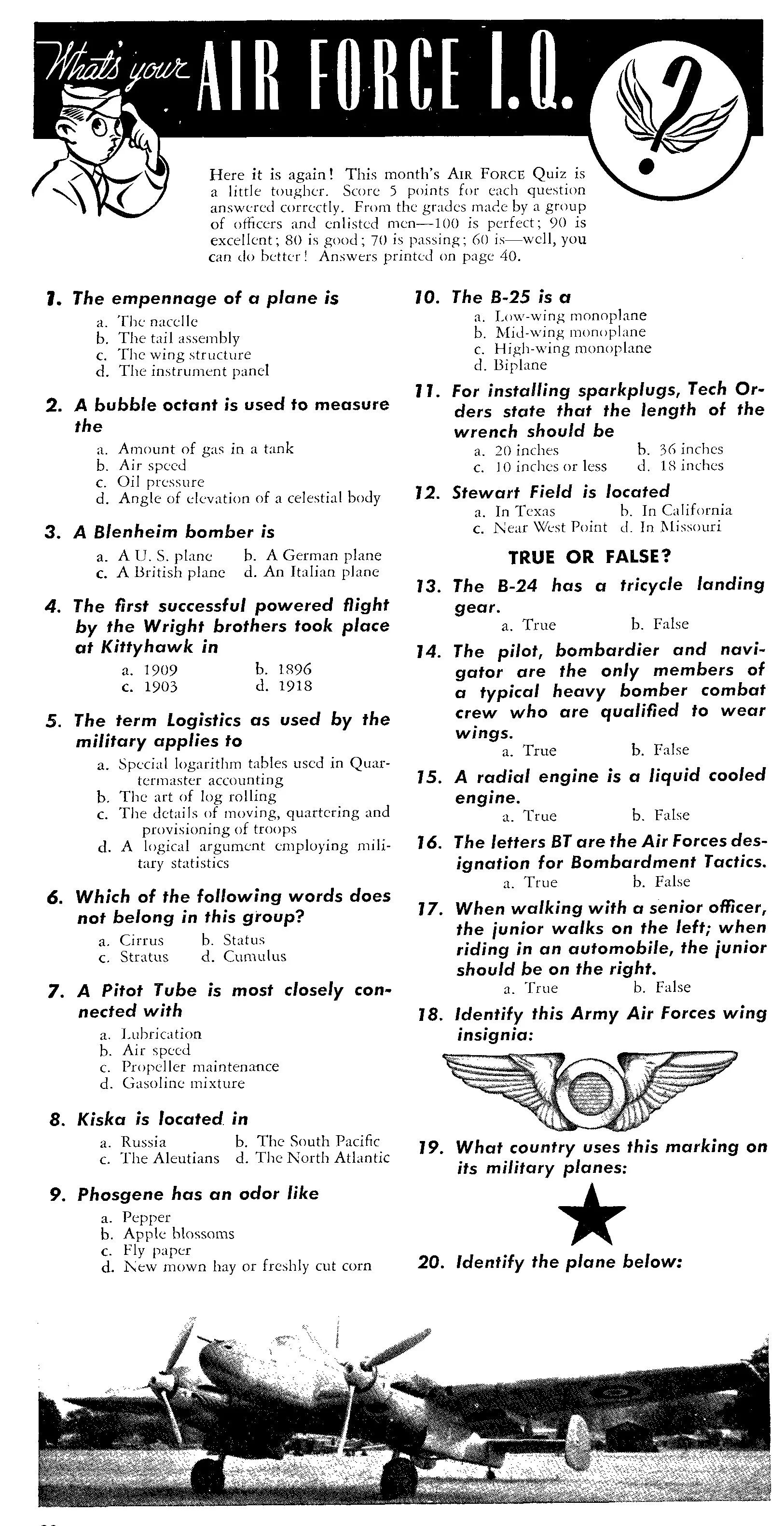

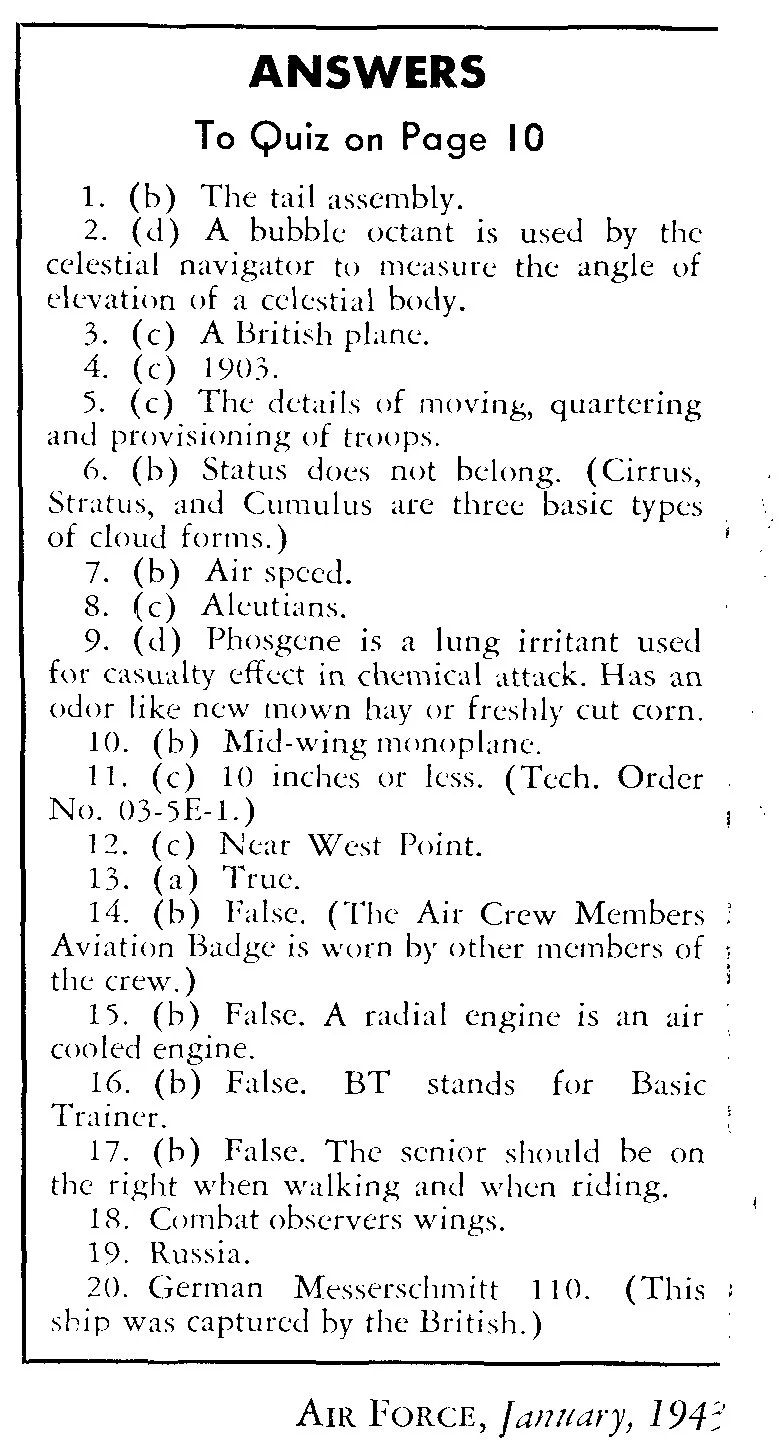
“I Am An Avigator”
by
Dave Powers
Over 28-29 June 1927, a team of two U.S. Army Air Corps officers spanned the Pacific Ocean between the newly opened Oakland Municipal
Airport, in California, and Wheeler Field on the island of Oahu. Flying a modified Atlantic C-2 tri-motor transport (s/n A.S. 26-202), which had
been christened the “Bird of Paradise,” First Lieutenants Lester J. Maitland (pilot) and Albert F Hegenberger (copilot and navigator) completed
the 2,425-mile flight in just under 26 hours. Other than dealing with some contrary weather, tending to temperamental Wright J5 radial
engines suffering from unforeseen carburetor icing, and the failure of their nascent electronic navigation gear, the flight was routine and went
off with little drama. Reportedly, upon arrival to Wheeler Field, both aircrewmen doffed their flying coveralls to reveal pressed military uniforms.
This was the first flight from the U.S. mainland to the Territory of Hawaii.
Side Note: Built in the United States, the Atlantic C-2 was a military version of the Fokker F.VIIA/3m. The C-2 was built by the Atlantic Aircraft
Corporation, based at Teterboro, New Jersey, which was the North American subsidiary of Fokker. A total of three C-2s were built: A.S. 26-202,
A.S. 26-203, and A.S. 26-204. The photo the the right is the Maitland/Hegenberger bird - A.S. 26-202.
Upon completion of their flight, Maitland and Hegenberger were feted as aviation heroes, and as such were subjected to intense media
attention. After all, much of the United States was riding a wave of aviation euphoria after Charles Lindbergh’s solo trans-Atlantic flight,
completed only a few weeks prior. In many newspaper articles, Albert Hegenberger mused about under what title he should be addressed,
under what capacity was his expertise used during the flight. In a short blurb that appeared in the 20 July 1927, issue of The Tampa Times,
as well as other national newspapers, Hegenberger posits that he should not be referred to as an aviator nor as a navigator, but rather as
an “avigator.” This word, according to Hegenberger, was not yet in any dictionary of the day.
First Lieutenant Hegenberger’s reasoning behind the usage of his new word is based on the Latin. He explained that the word “navigator”
was the combination of the Latin words “navis,” meaning boat, and “agere,” which means “to direct,” in other words, a person who directs boats. Along a similar vein, he reasoned that the Latin word “avis,” which means bird or flier, should be combined with the word “agere.” Thusly, a person who accomplishes the direction of aerial vehicles is an “avigator,” or one who practices “avigation.” Simple. Hegenberger thought that the new word “avigator”was a more appropriate word to describe his skill of directing an aircraft. Many aviation pundits of the day agreed, and predicted that “avigation” and “avigator” would soon be in common use. History was to show otherwise.
Of course, Hegenberger’s suggestion about the use of the new word avigator brought a bit of discussion, some rather tongue in cheek. One correspondent wondered if a navigator directs ships, and an avigator directs airplane, what is a person called who directs ground vehicles - a “terrigator?” One letter that appeared in the 19 August 1927, issue of The Tampa Times, signed only by a person called “The Sage of Guava Gardens,” of Wauchula, Florida, forwarded the question: “Talking about navigators, avigators, terrigators, fumigators, etc… Is a garbage man an Alley Gator?”
All Photos: The Bain Collection via the Library of Congress. Dave Powers, of Pensacola, Florida, is the editor of LOGBOOK magazine - Great Aviation History.
This article originally appeared in the 3rd Quarter 2020 print issue of LOGBOOK magazine
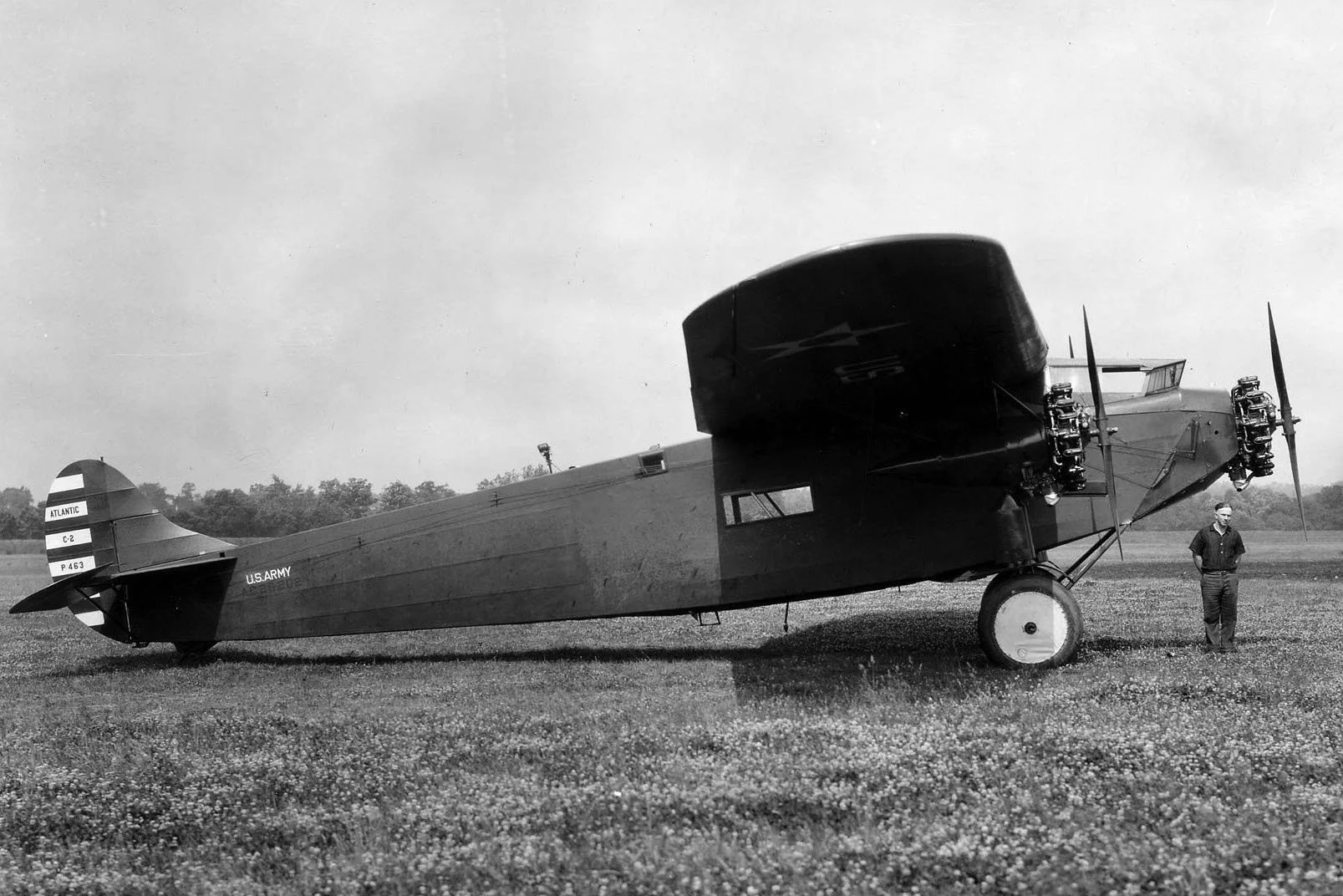
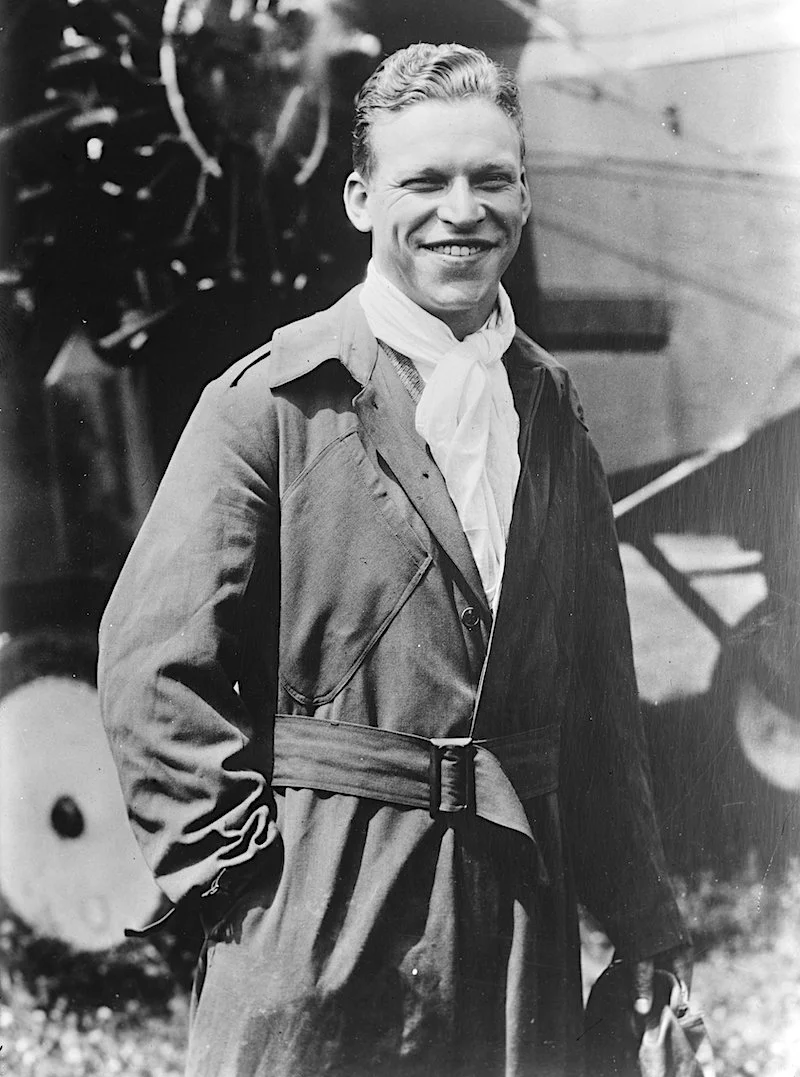
As mentioned above, certain members of the Alabama Air National Guard played a key role in the Bay of Pigs operation. For the full story of this involvement, we can highly recommend the book “Wings of Denial,” by Warren Trest and Donald Dodd.
The book, published by NewSouth Books in 2001, is still available, now at the University of Georgia Press. Here’s the link:
University of Georgia Press
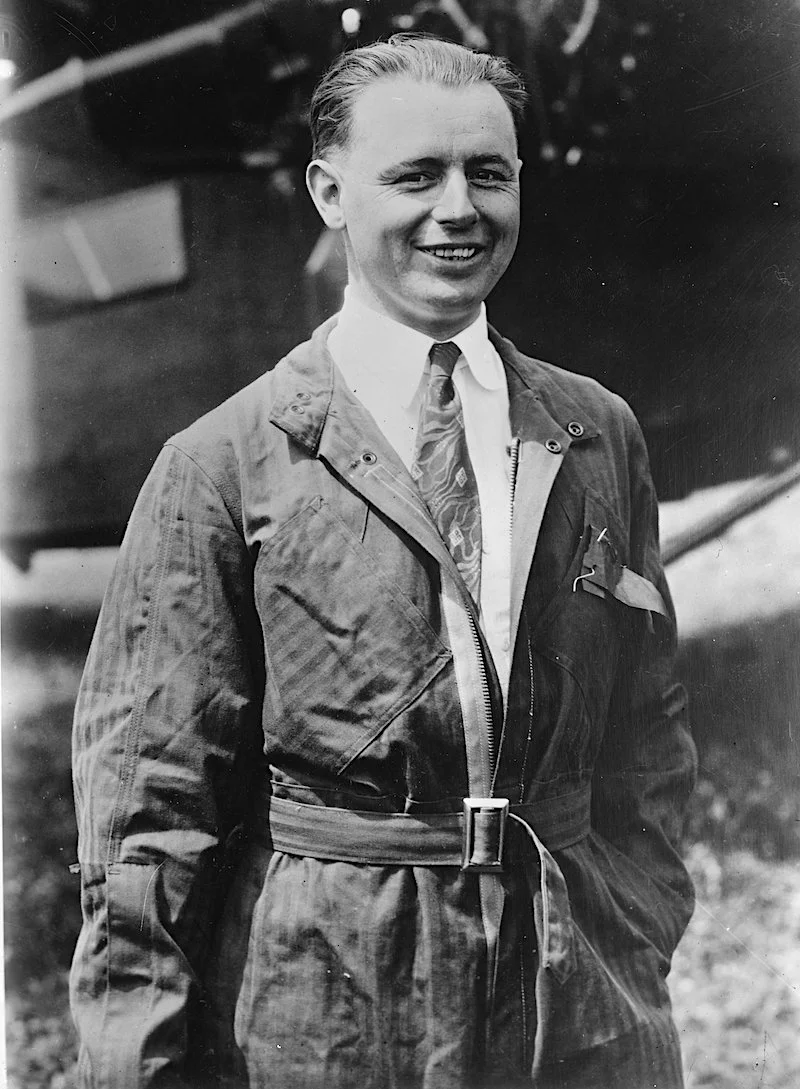
Above, Left: First Lieutenant Lester J. Maitland (pilot). Above, Right: First Lieutenant Albert F. Hegenberger (copilot and navigator = avigator). Below: An advertisement from the August 1927 issue of Aero Digest magazine.
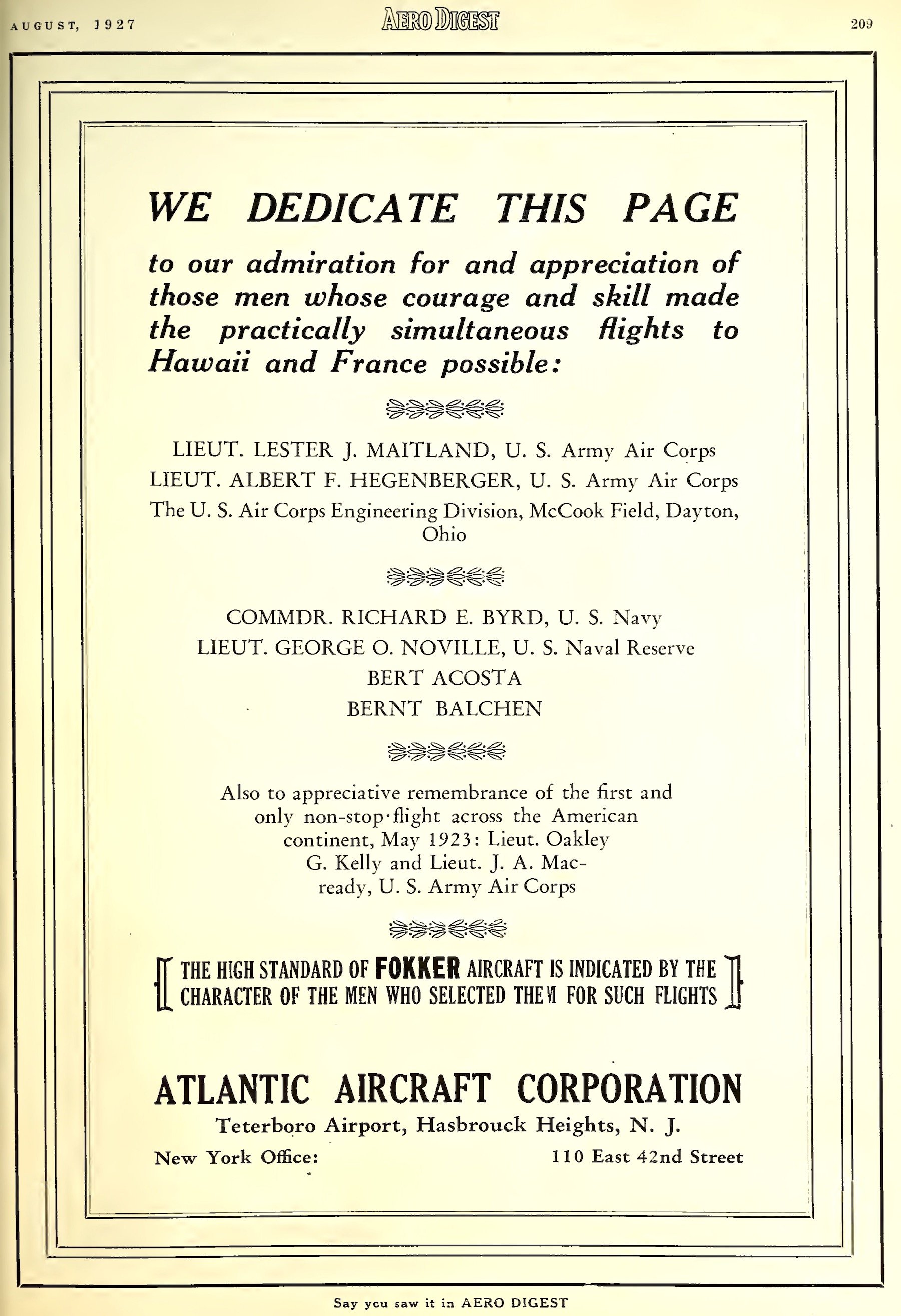
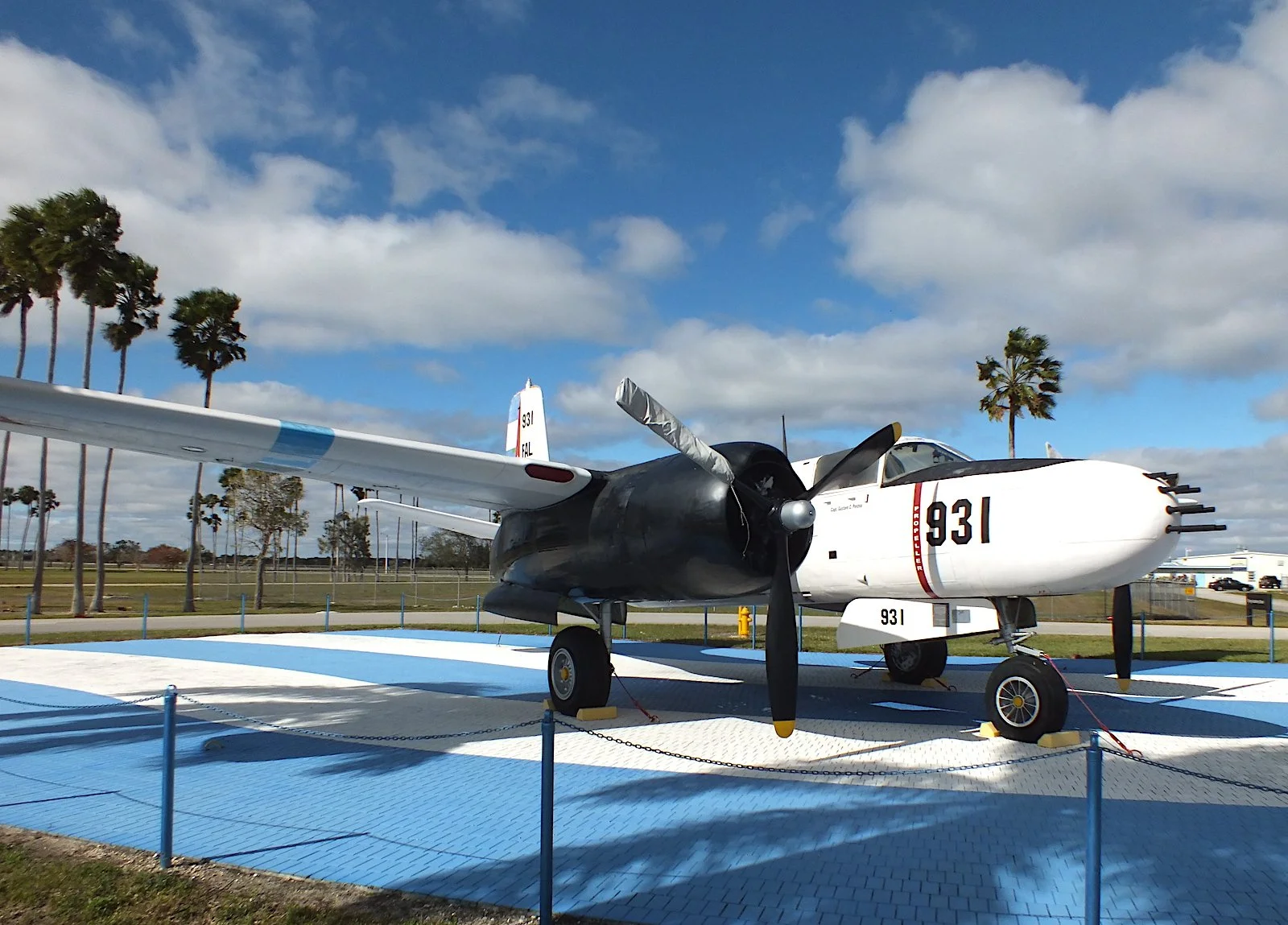
Preservation
Bay of Pigs Memorial
Miami Executive Airport (formerly Kendall-Tamiami Executive Airport), Miami, Florida.
Much has been written about the Invasión de Bahía de Cochinos - the Bay of Pigs invasion - and it would amiss to try to give a complete review of the operation here. So, keeping in mind
that formerly classified documents are still coming to light, and thus the story is still evolving after nearly 60 years, here are a just few of the key points. The plan to invade Cuba, and
ultimately dispose Fidel Castro, was backed by two Presidents of the United States - Eisenhower and later Kennedy - both of whom wanted to stymie the spread of Communism in the
U.S.’s own backyard. Assisted by covert elements, mainly from the Central Intelligence Agency (CIA), some 1,400 Cuban exiles formed a paramilitary unit called Brigada 2506 - Brigade
2506. The Brigades’s mission was to initiate, through military action, the process to topple the regime of Fidel Castro. In support of Brigada 2506, there was a small squadron of Douglas
B-26 Invader attack bombers - the Fuerza Aérea Liberacion (FAL), the Liberation Air Force - that was also formed and supported, and the pilots trained, with assistance of the U.S.
government. A multifaceted operation, the main invasion - an amphibious assault - began in the early morning hours of 17 April 1961, at Playa Girón, in the Bay of Pigs. Analysis of what
happened over the next few days has filled countless volumes, but in short, by 20 April, the invasion had been thwarted, and the majority of Brigada 2506 had been captured or killed
by an overwhelming Cuban force. In the aftermath of the failed invasion there was considerable finger pointing, especially in the highest echelons of the U.S. government. Politics, of
course, had reared its ugly head.
The actual number of B-26 Invaders amassed for the FAL’s Bay of Pigs operation is subject to debate, some references noting upwards of 26 airframes. These were believed to all
hard-nose B-26Bs. Interestingly, the Castro’s Fuerza Aérea Revolucionaria (FAR) - the Cuban Revolutionary Air Force - also had a small fleet of perhaps 18 mixed B-26B and B-26C
airframes. However, at the time of the invasion it is thought that only a few clear-nose B-26C airframes were actually airworthy. In an effort to instill some indecision and hesitancy in
the Cuban defenders, the U.S. advisors had many of the FAL Invaders painted overall white, as some of the FAR’s own aircraft appeared, complete with FAR-like insignia.
As a side note, the Douglas Invader - first flown on 10 July 1942 (the XA-26) - was initially designated as A-26, a designation that was changed to B-26 in June 1948. Of course, this
Douglas aircraft should not be confused with the Martin B-26 Marauder. The B-26B model was considered a ground attack bird, and can generally be identified by its solid aluminum
nose, usual sporting a battery of several machine guns. The B-26C variant fulfilled the light bomber rôle, and can be identified by a clear Plexiglas nose. Rather confusingly, an Invader
could start out on the assembly line as a hard-nose B-26B, only to have it roll off the line as a clear-nose B-26C, and vice versa. To add more confusion, during depot-level maintenance
it was relatively easy to swap one nose type out for the other, thus making proper identification sometimes problematic.
At the end of the battle, a total of eight FAL Invaders were believed to be shot down, one by anti-aircraft fire, with the remaining seven downed by FAR fighters - five by armed
Lockheed T-33 T-Birds, and two by Hawker Sea Furies. Ten Cuban exiles and 4 American pilots lost their lives. Regarding these 4 Americans, their exact capacity is still subject to
discussion. When U.S. covert operatives decided upon the B-26 Invader as their aircraft of choice - the Douglas AD-1 Skyraider had also considered - they cast around for a group of
instructor pilots and maintenance experts to support the operation. The only group that they found appropriate was the 117th Tactical Reconnaissance Wing, part of the Alabama Air
National Guard (ANG), and the last Air Force unit to fly the B-26, having only just retired their own Invaders. While records do vary, it seems that over 80 Alabama ANG members signed
up for the operation, not as members of the U.S. military, but rather as CIA contractors, or by that indeterminate job description - an advisor. At first, American advisor pilots were there
for training purposes only, and were thus prohibited from flying operational missions, a rule that soon changed. On the 19th of April, two B-26s crewed by four Americans, were downed
by a pair of FAR T-33s.
The plan for pre-invasion air raids, as well as later close air support of the troops on the ground during the assault, was convoluted at best, and seemed to change on a moments notice. Too many people had too much influence, with the result being uncertainty and confusion. Aircraft and other resources were promised to the Brigade by the CIA, only to be taken away at the last minute. FAL missions were authorized by the U.S., only to be later cancelled. There was also a significant U.S. Navy presence in the area, including a couple of aircraft carriers, assumed to be standing by to render assistance, that in the end, never really came. Records do indicate that the U.S. Navy did launch a few sorties, but these remained mostly at arm’s length. The United States was not supposed to be involved. Even though the FAL’s missions that were flown did not turn the tide of the battle the conspicuous dedication of the pilots and crew, a number of whom lost their lives, is clear. It is these lives that are commemorated by the Bay of Pigs Memorial, located at the Miami Executive Airport - formerly known as the Kendall-Tamiami Executive Airport - in Miami, Florida.
The project, which had been sometime in the making, was announced on Thursday 19 August 1999, by a Miami-based group called the Cuban Pilots Association (CUPA). The goal was to build a memorial, complete with a static display B-26 Invader, to honor the 10 Cuban FAL pilots and 4 American pilots who were killed in the action. Monetary support for the project came from a number of sources, including a large donation from the Bacardi-Martini USA company, the rum distiller that had thought it prudent to move to Puerto Rico as Castro consolidated his power in Cuba. A dedication ceremony was planed for 15 April 2000.
Even before the official announcement of the project, the whole scheme almost came to an end. With the general location selected - the Tamiami airport - CUPA
approached the U.S. Air Force Museum (USAFM), at Wright-Patterson Air Force Base, Ohio, to see if they had an appropriate B-26 Invader available for loan. At the
time, USAFM regulations prevented the museum from loaning any of its aircraft to a private group. The museum would only loan a bird to another governmental
entity. CUPA members then asked the leadership of Miami-Dade County if they could step in and become a partner in the project. On 4 March 1999, the
Miami-Dade County legislature approved the plan whereas the county would be the recipient of, and assume responsibility for, the aircraft, thus staying within
USAFM rules. While the county would form an oversight committee to ensure that USAFM rules regarding aircraft custody were followed, CUPA would be
responsible for all costs of moving and maintaining the aircraft. The USAFM offered CUPA a Douglas B-26C - serial number 44-35440.
The aircraft on display was built at the Douglas plant at Tulsa, Oklahoma, and rolled off the assembly line as an A-26C-35-DT. Although it was apparently built as
a clear-nose C model it appears that during a significant portion of its existence, including the present, it had the solid-nose of a B-26B. When this modification was
accomplished is not certain. In any case, after several years in the U.S. Army Air Forces/U.S. Air Force inventory, it was then loaned to the French Armée de l’Air in
February 1954, where it saw service in French Indochina with the Groupe de Bombardment I/19 (Gascogne). In October 1955, it was returned to the USAF, and
placed in storage at Clark Air Force Base (AFB), in the Philippines. Then, in 1966, the airframe was sold off to the Rock Island Oil and Refining Company, registered
as N6838D. After flying for some time variously as a research aircraft and as an executive transport, it joined the fleet of the Aero Union Corporation, as a fire
bomber. In 1971, it moved north to Canada, joining the fleet of Conair Aviation Ltd, also as a fire bomber. In 1988, the operational days of the aircraft were done, it
was obtained by the USAFM, and placed on display at Travis AFB. It was from here, in early 2000, that CUPA was loaned the airframe. Bacardi-Martini picked up the
bill to have the airframe disassembled and trucked to Miami.
While the group had their B-26, and had completed an eight-month restoration program, it would be a number of years before the memorial could be dedicated.
One of the problems was where exactly the memorial would be. Originally, a quarter acre patch of ground between two hangars was selected for the memorial site,
the land donated Miami-Dade County. However, bureaucracy stepped in to complicate, and potentially scupper, the whole plan. The U.S. Federal Aviation Administration (FAA), who does provide a manner of development funds to airports around the country, including Tamiami, had determined the selected site would be better used for commercial use. Evidently, FAA officials thought that since they provided development money to the airport, they had a right to veto decisions made by the county. The FAA said the CUPA group could use the site, but would need to pay upwards of $40,000 a year in rent, an amount that the FAA had determined would cover the “fair use” of the land. Amando Cantilla, a Bay of Pigs veteran, and then the president of the group, noted in an interview that the group would be hard pressed to come up with that sum of money every year. The FAA also voiced concerns that the memorial would be a target for terrorist activity, although succinct FAA reasoning for these beliefs was never forthcoming. In 2007, the commissioners of Miami-Dade County agreed upon an alternative site on the airport. The site would be leased to CUPA for a very nominal fee each year. This time the FAA did not object, although it was specifically pointed out that no FAA funds would be used to develop the site. The memorial park, complete with the B-26, as seen today, was finally dedicated on 17 April 2010.
All Photos: Aviation Antiquities Service
This article originally appeared in the 4th Quarter 2020 print issue of LOGBOOK magazine.
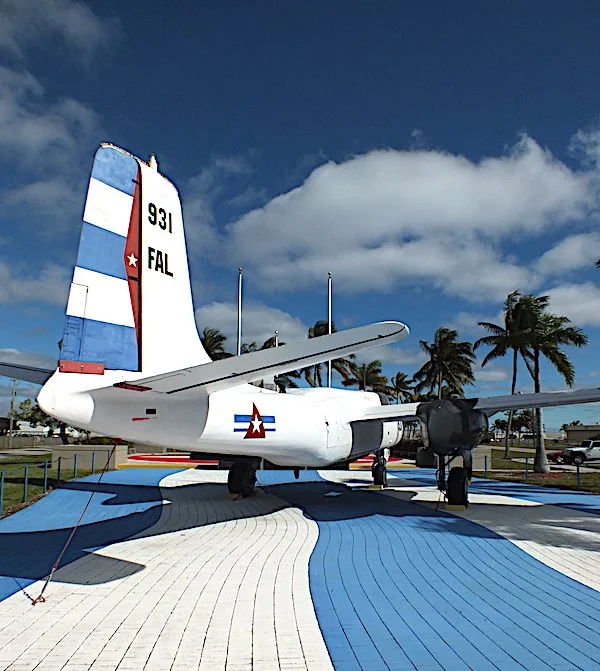
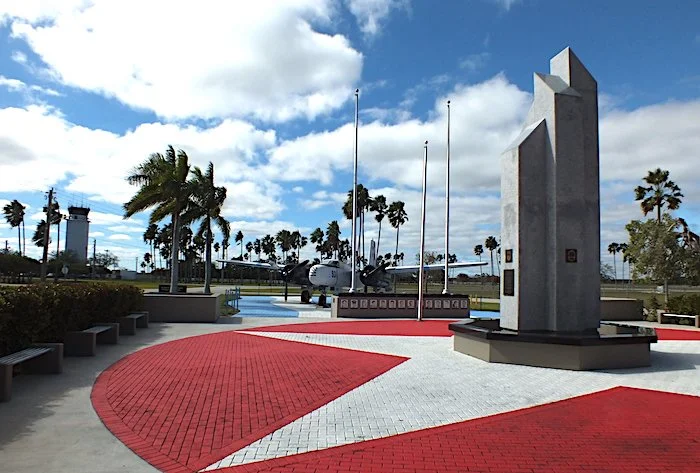
And Now, We Would Like to Recommend…
Here are a few fine aviation history organizations and museums that are well worth checking out. Just click on the link below.
Gotta a lead on a good group of aviation history enthusiasts? Drop us a line at:
Contact@logbookmag.com
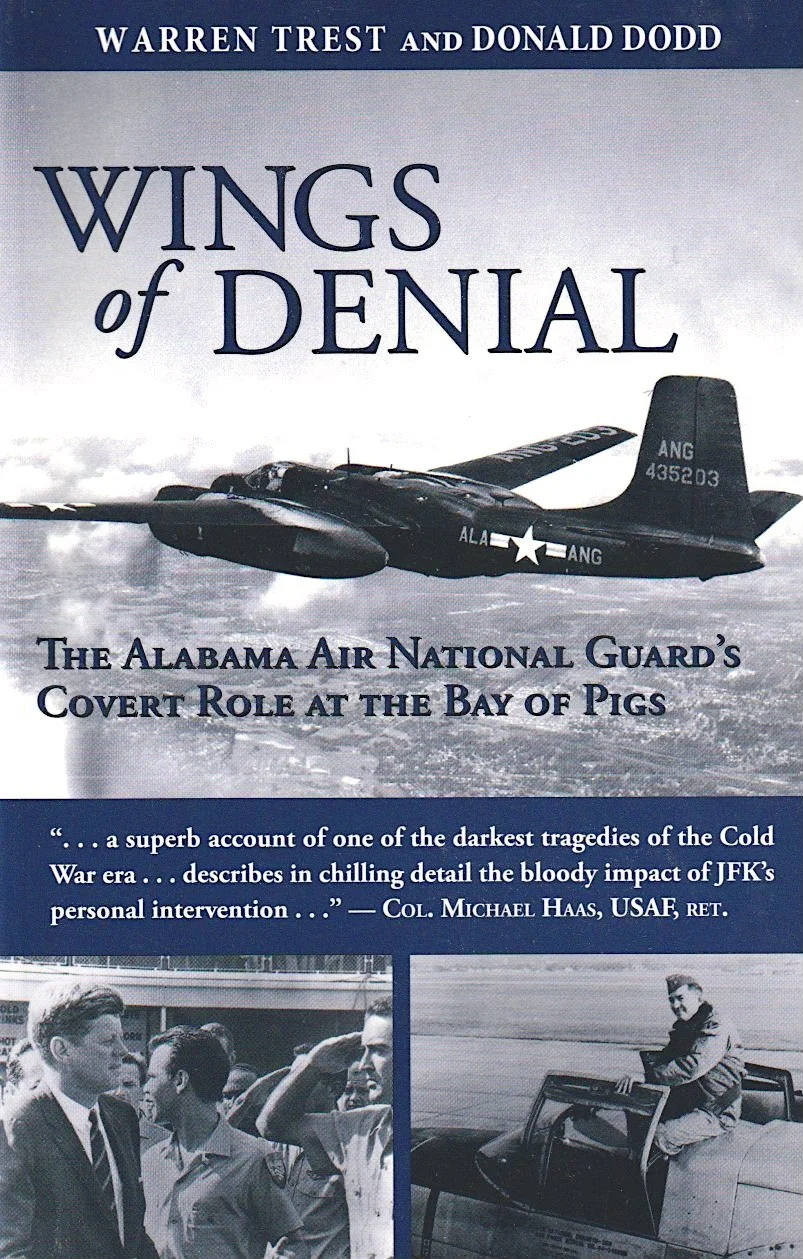
A file photo of Chance Vought F4U Corsairs preparing to launch on a mission over Korea, circa late 1950. These F4U-4Bs were assigned to Fighter Squadron FIFTY-FOUR (VF-54), Carrier Air Group FIVE (CVG-5), aboard the USS Valley Forge (CV-45) - the “Happy Valley.”
Photo: National Naval Aviation Museum
Risk Aversion
by
Captain Owen W. Dykema USNR (Ret.)
Brain doctors tell us that our brain develops slowly from back to front, leaving the front part - where risk is fully evaluated - until mid-20 or so for full action. In my early 20s, I was flying F4U-4 Corsairs in the skies over North Korea. On every flight the surrounding skies were filled with AA fire, including massive streams of tracer bullets. After flying about 30 such strikes my brain must have decided that they would somehow continue to fail to hit me. We were usually cruising in and out at 6,000 feet, so we knew that we had some six seconds to see and dodge any diversion in the direction of those tracer streams. Plenty of time to dodge away, right? No problem.
We had cameras in our wings that took pictures every time we fired. Our squadron said they would save everyone’s films, patch it all together and gives it to us at the end of the cruise. Now, one day around that time, they told me that I had color film in my gun camera. So, while attacking the target that day I was anxious to get some great color movies. Unfortunately, that day the primary gunner [on the ground] was way off and there was just a steady stream of tracers “way out there” off my right wing. So finally I moved over a little bit so the tracers were passing just about over my right wing, just over my (color film) gun camera. Yes, I got a nice stream of gaudy pictures.
When I got back to the ship and they showed my gun camera film in the ready room there was a massive silence. The unanimous conclusion was that I desperately needed to get off the ship and toss down several stiff martinis. When I listened and thought about it, a little chill ran through me. My God, did I actually DO that? Where was my “risk aversion” brain - anywhere? Right at the end of the cruise BUAER [the Bureau of Aeronautics] said “Send all gun camera film to us” - so I can’t prove this event.
Editor’s Note: In the summer of 1952, Captain Dykema was assigned to the Golden Dragons of Fighter Squadron ONE-NINE-TWO (VF-192), which was part of Carrier Air Group NINETEEN (CVG-19), then cruising aboard the USS Princeton (CV-37).
This article originally appeared in the 3rd Quarter 2020 print issue of LOGBOOK magazine.
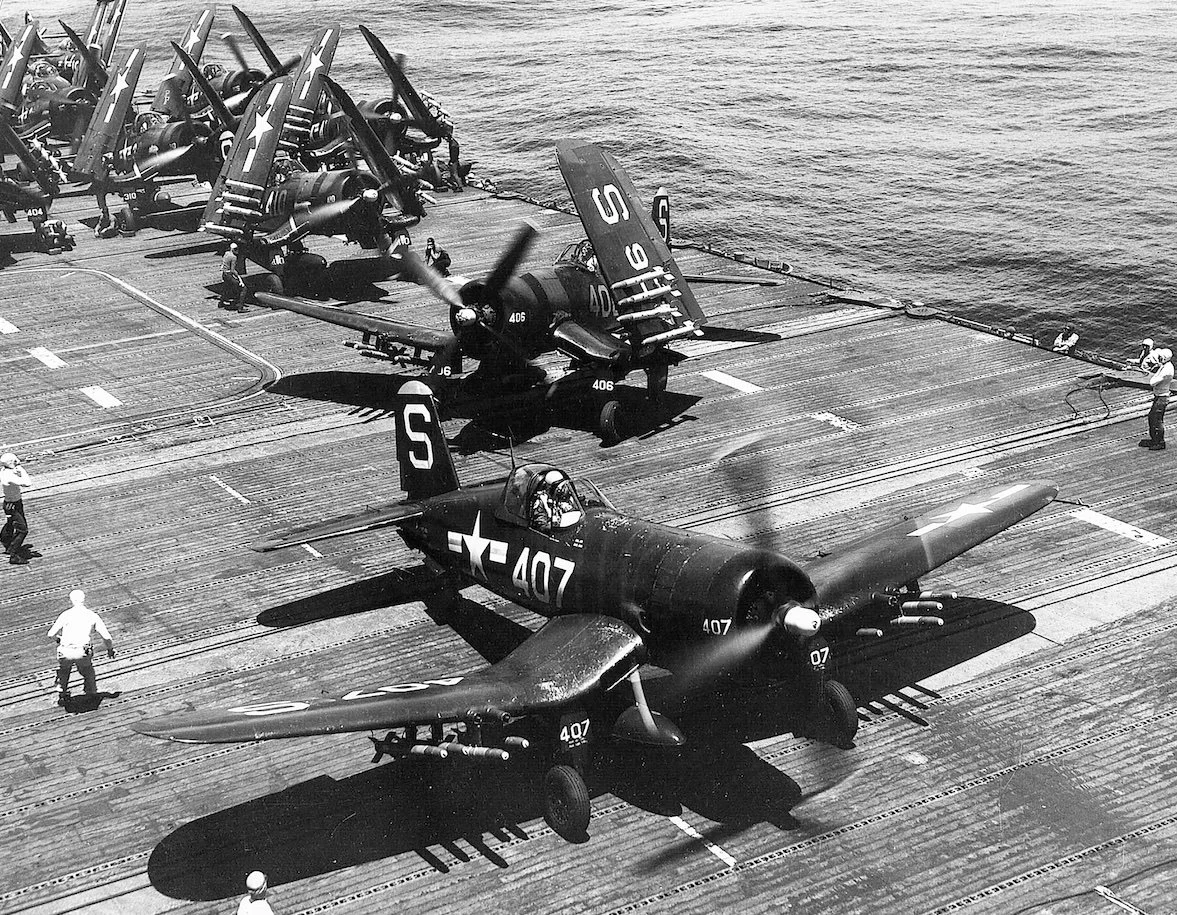
Prairie Airways
by
Dave Powers
I have had this patch (to the right) for probably 20 years, so long I can’t even remember where I got it. It has been in my desk drawer for years, so every now and then I catch a glimpse of it. Being
a pilot, into aviation history, and having been raised in Omaha, Nebraska, this patch has always fascinated me to a certain extant. Was there ever a real Prairie Airways? The patch is seemingly quite
vintage, embroidery on felt. Unless the embroiderer made a mistake and omitted half of the horizontal stabilizer, the aircraft depicted is most certainly a V-tail Beechcraft Bonanza. Clearly it
was meant to be worn by a pilot, maybe based in Lincoln, the capital city of Nebraska, or my old hometown of Omaha. Was there actually an airline, or an air service that operated out of Lincoln
and Omaha, flying a Beechcraft Bonanza? Well, yes, as a matter of fact there was.
It was just before the end of World War Two that Prairie Airways began showing up in the local Nebraska newspapers. In an article dated 12 March 1944, a Mr. Harry Gantz, state senator from
the town of Alliance, Nebraska, announced that Prairie Airways was a newly formed aviation corporation - Gantz was its vice president - in the state. The company’s business plan included offering
transcontinental air transportation. In this case, transcontinental did not mean east to west, but rather southeast to northwest. Civil Aeronautics Board (CAB) approval had been applied for.
At the helm of Prairie Airways was its president, a local banker and rancher from Hyannis, Nebraska, named Christopher J. Abbott, and he had big plans. Initial ideas was for a route structure that
ran from points in Kentucky and Tennessee up through Nebraska to destinations in Montana. Christened the “Park Route,” many of the en route stops were located near national parks, like
Yellowstone, Grand Teton and Glacier National Parks. Future route extensions would run all the way from Miami, Florida, up to Seattle, Washington. There was also talk of a route from Seattle to
Nome, Alaska, stopping at several points along the Al-Can Highway. One aspect of this route structure was the planned use of former military bases as intermediate stops. These bases, it was
thought, would soon be deemed redundant with the close of the war, and turned over to local governments. The home office and maintenance base for Prairie Airways would be in Alliance,
at what was then the Alliance Army Air Field. The envisioned fleet of aircraft would consist of Douglas DC-3s to service the main trunk line, and a smaller, twin-engine type Cessna or Beechcraft
feeding the smaller cities.
The concept was grand, but the actual execution started out small. Permission for the long haul trunk line was bogged down with the CAB, mostly because of protests lodged by United Air Lines.
United had flown many of these legs before being forced to suspend service because of the war. Well, the war was soon to be over, and United wanted their routes back. Regardless, Prairie
Airways launched a series of survey flights, wholly within the state of Nebraska, in early July 1946. Initially, for the Nebraska intra-state operation there were two routes: The Northern Route -
Alliance, Chadron, Rushville, Norfolk, Omaha, and the Southern Route - Omaha, Grand Island, North Platte, Alliance. Interestingly, these surveys flights were flown in an AT-6 Texan and a BT-13,
both emblazoned with “Prairie Airways” on the fuselage. Permission from the Nebraska State Railway Commission was slow but finally came. This permission, however, was only temporary.
On 3 September 1946, the inaugural flight of Prairie Airways departed Alliance on the run to Omaha. Since the flight was completely within the state of Nebraska, no CAB approval was required.
Reports state a “four-place, twin-motored ship,” was employed. The service caught on reasonably well, and by the end of the year the small fleet was joined by a pair of 14-place Lockheed Lodestars.
Abbott’s Prairie Airways grew into a multi-faceted organization, to include pilot training, aircraft maintenance, aircraft sales, and a charter division using, among other types, the Beechcraft Bonanza. Evidently good business was found by flying passengers to University of Nebraska football games.
Despite the relatively positive start for the airline, passenger levels never really paid the bills, and Prairie Airways began to pull out of many of their original cities. CAB authority for interstate
routes, as well as CAB subsidy money, never happened. The temporary Nebraska State route authorizations expired. Abbot began to concentrate more on his other aviation interests, at the same
time moving most operations to the Omaha and Lincoln areas. A 1950 reorganization saw the name Prairie Airways replaced by Abbot & Company, now a nonscheduled charter outfit. The
airline was gone. In 1951, he closed the entire operation for good. Unfortunately, Chris Abbott died in 1954, in a seaplane crash on Lake Wallace just south of Shreveport, Louisiana. As a side note,
Thomas E Braniff, of Braniff International Airlines also perished in the crash.
This article originally appeared in the 4th Quarter 2020 print issue of LOGBOOK magazine.
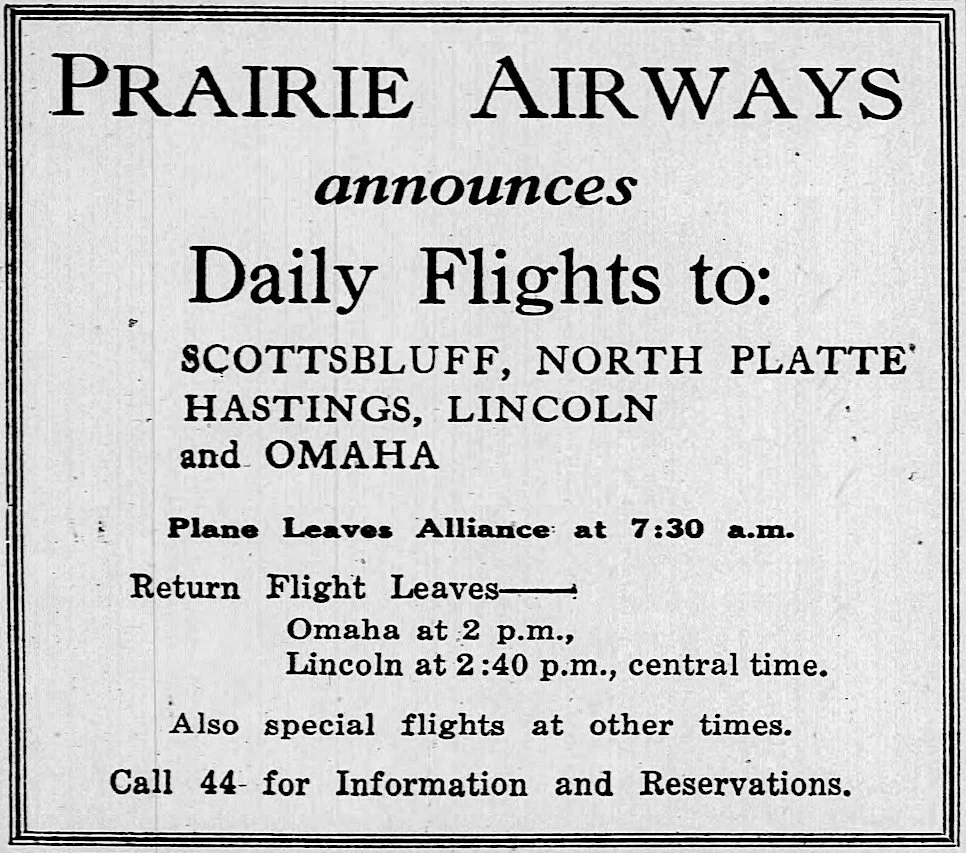
Designs Floating Mail Sack
AVIATION magazine - 11 August 1928
PARIS, FRANCE - Cork composition has been employed in the design of a new mail sack brought out by a French inventor. By pulling a release wire, pilots of mail planes may drop the new type floating water-proof bag to the surface of a body of water as they pass. Postal employees pick the bag up as the flier continues to the next mail station.
Lockheed/Martin C-130J Super Hercules
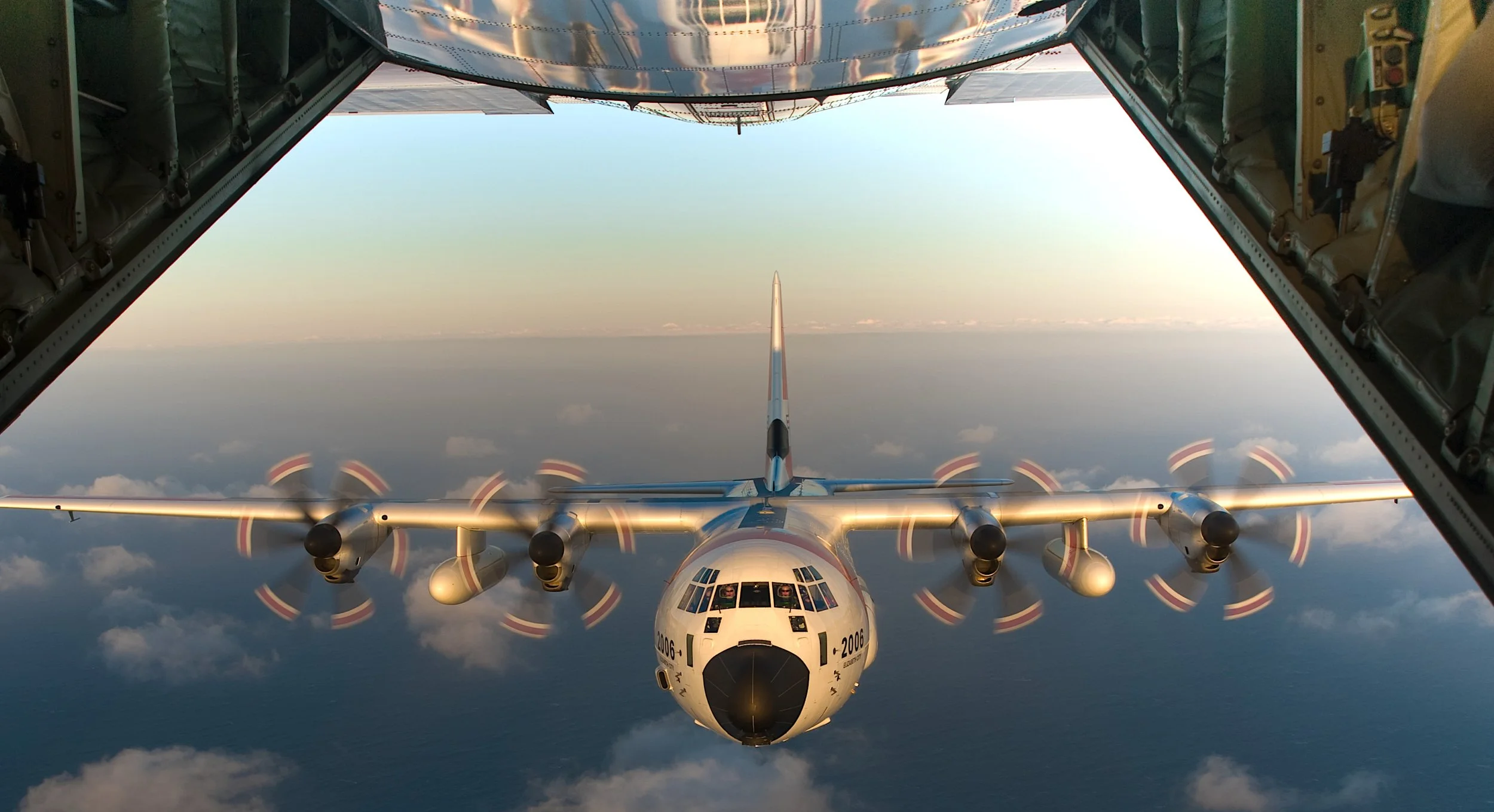
16 APRIL 2007 - Coast Guard Air Station Elizabeth City, North Carolina
A U.S. Coast Guard Lockheed Martin C130J Hercules is reflected in the cargo ramp door of a second C-130J . The C-130J is the latest incarnation of this enduring, multi-mission platform. Air Station Elizabeth CIty has the first operational J models. The Coast Guard has been using a version of the C-130 since the first one was delivered to Air Station Elizabeth City back in December 1959.
Photo: USCG by Dave Silva, via DVIDS
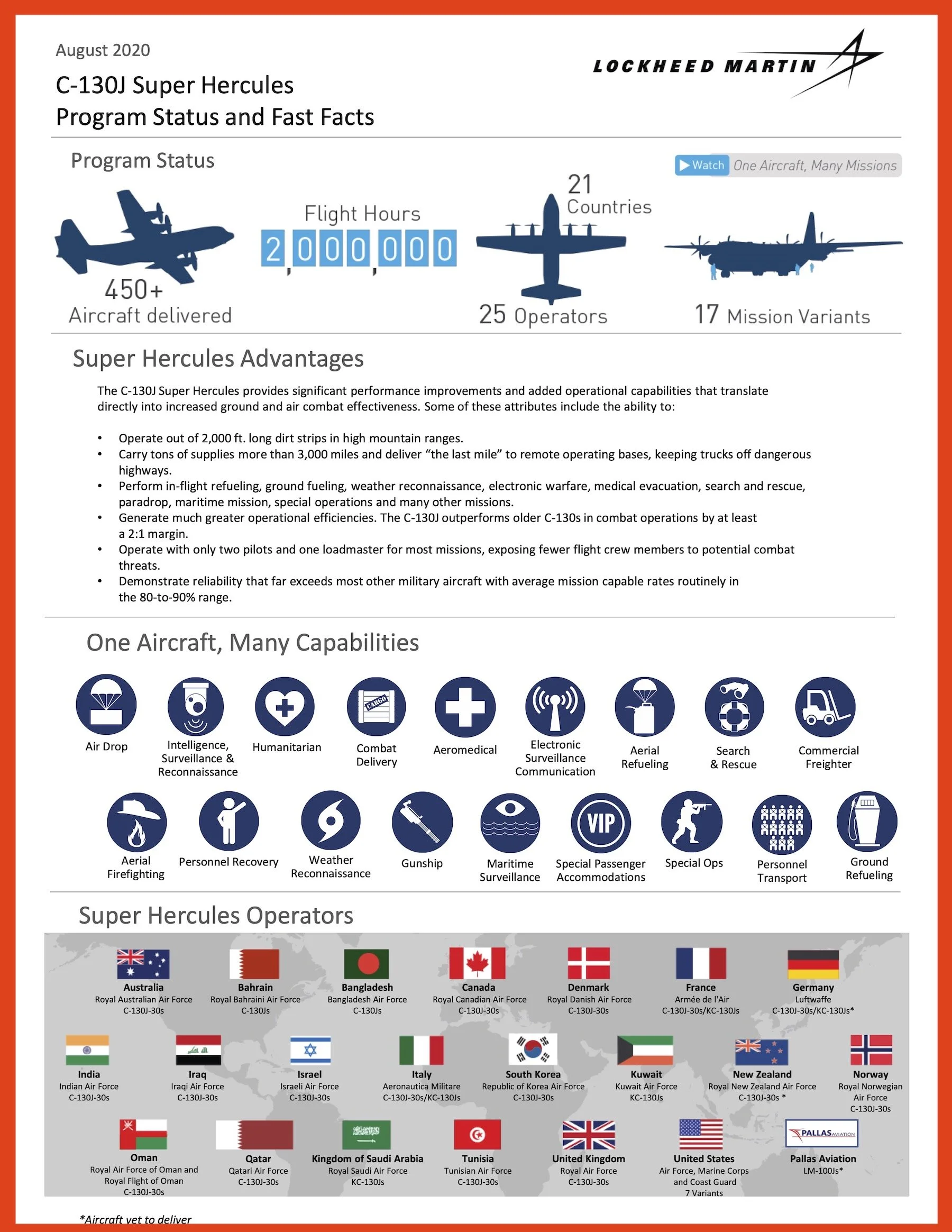
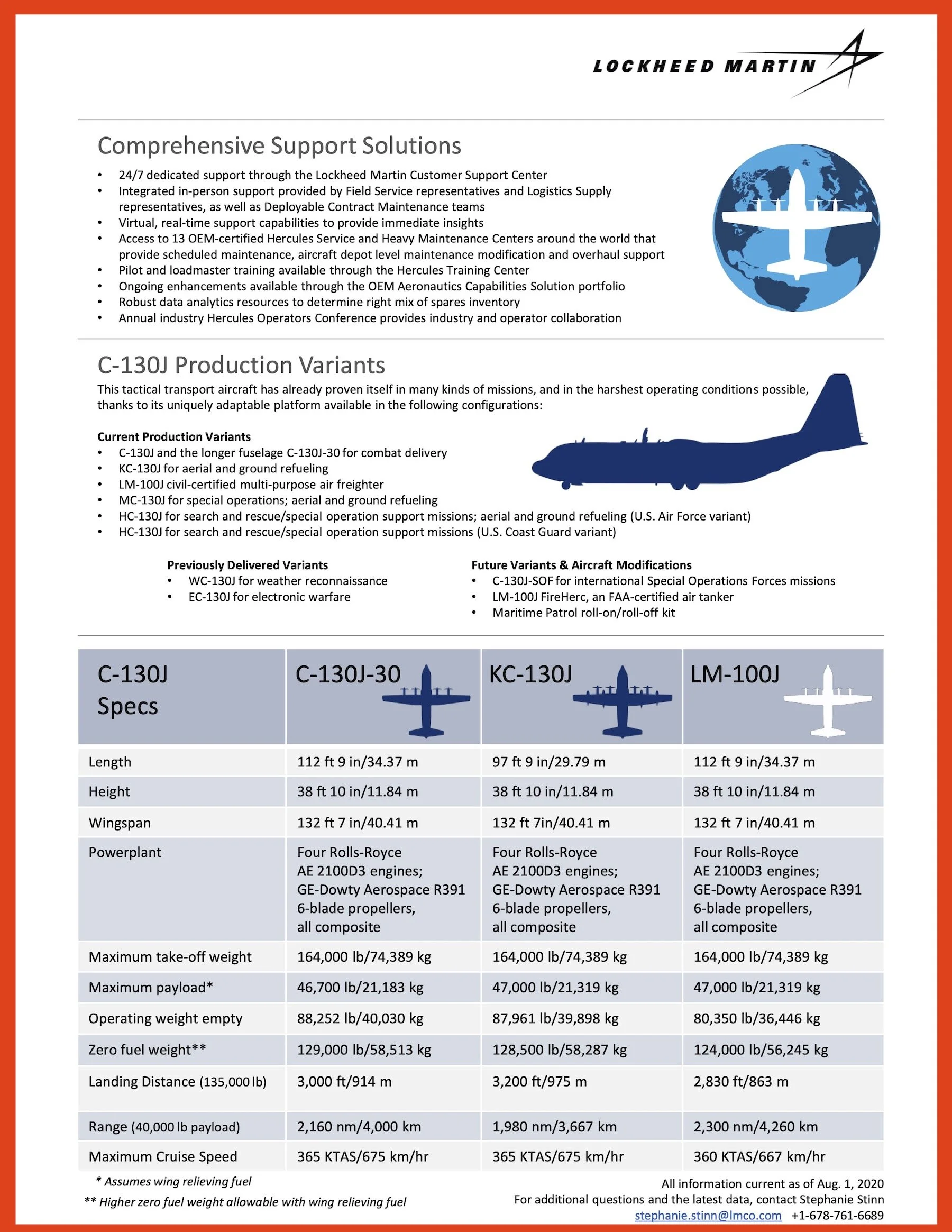
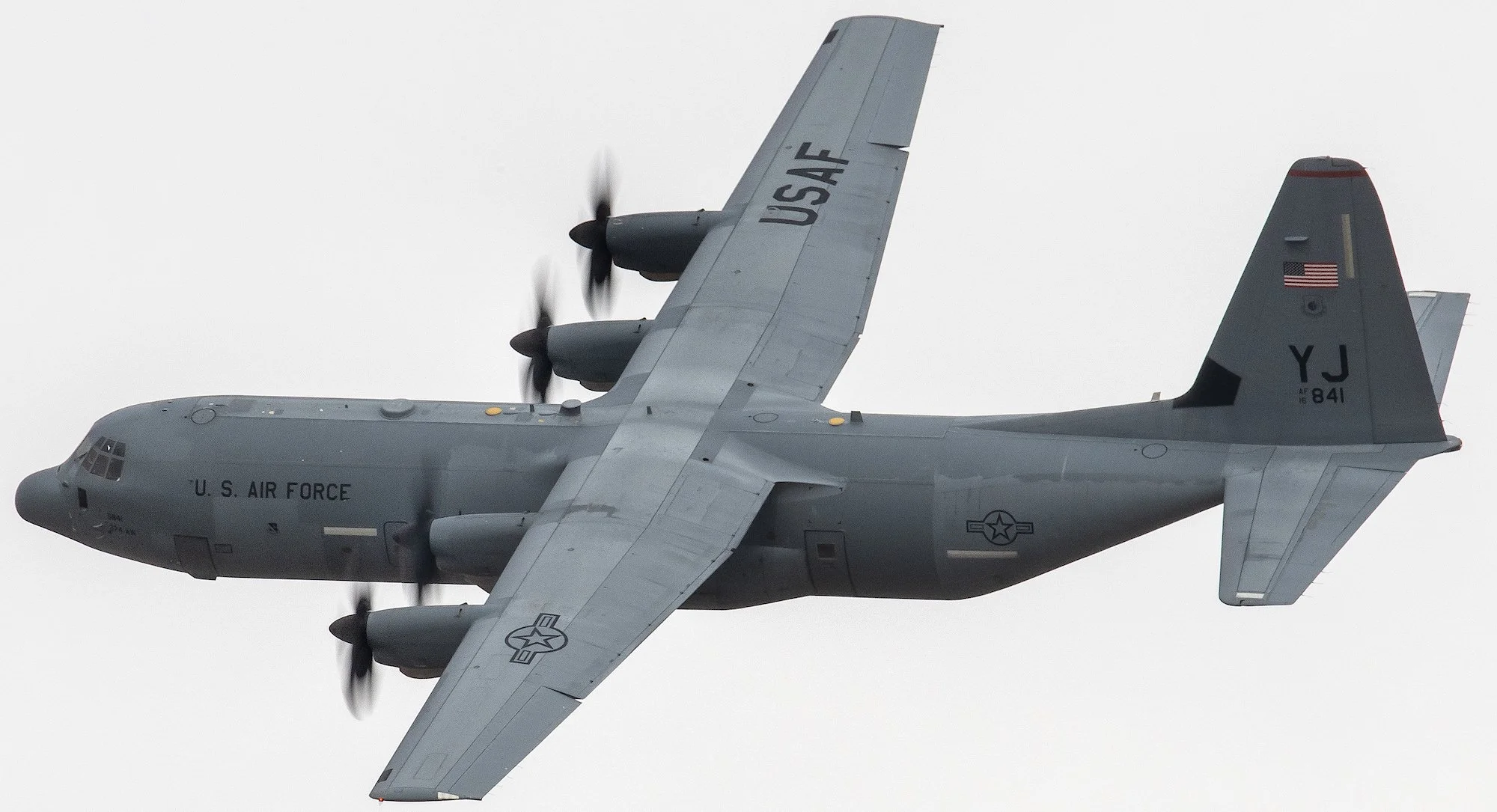
11 January 2024 - Yokota Air Base, Japan
A U.S. Air Force Lockheed Martin C-130J Super Hercules, assigned to the 36th Airlift Squadron (AS), maneuvers over Yokota Air Base, Japan, during a training mission. The 36th AS regularly conducts training missions to maintain a mission-ready aircrew to conduct theater airlift, special operations, aeromedical evacuation, search and rescue, repatriation and humanitarian relief missions.
Photo: U.S. Air Force by Yasuo Osakabe, 374th Airlift Wing Public Affairs, via DVIDS
Graphics above: Courtesy of the Lockheed Martin Company
War Posters
at the National Archives
Back during World War Two, various U.S. Government agencies published hundreds of informational posters. While buying War Bonds was always a major push, a myriad of other topics were also covered The concerns of these posters ranged from encouraging people to work in war production, and pitching in to recycle materials needed in the war effort, to extolling the need for folks to grow their own food, and honoring those men and women working hard back on the home front who “Were In The Fight, Too.” Of course, some topics were quite ominous like the idea that “Loose Lips Sinks Ships,” and “Someone Talked,” explaining to people that even a casual conversation can be of benefit to the enemy. There was even a poster, published by the U.S. Forest Service, advising the public to completely crush out their spent cigarettes, because “Forest Fires Aid The Enemy.”
The National Archives and Records Administration (NARA) holds thousands of these posters in their collection, of which over 2,200 can be found on line. These are great pieces of history - wonderful artwork all with an important message. To review the collection, log on to the web address listed below, and enter “War Posters” in the search box, then select Record Group 44. Enjoy.
An Excerpt From The:
Action Report of Carrier Air Wing TWELVE (CVG-12) for the period
7 January through 11 February 1953
In the section listing aircrew survival debriefs there is this paragraph concerning the ditching of Ensign D.L. Brenner, a fighter pilot assigned to Fighter Squadron ONE-TWO-FOUR (VF-124), part of Carrier Air Wing TWELVE (CVG-12), embarked aboard the USS Oriskany (CVA-34), then on a Korean War cruise. On 26 January 1953, Ensign Brenner was on a naval gunfire spotting mission, when he was forced to land his battle damaged Vought F4U-4 Corsair in the water. He survived the ditching, but had to face a rather odd situation once he abandoned his Corsair. Luckily he made it.
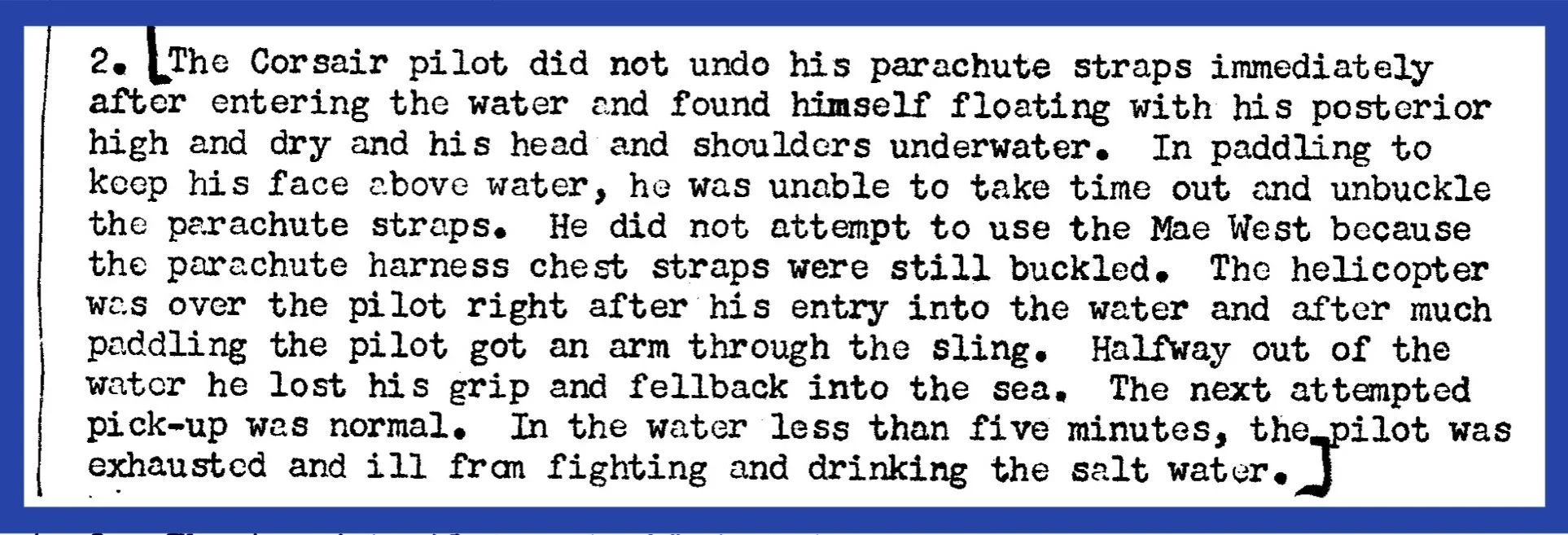
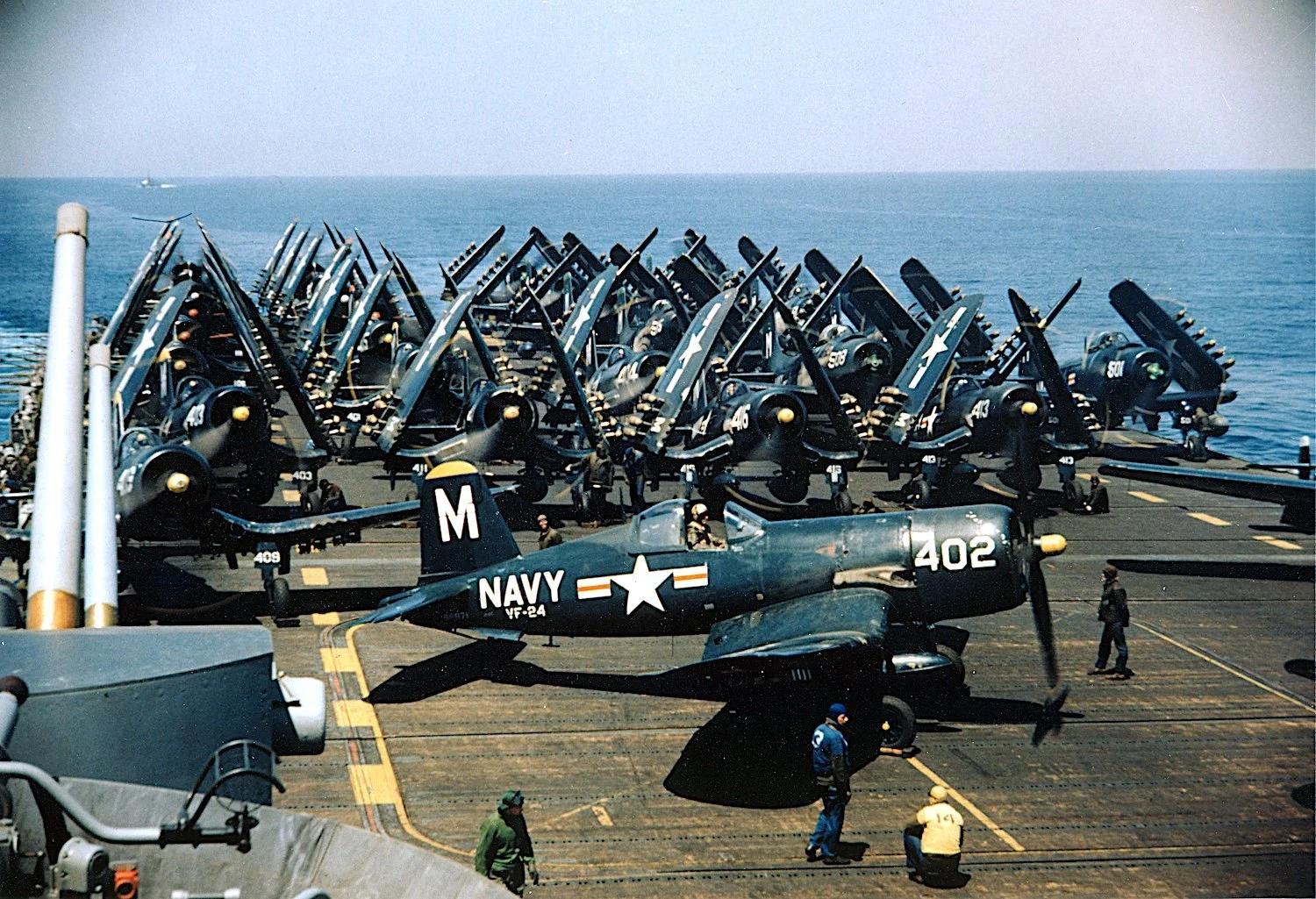
A fine file photo of Vought F4U-4 Corsair preparing to launch on a mission. The photo was taken aboard the USS Philippine Sea (CV-47).
Photo: Part of the Robert L. Lawson Photo Collection, via the Naval History and Heritage Command. To visit this amazing on line resource, click HERE
Under Pressure
-Two Stories-
Explosive Decompression
by
Mike Spaight
In the U.S. Air Force, Explosive Decompression is officially
known as Rapid Decompression, but has picked up the change
in name by the people that have actually been exposed to it.
The first thing that happens is what sounds like a loud
explosion immediately followed by what looks like smoke
filling the entire area. Actually, when it happens you
immediately loose pressure, which causes the loud “boom” and
with the rapid loss of pressure condensation forms immediately,
which you think of smoke and it scares the hell out of you.
And that is exactly what happened aboard Southwest Airlines
recently when they were climbing through 33,000, feet when
suddenly there was a load explosion, and the passengers seeing
the smoke and also looking up to see they now had a sun roof.
Also creating more fear for those passengers was when the pilot
started an immediate descent, which is the emergency procedure
to get down to a safe altitude, so the passengers can breathe
without oxygen. Bear in mind the pilot did not have time to
explain to the passengers what had happened or that they were
about to make a dive towards the earth, because at that altitude
within about 30 seconds people will start to pass out.
(This incident occurred on 1 April 2011, when a Southwest Airlines Boeing 737-3H4 airliner, en route from Phoenix Sky Harbor Airport to Sacramento International
Airport, suffered a structural failure in the skin about midway back on the fuselage. The failure left an approximately 5-foot long tear in the skin. Following the
appropriate emergency procedures, the crew completed an emergency decent, and landed at the Yuma International Airport. There were only two minor injuries.)
All Air Force flight crews are exposed to rapid decompression in an altitude chamber as part of their training to fly in pressurized airplanes. They are told in advance
exactly what to expect and when it will happen, but when it happens it is so sudden it is still a shock to your system.
About a year after my original qualification in the altitude chamber I had an unexpected surprise on one of my flights. We were on a gunnery mission at Luke Air
Force Base, Arizona, about to finish our training in the F-84 prior to going to Korea. I was the last in a flight of four and had just completed my final dive bomb run
for the mission and was going full power to join up in formation with the other three aircraft. They had already initiated a turn back to the home base so I really had
to hustle to join up with them. As I said I was at full power trying to catch up and then they started turning back towards me so I had to pull about six G's to
complete the join-up, and as I slid in to position I popped the speed bake, came back on the power and completed a perfect join-up. I then said to myself: “Damn
you getting good!” And all of a sudden it happened - a loud BOOM as the canopy blew open and the wind hit me. It was so loud I couldn't talk to my flight leader.
So, in a very few seconds I went from being the hottest pilot in the world to damn near wetting my pants.
So I can very much understand what the people on Southwest went through. I, as a pilot had been trained to handle the situation, but it happened so fast it's
scary. Plus I had another advantage over the Southwest passengers, I had a parachute. Immediately I pulled off the power, popped the speed brake and dropped
the gear and flaps, using everything I had to slow down. Once I got slow enough I closed the canopy and again attempted to re-join the formation. This time I very
slowly inched into formation and BOOM, it happened again and it scared me as much then as it did the first time. Only this time the canopy came off. Guess it
figured it had had enough.
By then we were getting pretty close to Luke so the flight commander declared an emergency for me and ushered me in to a safe landing. I had one more slight
trauma. When a canopy has been ejected, whether or not it was intentional, the ejection seat is automatically “hot,” so as I got in the traffic pattern I installed the
safety-pin in the seat to make sure it didn't fire as I landed.
Another Decompression Story
by
Dave Powers
When airline pilots upgrade from one airliner to another they have to complete a long training program that starts on the first day of ground school and ends with
being signed off on an Initial Operating Experience (IOE) line checkride. So after ground school, fixed-based simulators, full-motion simulators, a simulator
checkride, and a myriad of other training events, the new upgrade pilots are then released to the line, where they will fly a number of hours with a line check airman.
During this IOE, the upgrade pilot flies a regular revenue line. This is normal operations, and although there is still a lot of training going on, there are no simulated
emergencies, nor any other abnormal training events. It’s simply line flying. At the end of the proscribed number of hours with a check airman, a final line check
is completed, and if successful, the new pilot is released to fly with any other pilot in the company.
On 30 June 2000, I was on just such an IOE line check. I had just competed the long training program to upgrade from the Douglas DC-9 to the mighty DC-8. I had
one leg to go - the IOE line check, and having no doubt I would pass, I looked forward to finally being done with training and going back to routine line flying. It
would be a simple, and short, leg from Chicago O’Hare to our hub in Wilmington, Ohio - total flight time less than one hour. Even better was the check airman, a
great guy named Gary, who I had known and flown with for years. This should be a laid back flight. Gary, earlier in the IOE syllabus (a minimum of 25 hours of flight
time and a certain number of landings), had briefed that this is IOE, not the simulator, so there would be no emergencies, abnormal events, rejected takeoffs,
engine failures, botched landings, go arounds, etc… If something happened, it was for real. Fair enough. I would be flying this leg.
Even though the leg from Chicago to Wilmington was short, we would still climb to, and cruise for a brief period, at 33,000 feet. During this cruise phase, with the
autopilot on, I was quite relaxed, with my foot up on the panel, when a bright red light suddenly illuminated in the cockpit, followed by a warning horn. Well, damn.
It was the cabin pressure warning system, designed to come on when the cabin exceeded 10,000 feet. Still, no reason to get too excited. The airplane was flying
along nicely, all four engines still turning and burning as advertised, no fires, nothing falling off, so no reason to over react. There was no big “bang,” and no
condensation “smoke” that you always heard about.
The first step in a cabin pressurization emergency is to don your oxygen mask, and establish communications with the rest of the crew. Even in the short time it took to do this it felt as if the air was being forcibly pulled out of my lungs. It was actually a bit painful. Oxygen mask on and a couple of hits of pure O2, and I was back to normal. Since I was flying I commanded the emergency checklist, and Gary pulled out the book and started through the procedures. When he got to the step that instructed the crew to try and reestablish the cabin pressurization, Gary casually turned in his seat and nonchalantly asked the flight engineer if he could please reestablish control of the cabin pressure, and bring it back below 10,000. The poor engineer - actually a near new hire second officer - was busy flipping switches and throwing levers (the DC-8 flight engineer panel has quite a few switches and levers). With all of the cabin air conditioning/pressurization compressors on high and the cabin outflow valve manually set to full closed, the cabin kept coming up, and finally leveled out at 33,000 feet.
Well, this left us only one option - do the “high dive,” or emergency descent to get down below 10,000 feet. Since I was the newest DC-8 first officer at the company, I thought Gary would have taken over control of the aircraft. Instead, he just looked over at me and said: “Let’s head on down.” Gary made a call to ATC, declaring an emergency and telling them we were beginning an emergency decent. Of course, ATC was cool, and said we were cleared to do anything we needed to do. I should mention that we were flying a DC-8 freighter, so no need to worry about any passengers.
Time to “Chop, Flop and Drop.” Power back to idle, autopilot off and lower the nose and accelerate to maximum structural airspeed, descend at the maximum rate. I called for the emergency descent checklist, and on down we went. There are no speed brakes on an old DC-8, and while we could have slowed up and dropped the landing gear for more drag, we opted not to as we were losing altitude quite well. Back in the olden days, we also could have deployed the inboard thrust reversers, at idle reverse thrust. It was an approved procedure but was so hard on the airframe that the procedure was no longer authorized.
It only took a minute or so to get down to, and level off at 10,000, where we could take off our O2 masks. After a brief conference in the cockpit we decided the best course of action was to stop trying to troubleshoot the failure, and motor on into Wilmington at ten grand. A quick crunch of the numbers showed we had plenty of fuel, although we were burning more at this lower altitude.
With the cockpit back to normal I had a chance to poke some fun at Gary. I looked over at him and, with fake consternation, said that I thought there would be no simulated emergencies on IOE, and just how did he get the cabin to dump like that - was there some switch he threw, or a circuit breaker he pulled. He simply shrugged and said he hadn’t done a darn thing.
We landed in Wilmington with no further problem, wrote the airplane up for maintenance, and headed to the cafeteria. Later we learned that a flexible rubber coupling, between two hard aluminum pressurization ducts, had failed and simply blown off. With that big of a leak in the system there was no way to control the cabin altitude.
By the way, I did get signed off on my IOE that night, with the minimum flight time required.
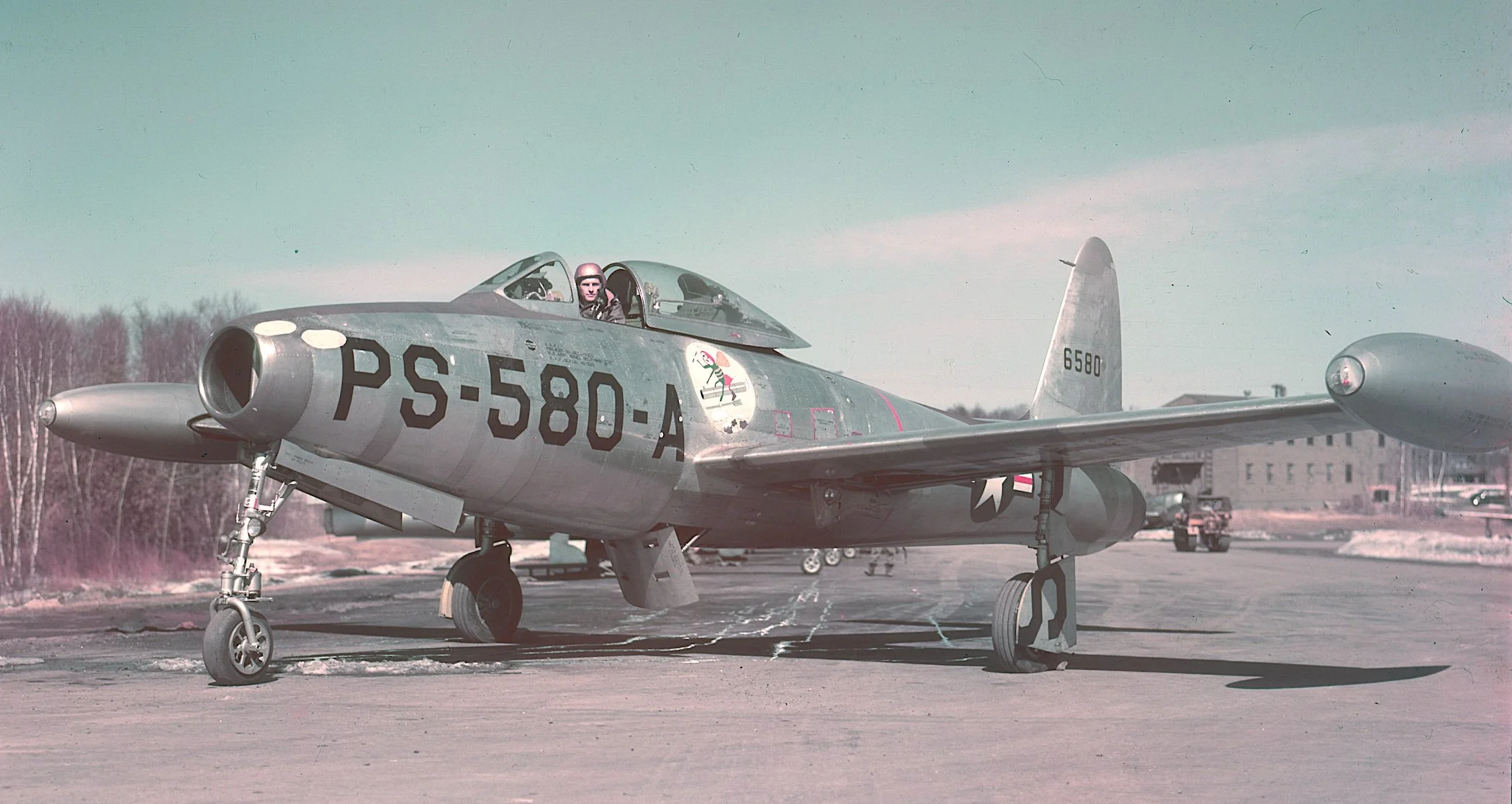
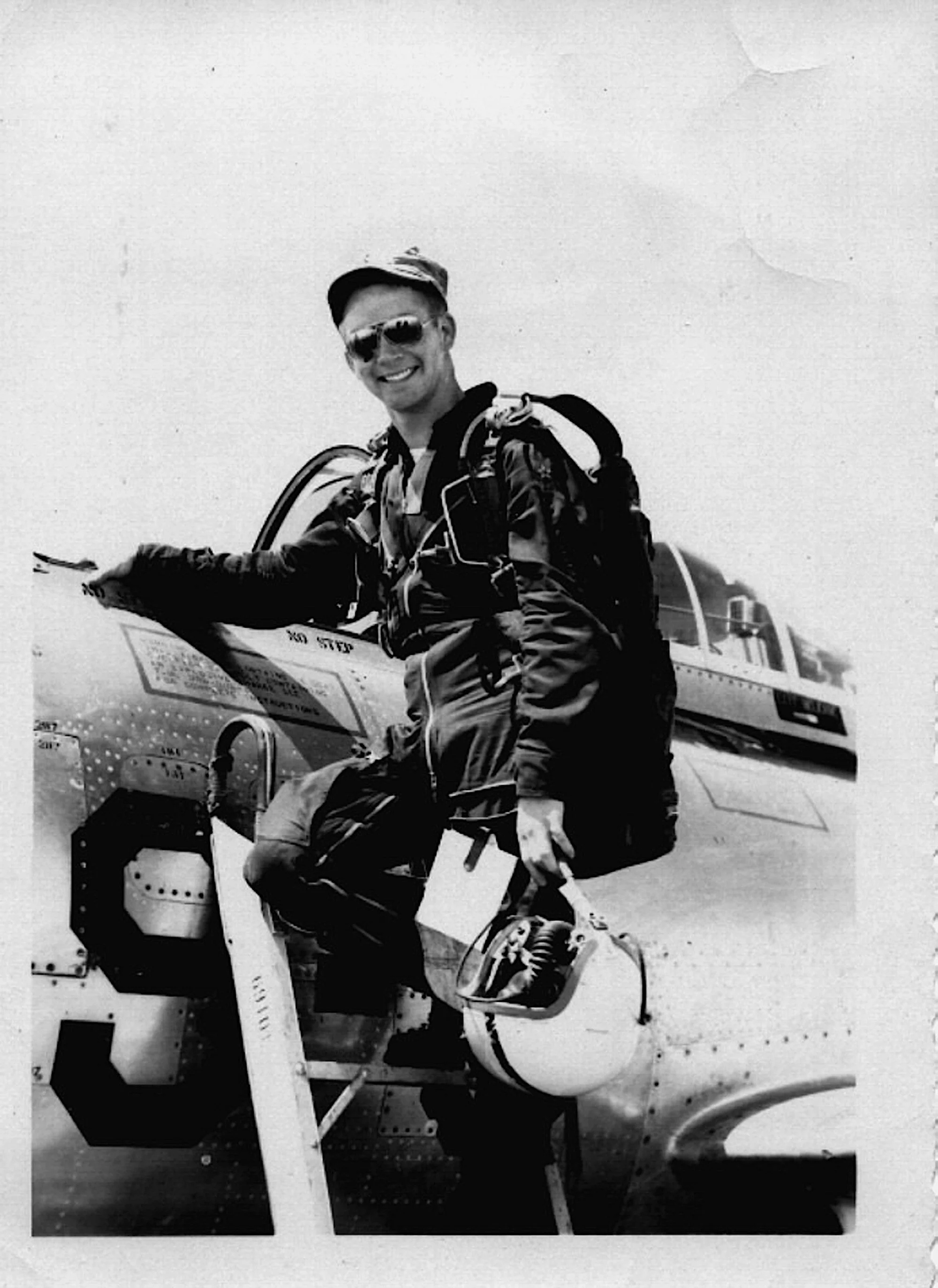
Top: A file photo of a Republic F-84B-26-RE Thunderjet, Serial Number 46-580, assigned to the 49th Fighter Squadron, 14th Fighter Group at Dow Air Force Base, Maine - March 1948. Photo: USAF by James Evans
Above: At one moment the author was the hottest fighter pilot, then he almost wet his pants. Mike Spaight is seen here manning up his F-84. Photo: via the author
Below: On the cargo ramp in some South American country - an Airborne Express DC-8. Photo: A.A.S.
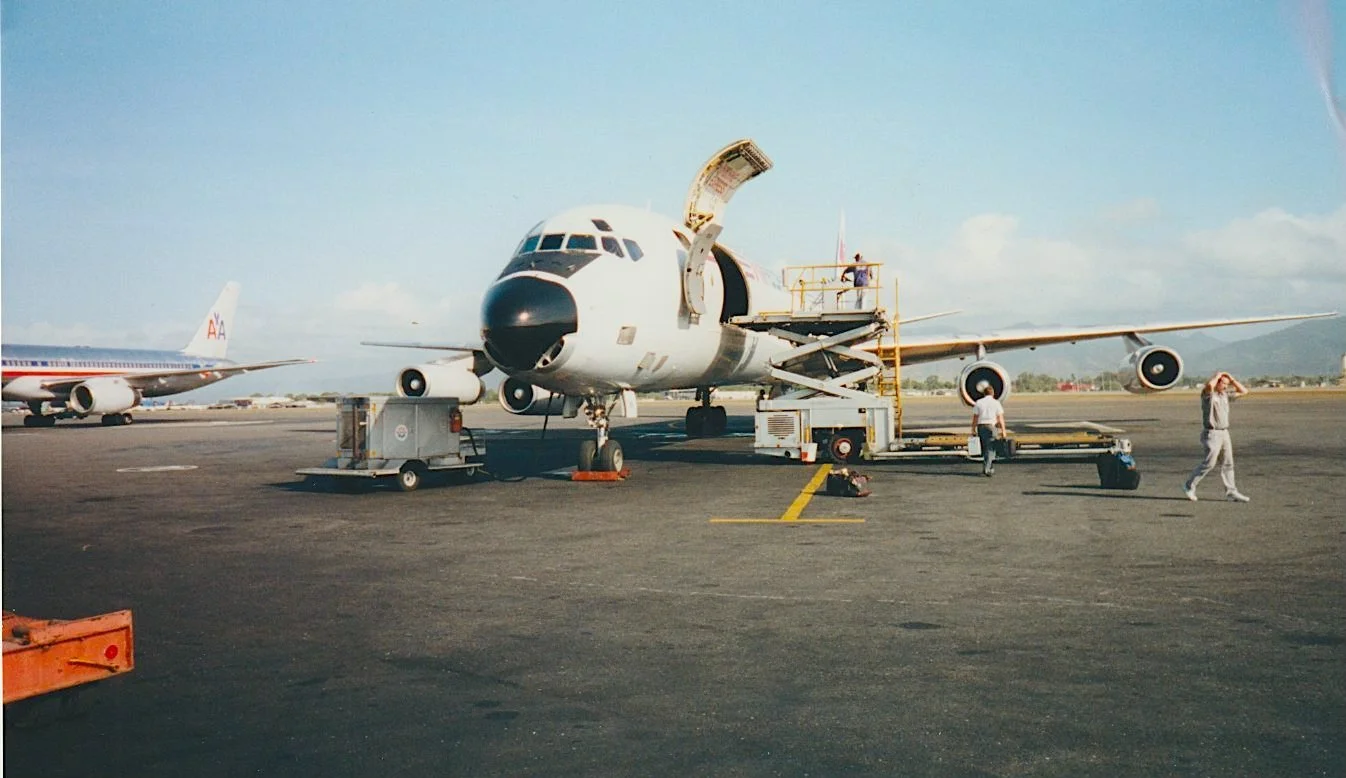
It’s Happy Hour a la Scott Crossfield
There’s a fun book call the “Famous Personalities of Flight Cookbook” (NASM, 1981), listing dozen of recipes connected with some of the most well known people of flying. There is a cornbread stick recipe, which Chuck Yeager said his mother often made for him when he was growing up in West Virginia. They were particularly good with butter and sorghum. Then there is one of John Glenn’s favorites - Annie Glenn’s Ham Loaf. On a more international table, James Doolittle relates his favorite recipe for Vichyssoise, which he noted that since he did not cook he depended on his wife Joe (Josephine) to prepare.
And, then it’s time for Happy Hour. By most accounts Scott Crossfield was known to enjoy a cocktail. For this book he proffers a recipe for the classic, time honored Martini. Excerpted from the book, the recipe is as follows:
Ingredients
7 watt light bulb (can be used indefinitely)
1 bottle dry vermouth (can be used indefinitely)
1 bottle gin (per recipe)
1 green unstuffed olive (optional)
The Process
Shine the 7 watt light bulb through the vermouth to impinge and pass through the gin - 1 to 5 minute to taste.
Turn out light.
Drink Dry Martinis.
Will vermouth to heirs.
There you go - doesn’t get any better than this. Enjoy!
Right: Scott Crossfield preparing for a test flight in the Douglas D-558-2 Skyrocket.
Below: Crossfield with the North American Aviation X-15, a type that he flew 14 times (1 glide flight and 13 powered flights). Both Photos: NASA
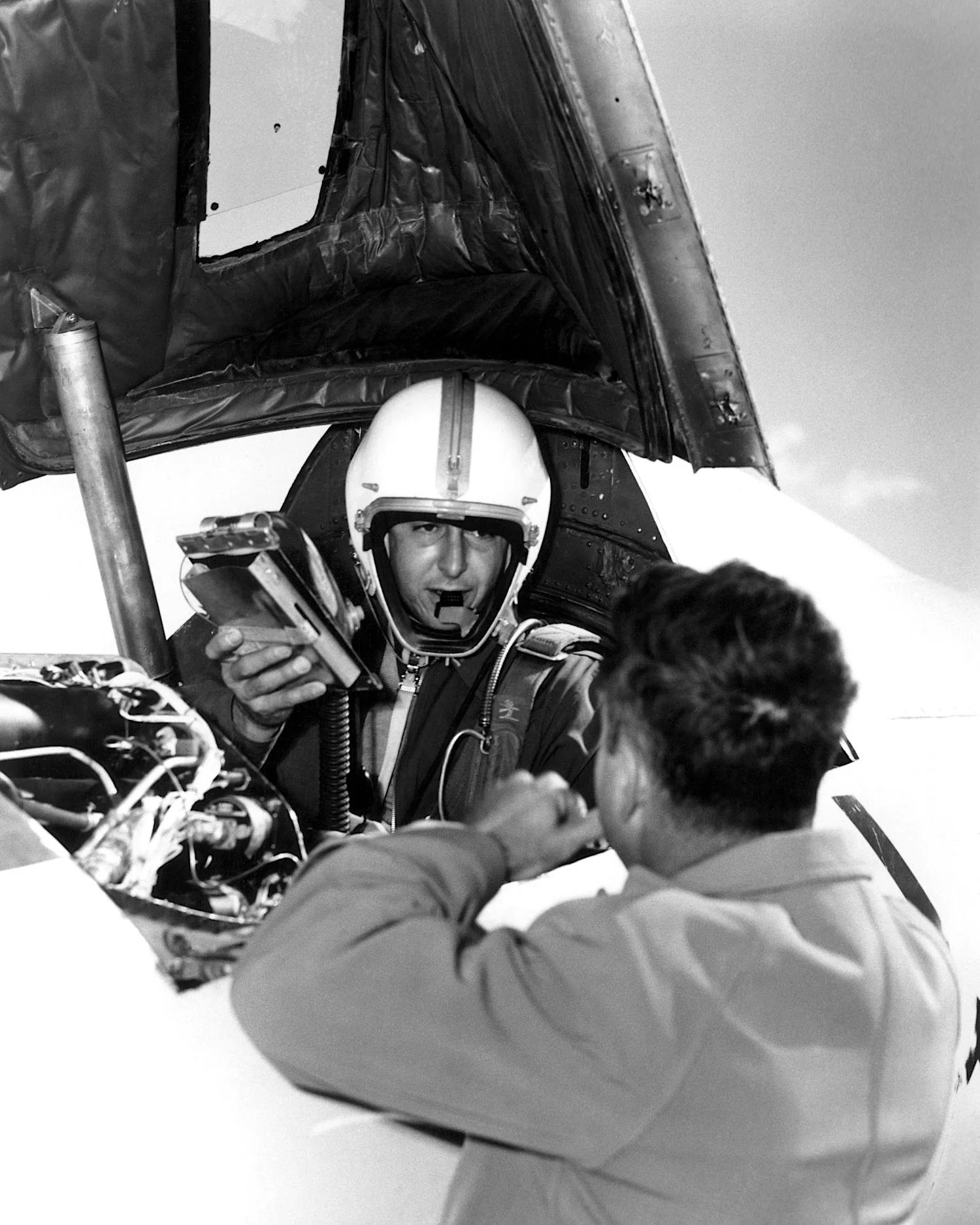
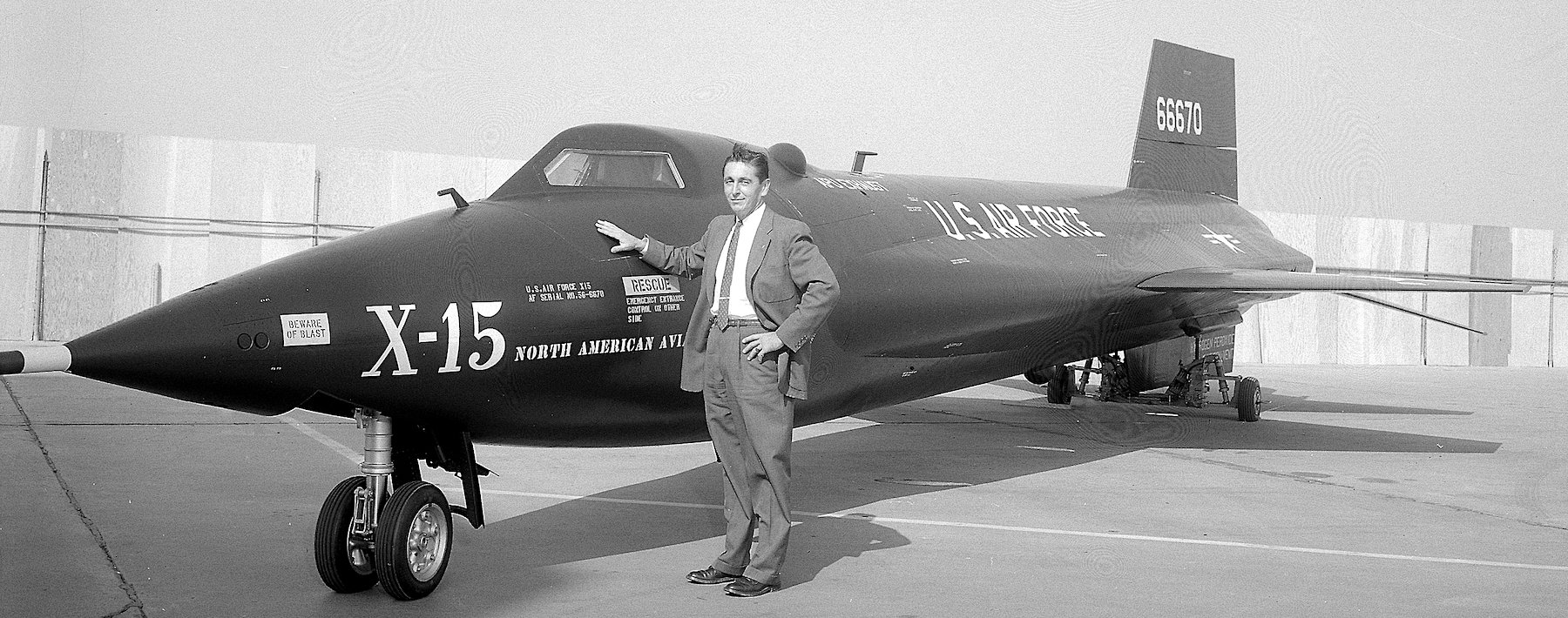
The Beach Umbrella
by
Colonel F.C. Goode U.S. Army (Retired)
In May or June of 1954 I reported to Gary Air Force Base, San Marcos, Texas for primary flight training. At that time the U.S. Air Force did all primary flight
training for the U.S Army. The Army possessed light airplanes and helicopters used for liaison, medical evacuation, artillery spotting and general utility.
The Air Force officers assigned to this duty of training Army pilots were not totally enamored with their mission. They had envisioned a career of flying
fighter aircraft and bombers only to be assigned the duty of training Army second lieutenants (ugh!) in Piper Cubs (double ugh!). Well, at least they were
Piper Super Cubs. But they were not exactly high-performance type aircraft. Sixty-five to seventy knots was perhaps the top speed – maybe in a dive.
They possessed no radios. As for instruments they were equipped with only needle, ball and airspeed. No batteries, they had to be hand-propped for
each start.
It turned out to be the typical, warm Texas summer. For some reason (revenge?) all of us Army students were issued blue, wool flight suits. The Air Force
instructors had lighter weight, khaki (cotton) flight suits. We usually flew or were bused out of the base airfield to one of two stage fields where there was
greater safety of open skies and a multitude of forced landing areas. These World War II stage fields were each structured as two, macadam cross-strips
with no functioning towers or other facilities. An Air Force officer would be assigned the duty of Air Control Officer, controlling the airfield for the day.
To function in this capacity he would position himself near the intersection of the cross strips. Seated on a folding chair on the grass he would be shaded
from the sun by a large, beach umbrella. Next to his metal folding chair there was a car battery with short wires running to a light gun. The light gun had a twistable handle that would display either a green light or a red light. As each student would fly his base leg prior to turning on final approach he would look for and receive either a green light or a red light. Rocking the wings in acknowledgement the student pilot would either make a “go-around” if receiving a red light or continue on a turn to final approach if receiving a green light.
In case the traffic pattern became dangerous due to student failure to observe or obey the light signals the Air Control Officer had a fallback option of firing off a red flare into the air over the center of the stage field. Lying on the ground next to his folding chair he had a flare pistol, with a loaded red flare and a box of additional flares. When a red flare was fired all students had to exit the traffic pattern and fly away before forming a daisy chain to re-enter the pattern and continue their practice landings. When a student was not flying solo or with his instructor the student was required to sit on the grass, in the broiling sun, next to the Air Control Officer who sat upon his folding chair in the shade, under the beach umbrella, and listen to him critique the landings. This critique usually included the Air Force officer’s wonderful rendition of many old and new adjectives describing dumb Army second lieutenants better equipped to be cannon fodder than to be granted the designation of aviator.
On one of these warm days I found myself sitting on the grass with a half dozen other students, perspiring in our winter flight suits and trying to pay attention to the Air Control Officer’s running critique of the landings and take-offs. Things began to get a bit hairy with more than one aircraft on the runway and more than one continuing their approach in spite of the Air Control Officer’s frantic flashing of the red light to each and all. As the situation continued to deteriorate the Air Control Officer’s language became more and more colorful until he finally reached down to his side and snatched up the flare pistol. Snapping it shut with a flick of his wrist he raised it over his head and fired. The flare exited the pistol and passed through the beach umbrella. It continued into the air over the runway intersection and all aircraft observed it and took the proper action of exiting the traffic pattern. However, in passing through the beach umbrella the flare set the umbrella to smoldering and we all watched the cloth gradually smolder itself away from the ribs. With ashes drifting slowly away from the umbrella’s skeleton there was a minute or two of absolute, amazed silence until the Air Control Officer burst into a long string of invective and all of us students began uncontrollable laughter while rolling on the grass.
The poor man was forced to spend the rest of the day under the hot sun. However he had the last laugh. We all received “pink slips” (indicating a failed ride) for our flights for that day.
This article originally appeared in the 2nd Quarter 2024 digital edition of LOGBOOK magazine.
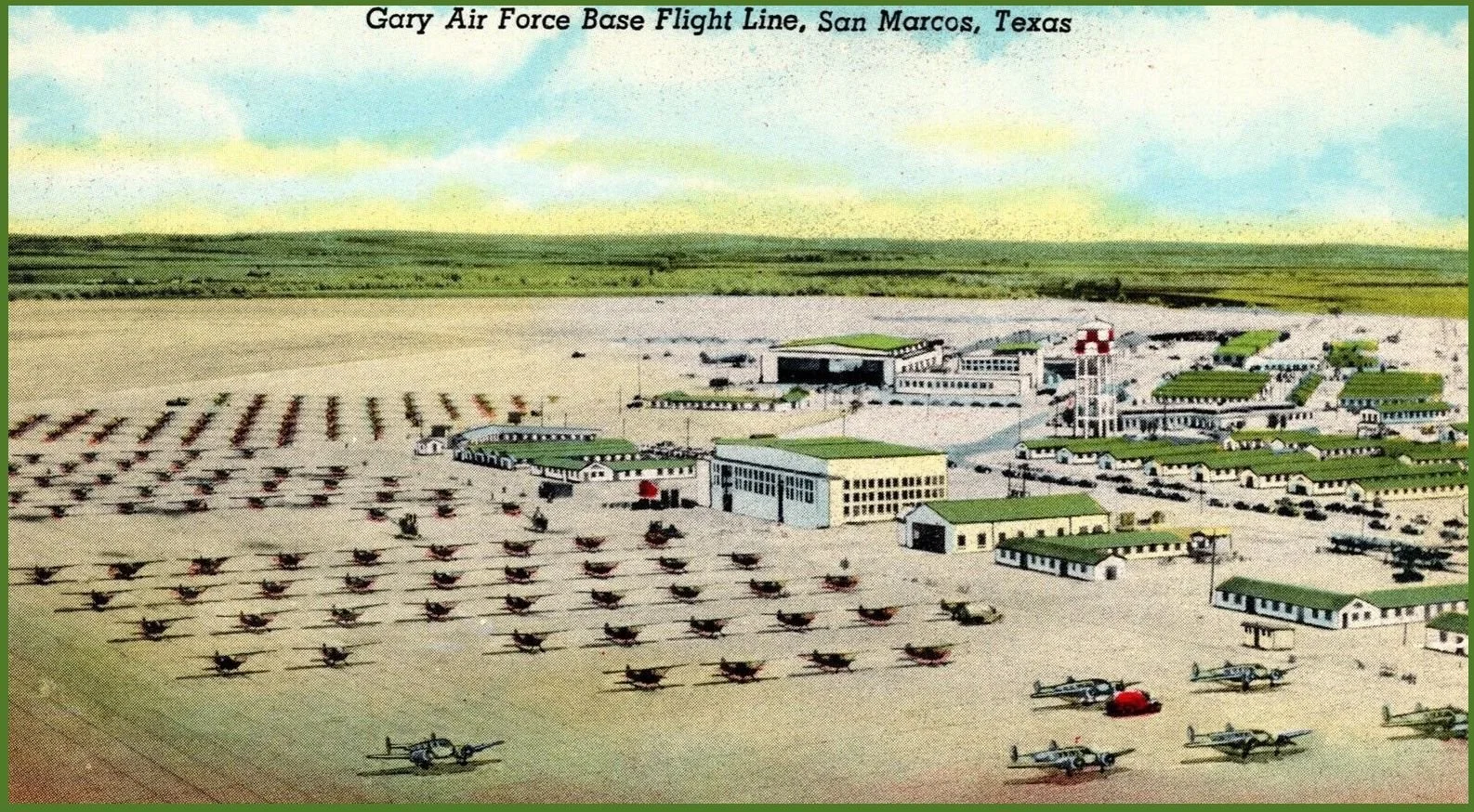
A-20s at The Kasserine Pass and the Artwork of R.T. Foster
by
The LOGBOOK Staff
In the 4th Quarter 2020, issue of LOGBOOK magazine we brought you Andrew Arthy’s excellent article on
the 31st Fighter Group’s operations in the vicinity of the Kasserine Pass, Tunisia - in February 1943. While
Mr. Arthy’s article was primarily concerned with the U.S. Army Air Forces Spitfire pilots of the 31st Fighter
Group, there was mention of the various missions flown by the Douglas A-20 Havoc crews assigned to the
47th Bombardment Group (BG). For one reader of LOGBOOK, this reference certainly caught his interest.
Shortly after this issue went in the mail, we received a note from Mr. Thomas Charbonneau. It turns out that
Tom’s father was a gunner onboard one of those A-20s, assigned to the 97th Bombardment Squadron (Light)
(BS), part of the 47th BG.
It was either in 1941 or 1942, that Ray A. Charbonneau, a Canadian then living in Detroit, Michigan, was
drafted in to the U.S. Army. Staff Sergeant Charbonneau ended up flying 50 missions in North Africa, Sicily
and mainland Italy before being wounded and sent home. Tom mentions that his father was never very
willing to talk about the war, so more details are not readily known.
In 1999, Tom, at the time an airline pilot himself, was at the SUN ‘n FUN fly in, at Lakeland, Florida, where
he met an aviation artist named R.T. Foster. Tom commissioned Mr. Foster to create a artwork depicting his
father’s service at the Kasserine Pass, in that February of 1943.
In an image that appears below is a copy of the “Citation of Unit” issued to the 47th BG for the
aforementioned operations in Tunisia. A well worn copy of the citation was kept by Staff Sergeant
Charbonneau. To the right is a copy of the fine art print created by R.T. Foster, with a photo inset of Ray
Charbonneau. He was the gunner on the A-20B Havoc, flown by Captain Marion Akers, commanding officer
of the 97 BS. They flew six missions that day. Great work.
Raymond T. Foster, always known simply as R.T., was a multifaceted artist born, and based, in Oklahoma
City, Oklahoma. He was an enlisted Marine who completed two and a half tours of duty in Vietnam, including
one with the First Marine Air Wing. He then worked for the next 40 years at Tinker Air Force Base, as a visual
information specialist. A self-taught artist, his work ranges from wildlife scenes - his work was selected for the
1987 and 1991 Oklahoma waterfowl stamp - to the Civil War, to aviation history. In addition to work on canvas,
Foster is well known for his art appearing on actual aircraft, leather jackets and large-scale murals. Mr. Foster
passed away in July 2016.
This article was originally published in Volume 15, Number 1 - 1st Quarter 2021 - print issue of LOGBOOK
magazine.
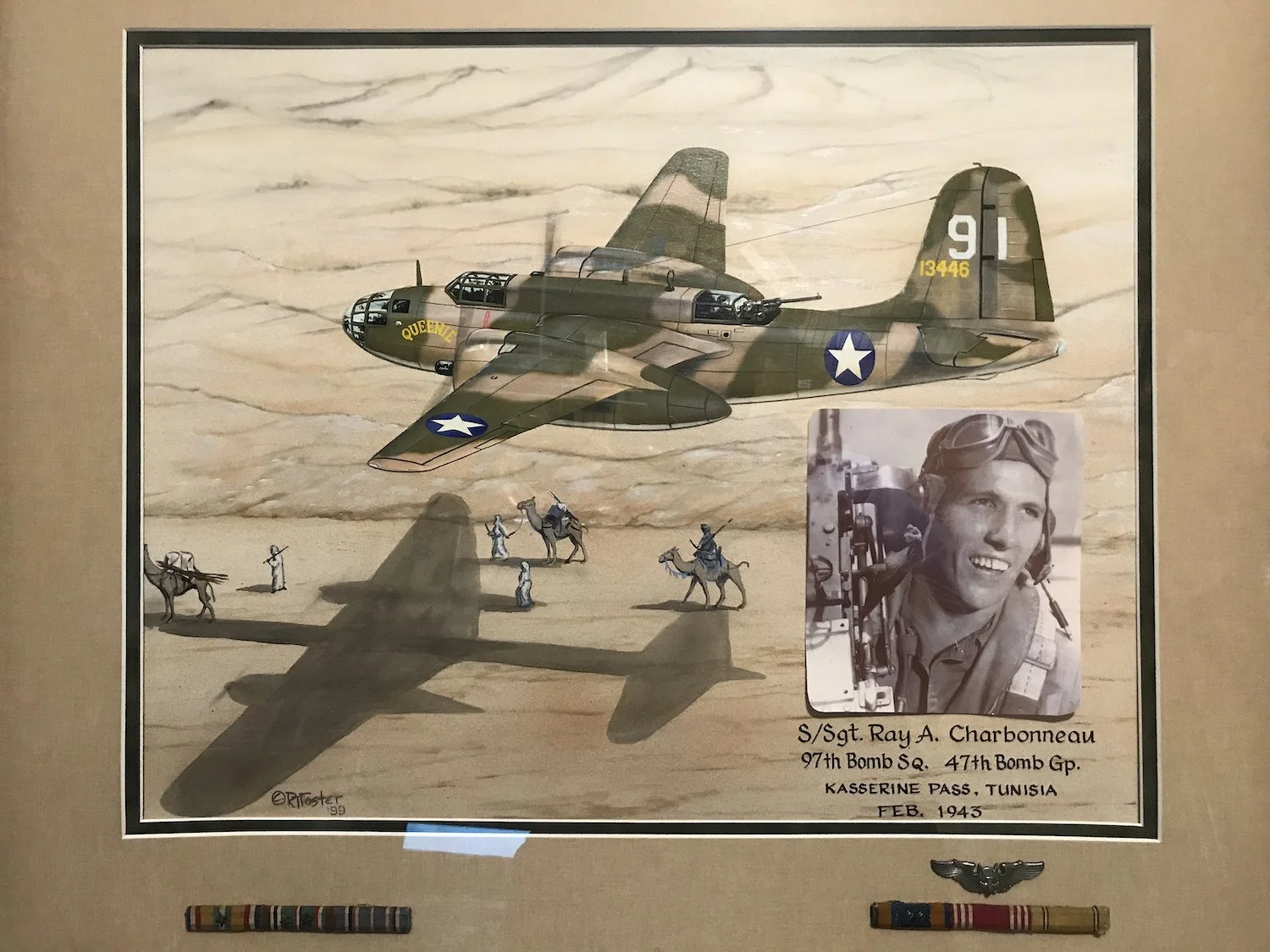
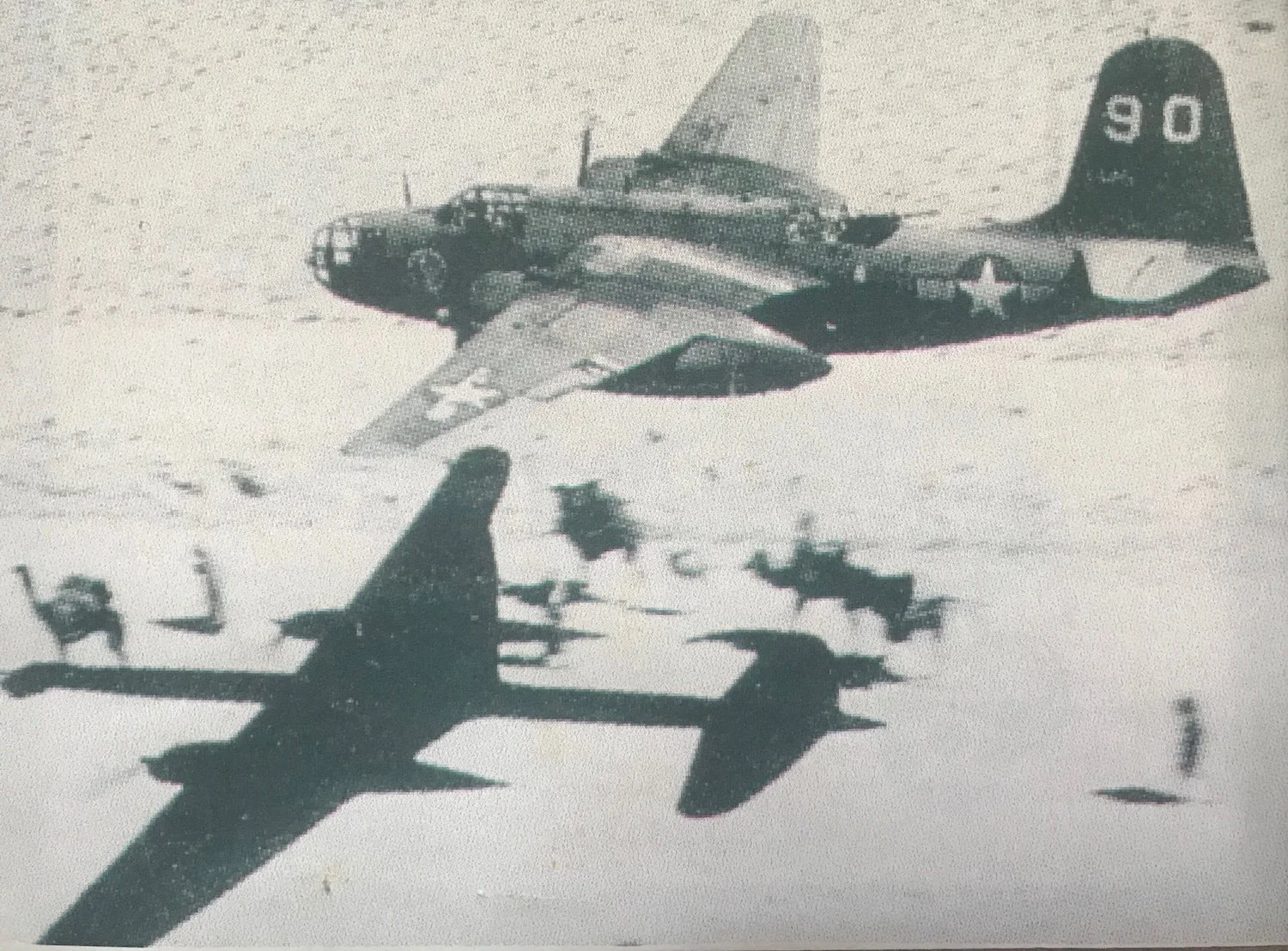
This photo was used by R.T. Foster to create his commissioned artwork for Tom Charbonneau, depicting one of his father’s - Staff Sergeant Ray A. Charbonneau - missions at the Kasserine Pass - February 1943. Photo: via Tom Charbonneau
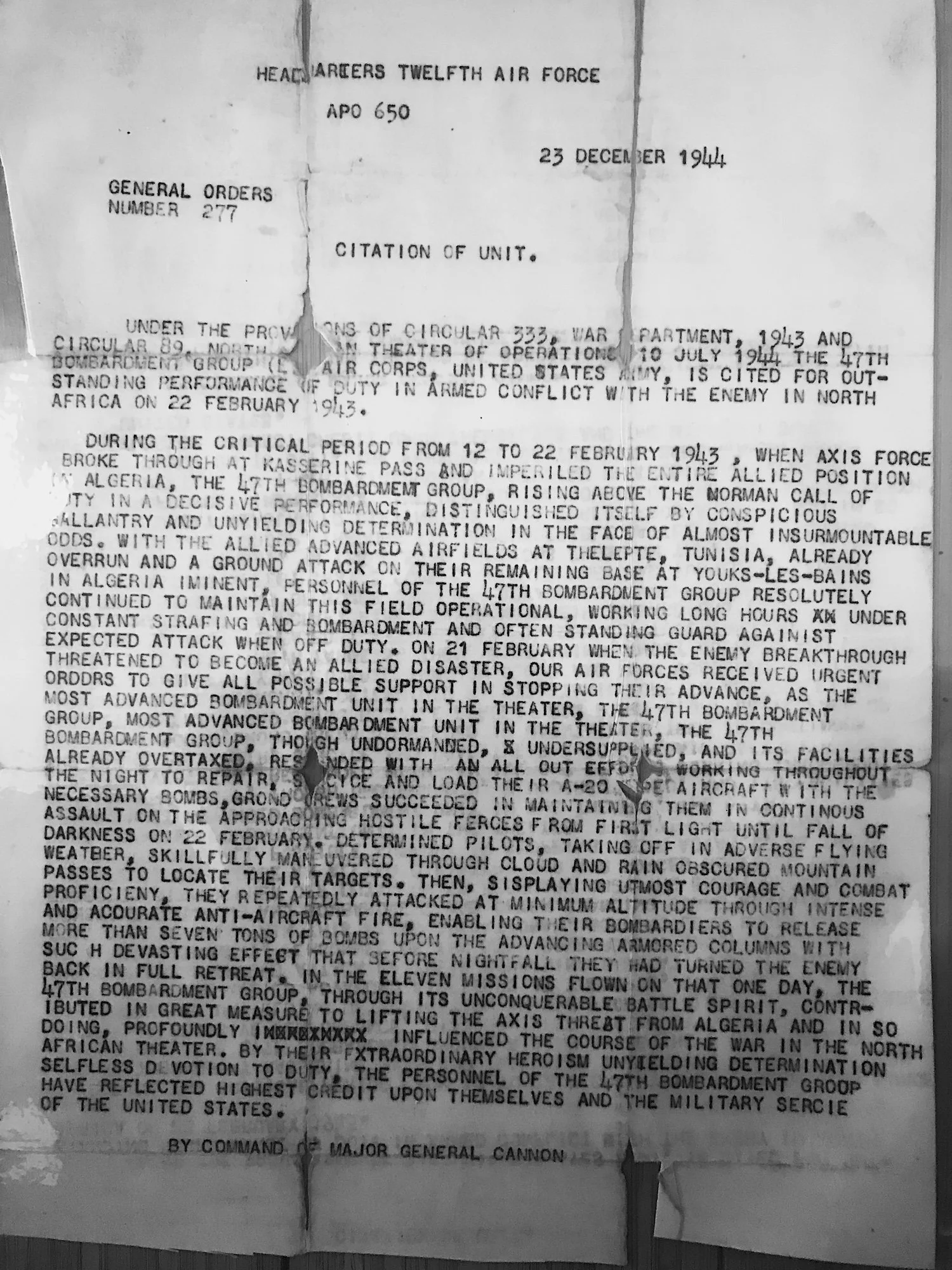

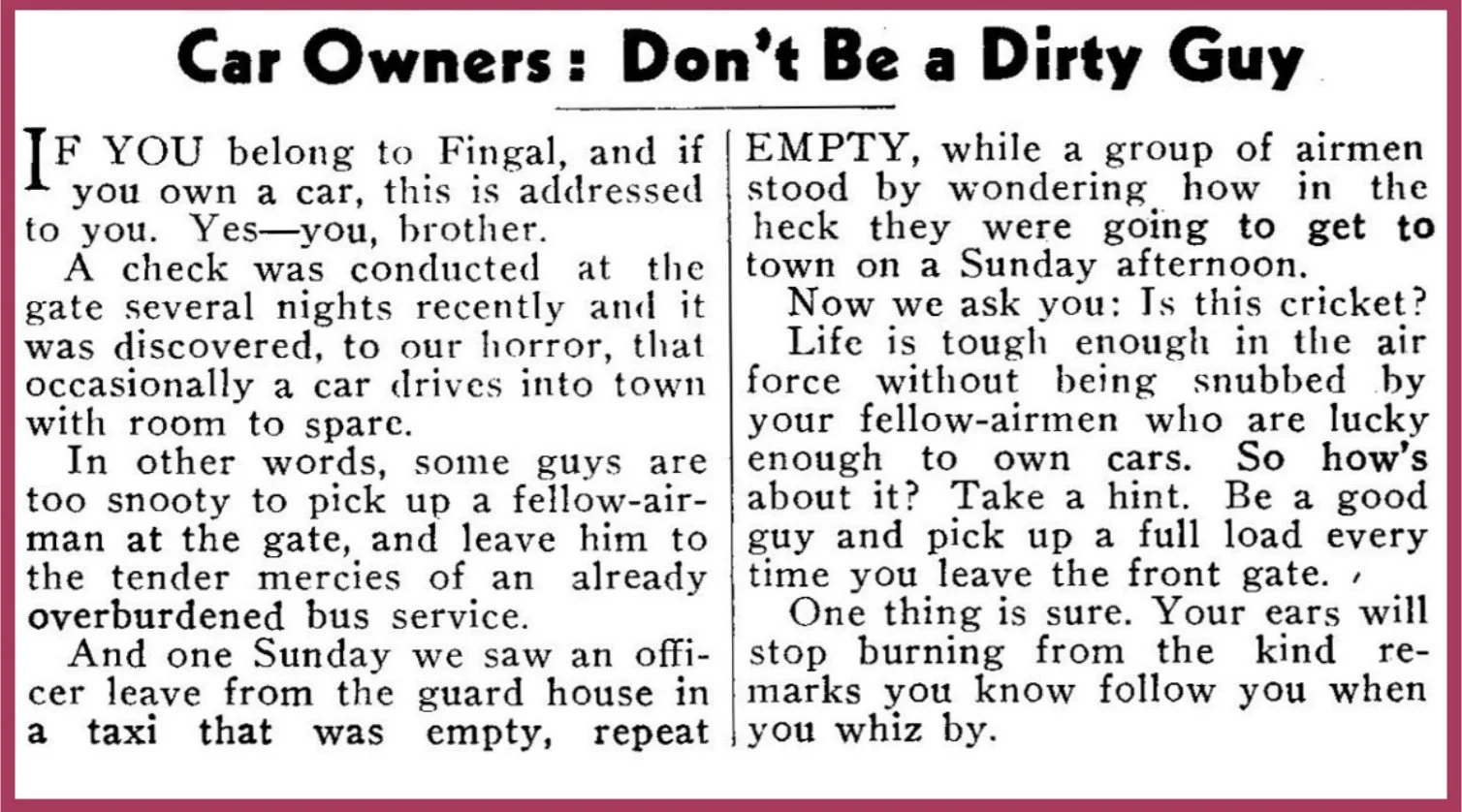
Royal Canadian Air Force Station Fingal was a training base located in Ontario, Canada, just north of Lake Ontario, part of the Commonwealth Air Training Plan. Active from November 1940 to February 1945, it was the home of the No. 4 Bombing and Gunnery School.
Presented here are a couple of clippings from the December 1943 issue of the Fingal Observer, the base newspaper. Above is a plea for those who were lucky enough to own a car to be a pal and give a fellow airman, who didn’t have a car, a ride into town. To the right is an introduction between the Royal Air Force’s Pilot Officer Prune and the U.S. Navy’s Dilbert, both of whom were noted as perhaps not the smartest of aviators.
Editor’s Note: I remember back in the old days, when at the front gate of many naval stations there was a covered bench - sort of like a bus stop - with a sign that said “Give a Sailor a Lift.” So, as you would be leaving the base, if there was a sailor sitting on the bench you would pullover and ask him where he was going. If it was anywhere near where you were going, you would give the sailor a lift. These benches are all gone today. Dave Powers - September 2026.